
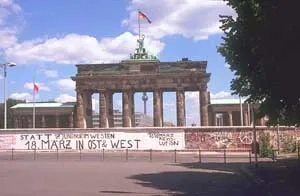
Germans miss the Berlin Wall
As the report of the German public opinion institute "Forsa", published in Austria, says, "almost 15 years after the reunification of Germany, every fourth resident of the western federal states of this country would like not only the 'Berlin Wall' to exist, but also the division into the FRG and the GDR to be preserved."
Among 12% of residents of the eastern federal provinces of Germany (the former GDR), the opinion prevails that the "Berlin Wall" should be preserved. As for Berlin itself, 11% of all residents of the western part of the German capital support the return of the "Berlin Wall", and in the east of Berlin - 8%, according to the report of Forsa experts.
On payment card fraud in Ukraine
Experts of the Ukrainian payment card market deny a sharp surge in payment card fraud in Ukraine, reports Interfax-Ukraine. Thus, according to Alexandra Karpova, director of the Ukrainian Interbank Association of Payment System Members EMA, the surge in fraud occurred in the autumn of last year; now the situation is standard.
"If someone tries to blame the Ukrainian ATM network for their mistakes in terms of monitoring, then these are the problems of those issuers, in this case Russian ones. If you don't want to monitor (in real time. - Ed.) - suffer," he said, addressing these words to Russian banks.
Alexandra Voropayeva, development director of the Ukrainian Processing Center (UPC, Kyiv), said that an analysis of data from real-time monitoring systems for payment card issuance and acquiring operated by UPC indicates that currently the situation on the Ukrainian card market in terms of the level of fraudulent situations is no different from the standard one. At the same time, she noted that a surge of fraudulent transactions involving cards of several Ukrainian banks occurred in the autumn of last year, and by now these problems have already been solved. The conclusions of Russian banks about a sharp surge in fraudulent operations with plastic cards in Ukraine are most likely based on analytical data from last year. "These Russian banks need to use online monitoring systems, then it will not be an attempt to solve the problems of long-past days," Alexandra Voropayeva emphasized.
Anton Romanchuk, director of the retail business department of Aval Bank, also believes that there is no surge in fraudulent transactions in Ukraine. Thus, according to him, over the past quarter the bank has not recorded a single case of payment card fraud. "Perhaps this is the result of the fact that we conduct round-the-clock monitoring of transactions on card accounts," he said, adding that most of the bank's clients are also connected to mobile banking, which notifies the cardholder of every transaction on the account, of every balance inquiry through an ATM, to the mobile phone, and thereby makes it possible to constantly control their card account.
As previously reported in the press, the Russian Master-Bank and Slavyansky Bank recommended that clients not use cards on the territory of Ukraine due to the large number of fraudulent operations with plastic cards of Russian banks. Earlier, the Russian Raiffeisenbank suspended acceptance of its cards through ATMs on the territory of Ukraine.
According to the National Bank of Ukraine, the total number of payment cards issued by Ukrainian banks (with at least one transaction during the year) increased by 48% during 2004 - from 11,529 to 17,079. In particular, the number of MasterCard cards increased by 48% (2,332) to 7,126 last year; VISA - by 57% (2,577) to 7,059. As of January 1, 2005, 93 banks (57% of the total) were members of domestic and international payment systems and issued and acquired payment cards.
Migration rates to wealthy countries fall
The number of people immigrating to rich countries is gradually stabilizing. As BBC reports, this is stated in the annual report "Migration Trends" of the Organisation for Economic Co-operation and Development.
The report's authors say that the decline in overall migration rates to OECD member countries is explained by the adoption of stricter laws regulating the admission of foreigners. Some European countries have made it more difficult for relatives of migrants to obtain residence permits. Others decided to speed up the processing of refugee applications. Last year, the report says, the total number of such applications in the 15 EU countries (before the organization expanded to 25 countries) was 25% less than the year before.
The reduction in the number of those wishing to settle in developed and rich countries is also explained by the easing of tension in some troubled regions of the world - especially in the Balkans and Afghanistan.
Against this background, the document notes, many OECD countries have taken a number of measures to make it easier for immigrants to find work and integrate into society. Norway and Denmark, for example, offer newcomers language courses, while France, Germany and Spain have adopted anti-discrimination and anti-racism laws. Spain has also solved one of the most acute problems facing immigrants, related to finding acceptable housing.
Despite all these initiatives, the report's authors note, it is still harder for immigrants to find work than for ordinary citizens of the countries they come to. Women have a particularly hard time.
Italy introduces compulsory twelve-year education
Italy is introducing compulsory twelve-year education. As RIA Novosti reports, this decision was made by the Italian Council of Ministers, approving two corresponding decrees.
The increase in the level of compulsory education will be phased. From the next school year, beginning in autumn, compulsory secondary education will rise from the current nine years to ten. Then, a year later, to 11 years. In the opinion of Italy's Minister of Education, Letizia Moratti, already starting next school year the number of secondary school pupils in Italy will increase by 30,000.
To track the level of youth enrollment in compulsory secondary education, a monitoring system will be established with national databases and measures of influence on parents who, for various reasons, attempt to limit the duration of their children's secondary schooling.
The second decree establishes that starting at age fifteen, that is, after finishing the ninth grade, students can choose to continue regular school education or combine it with vocational training. In the second case, the school, in addition to the standard certificate, will also issue a certificate of acquired professional qualification.
To ensure vocational training in parallel with school education, schools will be able to conclude agreements with regional chambers of commerce, public, private, and civic organizations, and enterprises, both industrial and scientific.