
Only about a thousand migrants had a legal right to apply for asylum in Germany last year
As law enforcement agencies note, writes "Russkaya Germaniya", only 905 migrants arrived in the Federal Republic "directly," that is, without crossing so-called "safe countries." According to the Dublin agreements, the validity of which was recently confirmed by the European Court in Luxembourg, an asylum application must be submitted in the EU country where the refugee first arrived.
In practice, however, this does not happen: refugees move from one country to another, making their way to Germany by any means. Only 903 people flew to Germany by plane, went through the registration procedure at German airports, and were able to legally apply for asylum. Another two migrants reached the borders of the Federal Republic by sea.
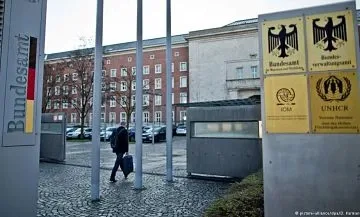
However, asylum applications from the vast majority of migrants who have reached coveted Germany are still being processed at the moment. This is done, as German authorities claim, for humanitarian reasons. At the same time, however, officials of the Federal Office for Migration and Refugees (BAMF) are clearly not coping with processing asylum applications.
According to data leaked to the press, as of the end of June, about 97,000 unprocessed documents were on the desks of BAMF employees. Meanwhile, the agency's work plan adopted last January called for reducing this figure to 79,000. By mid-July, this figure had decreased somewhat, but still did not reach the set limit.
Particularly noteworthy is that the average processing time for asylum applications, despite all the efforts of BAMF management, remains extremely long. Only eleven months after submitting an application do officials get around to considering it on its merits. However, it was assumed that this time should be reduced to five to six months. Only those applications submitted this year are being processed on an expedited basis. Within 1.7 months, a specific response is given to such applications.
Currently, the longest wait for a decision from BAMF officials is for applicants from Somalia – 17.3 months. Turkish citizens must expect a processing time of 16.3 months, and Russians – 15.6. In turn, BAMF leaders claim that the number of asylum applications under their consideration is constantly decreasing. According to the agency, as of the end of July, there were about 129,000, of which about 81,000 were old cases opened before the end of 2016.
It is noteworthy, however, that even a negative response to an asylum application today does not mean immediate deportation of the refugee from Germany. This was openly stated in an interview with journalists by the Prime Minister of Bavaria, head of the Christian Social Union, Horst Seehofer. "Based on my nine years of experience as prime minister, I will say that in the matter of extradition, a great illusion reigns in Germany," the politician admitted.
According to him, a situation has now arisen where "it is practically impossible to send back illegal immigrants if they have already reached Germany." There are both internal and external reasons: from appeal hearings dragged out for years in German courts to the lack of official documents proving the identity of illegal immigrants.
Horst Seehofer is confident that the only reasonable solution to this problem is to check asylum applications already at the external borders of the European Union. As the politician notes, this way it can be immediately determined who has the right to enter EU territory and who should be denied such permission. "I think this is much more humane, more Christian, than moving refugees across Europe and then telling them they cannot stay," the Bavarian prime minister believes.
Currently, there are about 250,000 people in the Federal Republic whose asylum applications have been rejected. All of them, in theory, are subject to deportation.
But about 200,000 of those rejected have appealed this decision to German courts. Last year, there were half as many. Naturally, judges are absolutely overloaded with cases, and those rejected get the opportunity to stay in the country without problems for another six months to a year.