
Fortunately, there is no need to rack your brains: as 'Study Abroad' notes, the educational institutions themselves take care of arranging student life. Regardless of the country and institution, the set of student housing options offered by schools and universities will most likely be standard. These are: a) host family; b) student dormitory; c) rented apartment; d) hotel. Everything else is nuances. By the way, there can be many nuances. Therefore, to choose the option that suits you, you need to conduct a thorough 'reconnaissance of the area' by meticulous inquiries with an agent or a representative of the educational institution - in short, those people who have taken on the organization of your trip. And then, after weighing all the pros and cons, make a decision.
Almost like home
Living with a host family is the option most often offered by language schools, many of which do not have their own dormitories. General education schools and colleges that lack their own housing to accommodate everyone also often avail themselves of the services of volunteers.
Families that host foreign students generally do not do it for profit; at any rate, it is not their sole source of income. And they are not necessarily 'families' in the strict sense. Among them are large clans with many children and pets, single women or old bachelors (the latter much less often), and elderly couples whose children have grown and live separately. What unites the hosts is that they are all financially well-off, eager to communicate, curious, and not xenophobic. Where do such people come from? That is the concern of the educational institution, which carefully selects homes that meet the requirements. After all, the hosts' duty is not only to provide the 'guest' with board and lodging (usually the cost of living with a family includes two meals a day). Communication also plays an important role, especially when it comes to language school students. For example, one requirement is that breakfast and dinner must take place with the family, and if this is not observed due to the host's fault, the school may terminate the contract - unwillingness to communicate at the table is considered a very serious violation.
Of course, to avoid conflicts, 'guests' must also follow certain rules of communal living and not treat the house where they live like a hotel. No matter how tolerant and friendly the hosts are, you should not test their patience by bringing crowds of friends, making long-distance calls on the home phone, or returning home late at night in a drunken state. And of course, you should not be a 'sourpuss': after all, conversational practice at home is part of your learning.
Do not be alarmed by the aforementioned children and animals that may be in your 'second home'. If you are not thrilled by the prospect of doing your homework to the accompaniment of crying babies and barking dogs, be sure to mention this in advance, and they will find you a quiet abode. Generally, negotiations about housing can go on for weeks. They will meticulously inquire about all your preferences and habits: what food you like, whether you smoke, what you are allergic to... But the tedious process of finding a new home will always end in your favor.
What kind of 'apartment' will the host family offer you? It is a separate, private room where you can live alone or share with another student - as you wish. Obviously, a double room will cost less. A private bathroom is only provided in the most expensive option - executive. You will be given a place to study - not necessarily in your room. For example, in Malta, during the warm season, students are often given the opportunity to do homework in the inner courtyards, a mandatory attribute of Maltese houses.
Despite all efforts and care, it may turn out that living with this family is simply unbearable for you. After all, people can have psychological incompatibility. Or irreconcilable differences in views that make peaceful communication impossible. In that case, you should contact the accommodation service of your educational institution, and they will move you to another home. However, it is not recommended to complain about trifles.
The charms of communal living
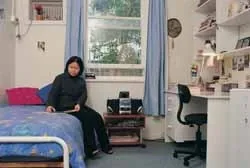
Most large foreign universities and colleges, as well as some language schools, have dormitories (residences) where the majority of visiting students live. As a rule, they are located on campus or nearby, although sometimes you have to commute to classes. Living on campus has many advantages. Those who have lived in or visited dormitories at domestic universities know where the true center of student life is, where the most important and interesting events take place. It is not for nothing that our dormitories are always crowded not only with out-of-town students, despite the supervisors' efforts to keep strangers out. So abroad it is exactly the same, only the living conditions are incomparably better. Rooms are single or double, kitchens (usually several per floor) are sparkling clean and equipped with modern appliances, and there are no fearsome 'Uncle Vanya' or 'Aunt Klava' at the doors, obsessed with the desire to 'let in and keep out'. Amenities may be in the room itself or in the hallway. But the latter is not a problem: there are plenty of showers and toilets on the floors, and needless to say, cleanliness is near-sterile.
What are the disadvantages of a student dormitory at a foreign university? Honestly, I don't know. Well, except that you might not like the smell of exotic dishes that your neighbors from China or Japan cook daily in the kitchen. But in principle, in terms of convenience, atmosphere, and cost, this option seems optimal. No, perhaps there is one serious drawback: dormitories often cannot accommodate everyone who wants to live there. What to do in this case, given that host families do not always take in long-term students?
Option for the independent
Some universities have found a way out by renting rooms for their students on the campuses of other institutions or giving them the opportunity to live in rented apartments. An apartment can sometimes be rented right on the campus or nearby. As a rule, it is the most ordinary dwelling that comfortably accommodates two or three people, so that they don't sit on each other's heads. Or it could be a dwelling with the romantic name "studio" - a tiny room that has a bed, table, closets, and a niche with a stove and kitchen utensils. Plus a similarly tiny bathroom. But you are your own boss.
Renting an apartment is not such a difficult task, given that rumors about cheap free housing always circulate among students. What can be much more difficult is the subsequent "wrestling" with foreign utilities if, God forbid, the lights go out or a pipe gets clogged. But you have to get used to household difficulties.
Don't want to get used to it? Want to avoid household problems altogether, devoting all your time and energy to studies? Well, you can also stay in a hotel. True, this option is hardly suitable for those who came for a long term, unless, of course, your dad is Berezovsky. A hotel is the most expensive accommodation option, regardless of the country. Actually, you don't have to stay at the "Ritz" or "Hilton" (although some originals do just that), you can find something simpler. Sometimes language schools cooperate with inexpensive hotels where they book rooms for their students. You can also do this on your own without involving the accommodation service, but you should remember that the cheapest, "no-star" hotels may simply be unsuitable for living. So it's better to find accommodation through the educational institution.
Wherever you live, remember: you shouldn't count on luxurious apartments. In any case, you won't be as comfortable as at home. Unless, of course, you have chosen the aforementioned executive option - increased comfort and, accordingly, increased cost. On the other hand, no one is stopping you from renting a penthouse if you have money to spare. But why? We are going to study, not to sybaritize. And it's better to spend the money saved on housing on textbooks, cultural programs, and trips around the country.