
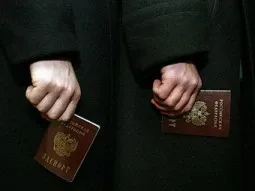
For several years now, Russia has been running a campaign to verify the legality of acquiring or registering citizenship, as a result of which thousands of people are suddenly declared "non-citizens."
Read the beginning of the interview: REVERSE PASSPORTIZATION
– So maybe the citizens themselves are to blame? They tried to get citizenship and passports as quickly as possible, and so they "messed up," and now the FMS is sorting it all out and restoring order?
– Undoubtedly, there were cases of obvious document forgery with fake registration as of February 6 through intermediaries who were in collusion with officials (who persistently convinced everyone that only this confirmed recognition of Russian citizenship), and citizens might have known about this, but their guilt must be proven.
And there are investigation procedures and bringing officials to justice – for this purpose, an internal inspection was conducted within the Ministry of Internal Affairs back in 2004. But it turned into a revision of the law by the FMS, with officials ignoring old instructions, according to which citizenship, for example, for Russian military personnel and their family members located outside Russia, was processed through the commander of the military unit.
What databases could there be? If they decided to restore order in these databases, then after the inspection, information about the verified passport (citizenship) should be entered into the database, or the article of the law under which the person registered or acquired Russian citizenship should be clarified.
Not all commanders of military units understood citizenship issues, but all military personnel who served in the Russian army as of February 6, 1992, or swore allegiance to Russia are recognized as Russian citizens, and accordingly their children cannot fall under "suspicion." Also their wives, even if they did not have citizenship by birth, living on the territory of a military unit were also recognized as Russians. Or they were issued (or could have been issued) citizenship under Article 18 – through registration. However, recently, military personnel and their families have especially often fallen into the "risk zone" as having allegedly illegally obtained citizenship.
– How is the prosecutor's office reacting to what is happening?
– Prosecutor's offices at various levels have repeatedly recognized the practice of confiscating passports as illegal. As an example, one can cite the submission of the Saratov Region Prosecutor's Office to the local FMS bodies. In some cases, these submissions led to a positive result.
But in dozens of stories described on my consultation forum, the reaction of local prosecutors was zero ("You have not acquired citizenship," and so on), even after a court decision! There were many appeals from victims to the Prosecutor General's Office, to the President, and to the Human Rights Ombudsman.
There are also many court decisions that recognized the actions of the FMS of Russia in confiscating passports as illegal. In the fall of 2008, the Prosecutor General's Office pointed out to the FMS of Russia massive violations of deadlines for issuing foreign passports to Russian citizens, which were precisely related to checks on citizenship. Foreign passports began to be issued on time, but after a short time, the internal passport was declared wanted on the initiative of the FMS, then confiscated, and accordingly, the foreign passport became invalid.
And as a result, under pressure from the press and television, which, albeit with large cuts, told about victims of "bad law," in April 2009, the Prosecutor General's Office of the Russian Federation recognized as illegal the practice of confiscating passports and refusing to replace them if there were no unlawful actions on the part of the citizen. It also recognized as illegal the requirement for a passport holder to confirm his citizenship or to establish in court the fact of permanent residence as of February 6, 1992.
– So the Prosecutor General's Office supported the position of human rights activists?
– Yes. And it did not stop at stating facts – the Prosecutor General's Office instructed prosecutors of the constituent entities of the Russian Federation to pay special attention to violations of the law in this area and to suppress cases of illegal passport confiscation. "If violations are detected, be sure to raise the issue of holding the responsible officials accountable, up to dismissal," the document says.
We, human rights activists, hoped that with the release of this document, the situation would change radically. However, so far these hopes have not come true – the situation has practically not changed. Apparently, the "steamroller" has a lot of inertia. And although recently the FMS does not confiscate the passport, it cannot be used because it is declared or will be declared invalid, will be put on the wanted list, and Russian citizenship is nevertheless "confiscated" until "the legal status of the person is determined" – this is how the FMS decided to respond to the instructions of the Prosecutor General's Office, allegedly in coordination with it.
– Is passport confiscation equivalent to deprivation of citizenship? In what cases do FMS employees have the right to confiscate a passport?
– A passport of a citizen of the Russian Federation can be confiscated administratively if it was issued on a stolen or forged form, issued by an unauthorized body, or in violation of the established procedure, as stated in paragraph 7 of the Government of the Russian Federation Resolution No. 828 of 07/08/1997. But it is precisely this paragraph that FMS department employees refer to in their conclusions about the absence of citizenship. Sometimes the court also refers to this paragraph, unfortunately, without applying the norms of the Law "On Citizenship" and the Regulations on the Procedure for Considering Citizenship Issues.
The resolution, like paragraph 80 of the FMS Administrative Regulations for the provision of passport issuance services, refers only to the procedure for issuing passports as specified in the Regulations on the Passport. And the procedure for acquiring (obtaining) Russian citizenship is regulated by the Regulations on the Procedure for Considering Citizenship Issues of the Russian Federation and by paragraph 82 of the aforementioned regulations. And if there are doubts about the legality of acquiring citizenship – we again recall Article 22 of the current law 'On Citizenship', which states that the fact of forgery must be established in court, and only after that can the decision on the issue of citizenship be revoked.
FMS employees, objecting to our references to Article 22, indicate that since there is no registration as of February 6, 1992, and there is no information in the database about the acquisition of citizenship, it means there was no decision on the acquisition of citizenship, and therefore there is nothing to revoke. But the database does not contain information about persons who have citizenship by birth, who were recognized as citizens by the date of residence, who were recognized as reinstated in citizenship in 1994 (under Article 20 of the 1991 law). And in the passport offices, in the UVIRs in the 1990s, quite competent inspectors worked, whose actions in issuing passports are now unjustifiably considered unlawful or erroneous.
At the same time, they themselves are 'released' from responsibility because the statute of limitations has passed or they have already been fired. And their decisions, as I already explained, even if they were erroneous, the citizen is not at fault. But for some reason, now the innocent holder of a passport is punished by deprivation of citizenship.
I personally do not know from what year the database referred to by the FMS has been kept, how this database was compiled – by passports or by those who acquired citizenship, whether information from all UVIRs was included, whether materials were destroyed after the expiration of five years, in accordance with the 1991 law. Not to mention cases of destruction of documents during fires, natural disasters, and so on.
There was a case when, in response to a request from the FMS department of one district of the Moscow region, another district replied that 'we do not have information on the basis for issuing the insert, since not all materials were preserved during the move.' And this served as a basis for refusing a Russian citizen in the city of Orekhovo-Zuyevo to exchange her passport when changing her surname – she allegedly did not prove that she is a citizen of Russia. She had to go to court.
– What to do if the FMS declares a passport 'unjustifiably issued'? Where to apply, when can you go to court?
– First of all – do not panic and do not feel inferior. You are not a criminal or an offender. First of all, you need to obtain a refusal to carry out the procedure for which you applied to the territorial division of the UFMS (passport exchange, registration of a child's citizenship, or for another reason). By the way, the registration of a child's citizenship should not be delayed due to a check of your citizenship. All communication with the FMS regarding your problem – only in writing.
It is advisable to figure out for yourself how you acquired citizenship – by birth, by recognition, or in the order of admission, on what basis. If you have not committed illegal actions, forgeries, then rest assured that it is not so easy to deprive you of your citizen status. Especially now, when there is at least some support from the Prosecutor General's Office in the form of instructions to local prosecutors to monitor compliance with the law. But do not slack off yourself; you may eventually have to go to court, which in most regions is quite independent in matters of citizenship.
In the FMS refusal, it will be indicated why your passport is 'invalid' and does not certify your Russian citizenship. Do not surrender the passport; wait for a ruling on its seizure – after a decision by the authorized body, and this should be a decision of the FMS of Russia or the UFMS of the region. The conclusion of the authorized body must indicate what kind of check (for what) was carried out and what it found: your submission of false information about your person, a stolen passport form, or a counterfeit form. Or the FMS considered, for example, that at the time of receiving the passport you generally had no right to acquire Russian citizenship.
Depending on the basis for the refusal, you will file a complaint with the court. More precisely, a statement in accordance with Article 254 of the Civil Procedure Code of the Russian Federation against this conclusion and/or decision, or directly against the fact of seizure. And you will prove that in the 1990s or even after July 1, 2002, you found a provision of the law pertaining to your situation. You applied to the PVS (Passport and Visa Service) with your documents, where they helped you determine, submitted all required documents, and as a result, you were granted Russian citizenship and issued a passport.
You did not forge the passport, did not buy it from some shady place, but legally received it from the hands of a state representative. Moreover, any decision on a citizenship issue can be appealed by appealing to the President of the Russian Federation, who has the legal right to cancel decisions of the authorized body or to reinstate persons in the citizenship of the Russian Federation.
– And did you try to appeal to the president?
– In December 2008, victims of the FMS sent a collective appeal to the president, the State Duma, and the Federal Assembly. The leadership of the FMS responded: they submitted a reply to the Duma regarding a deputy's request and to each of the applicants regarding their problem, but the gist of the replies was the same as before – 'you are not a citizen of the Russian Federation, you must surrender your passport and acquire...' Nevertheless, already in April 2009, the FMS position changed somewhat – due to an instruction from the Prosecutor General's Office to stop the seizure of passports.
Personal complaints to the head of state about the FMS – and there are many – are sent from the presidential administration to the FMS for consideration, citing the Law on the Procedure for Considering Citizens' Appeals. But the procedure for considering citizens' appeals established by this law does not apply to those appeals that are subject to consideration in the procedure established by federal constitutional laws and other federal laws.
The Law 'On Citizenship', being a federal law, established that only the President of the Russian Federation has the right to cancel a decision on issues of citizenship of the Russian Federation made by another authorized body. This is stated in Articles 23 and 29 of the Law on Citizenship, and in paragraph 54 of the Regulations on the Procedure for Considering Citizenship Issues of the Russian Federation.
If the FMS has deprived you of citizenship, then besides the court, only the president has the right to cancel this decision. And to whom, if not the president, should a citizen turn? And a decision that was made many years ago in the OVIR, which no longer exists, must also be canceled by the president upon the recommendation of the FMS, but not by the FMS itself (that is the meaning of Article 23). And here is an example of such an appeal.
However, the result is the same: a citizen's appeal addressed personally to the president is forwarded from his administration (and not a proposal from the administration or the president's assistant to the FMS – for example, to prepare a draft of a corresponding decree) to the FMS with a standard reference to paragraph 3 of Article 8 of the Law on Appeals, despite the fact that it is the president who is authorized to consider this issue.
We understand that regarding a dispute about the fence between plots or incorrect calculation of utility payments, one should not turn to the president. But in this case of ours, it is not about a complaint against an ordinary official or a neighbor, but about canceling a decision on citizenship, specifically about deprivation of citizenship. The consultants of the presidential administration should more carefully familiarize themselves with the law they refer to and with the articles we refer to in our appeal to the head of state.
– When analyzing some cases, it turns out that PVS employees made a mistake. That is, a citizen had the right to obtain citizenship under one article, but he was processed under another. Now the FMS claims that the acquisition of citizenship was illegal. How are such cases considered from the point of view of the law?
– Again we have to refer to Article 22 of the Law 'On Citizenship'. If the court has not established the fact of forgery or provision of knowingly false information, no one has the right to deprive the status of a citizen and simply confiscate the passport.
It's 'good' if it was just a typo or error in indicating the article under which Russian citizenship was formalized (or acquired). In this case, the former USSR citizen had the opportunity to acquire (or formalize) under another article, and this can be proven to a reasonable inspecting official or in court. 'Good' in quotes, because litigation with officials is inevitable, up to success in court or deprivation of citizenship.
Here, for example, is the case of citizen B., which was considered in 2003 in Kislovodsk. When considering an application about the illegality of destroying the insert on a person's belonging to Russian citizenship, the court established that B. had the right to acquire citizenship under paragraph 'a' of Article 18 of the Law 'On Citizenship of the Russian Federation' of November 28, 1991, in the registration procedure, since he had been married to a Russian citizen since 1990. And they issued him an insert under Part 1 of Article 13 – based on residence as of February 6, 1992. Therefore, the court decided that as a result of incorrect application of the current legislation, B. was deprived of the opportunity to acquire Russian citizenship on legal grounds. As a result of the mistake made, he was recognized as a citizen of the Russian Federation, but on a different basis. However, since B. provided truthful information about himself and did not commit forgery, the passport department unlawfully refused to issue him a passport of a Russian Federation citizen.
Since the citizen did not violate laws and had the right to acquire citizenship, the court declared illegal the decision of an employee of the Kislovodsk City Department of Internal Affairs to cancel the decision on recognizing B. as a citizen of the Russian Federation and obliged to issue him a passport of a Russian Federation citizen.
Much worse is when citizenship was formalized legally more than 10 years ago, and FMS workers suddenly 'find an error' of a former PVS employee, which in fact did not exist, and confiscate the passport when there is no one's fault, especially that of a Russian citizen. The fact is that the FMS interprets the norms of laws in their own way, such as about permanent residence, acquisition of citizenship by birth, acquisition of citizenship by children, and ignore judicial documents of the Constitutional Court. Sometimes they even suddenly recognize someone or his children as citizens of some CIS republic. One has to go to court.
– How do you assess the judicial practice in citizenship cases? How likely is it that judicial authorities will protect the legal rights of a citizen?
My personal experience of litigation in cases of non-recognition of citizenship in persons with a passport of a Russian citizen has positive statistics. You can learn more about court cases and decisions on our forum. There are already hundreds of them. And statistics show that the court understands the law on citizenship well if the applicant or his representative has himself understood his citizenship.
Unfortunately, most of our victories occurred in the regions. In Moscow, it is much more difficult to prove one's case. Especially in the Moscow City Court when hearing cassation cases. There are examples when the court agrees with the arguments of the FMS about the presence of an error in determining citizenship affiliation by employees of the former PVS. And the lawful decision of the first instance is overturned.
In a situation similar to the story in Kislovodsk, the Moscow City Court overturned the district court's decision, sent the case for a new trial, which dragged on for a long time, and then the actions of the FMS to confiscate the passport were recognized as legal. Although the first instance court's decision stated that the divisions of the FMS of the Russian Federation, when deciding on the unjustified issuance of a Russian citizen passport to the applicant, did not take into account the existence at the time of issuance of the passport of circumstances indicating the acquisition of Russian citizenship through registration in the presence of a relative, in this case the mother, who was a citizen of the Russian Federation in the direct ascending line at that time.
The Moscow City Court recently overturned a court decision that confirmed the legality of citizenship registration and actually established the fact of permanent residence in Moscow on the cherished date of citizen Yu., sending the case for a new trial. The Moscow City Court, contrary to its previous practice and the instructions of the Deputy Chairman of the Supreme Court of the Russian Federation, does not consider residence permanent if the person at that time studied, lived in a dormitory, simultaneously started a family, worked and had no citizenship other than Russian.
And it considers it possible to deprive citizens of their passports and citizenship, despite the fact that even if one agrees with such an interpretation of the concept of "residence," doing so now, after 10–17 years, in the absence of wrongful acts by the citizen himself, is prohibited by law. It must be said that it is practically impossible to initiate supervisory proceedings in the Supreme Court upon a citizen's complaint, but overturning a decision that is in favor of the citizen upon a complaint from the FMS — that has happened!
Earlier, it was possible to at least get the case requested, to receive a refusal with objections to our arguments. Now it seems that the complaint does not reach the judges of the Supreme Court. Two or three sentences from the decision of the previous instance are rewritten, but our arguments are not refuted, except that the standard phrase appears – "the arguments of the complaint contain a different interpretation of the law," or "a different assessment of the evidence."
This situation with the Supreme Court's reluctance to review such cases has not surprised me for a long time, ever since I lost Irina's case in the regional court — a citizen of Russia by birth, which had been won in the district court back in 2004. Has something changed in the country's attitude toward indigenous Russians and the population as a whole, or is it perhaps the economy imposing its "conditions"?
– What do you mean?
– I mean "concern" for the country's budget. The review of an application for acquiring citizenship is paid for by a state duty of 1,000 rubles. And if a million citizens reacquire citizenship, that's already a billion. And if they are first forced to obtain a residence permit, then a permanent residence permit with the same duty, that's already three billion. Not so much, but "many a mickle makes a muckle." And different offices are involved in the registration process – notaries, photographers, translators for document preparation on forms, and also laboratories for issuing medical certificates – paid ones. And that means employment and, accordingly, taxes to the budget...
– Returning to judicial practice: is it worth going to court?
– Of course it is. And not only on citizenship issues. Judges understand our laws well, and it is not as easy to justify lawlessness in a decision as officials do, and so far there is no other way to restore a violated right if you do not wish to "surrender" to the mercy of an official. And it is precisely thanks to the court that we have achieved some things.
For example, the Agreement of four republics – Russia, Belarus, Kazakhstan, and Kyrgyzstan – on the registration procedure for acquiring citizenship in Russia only began to actually work on November 13, 2003, after a ruling was issued in the Tarusa District Court, although the Agreement came into force as early as January 2000. Before that, officials understood the concept of "residence" differently than specified in the Agreement.
There are simply precedents, such as the recognition of citizenship by birth, which the FMS department did not want to recognize for six years because the person was born in Kazakhstan – the recognition of Russian citizenship despite already having another citizenship (and passport of another country).
Court decisions are material on which citizens improve their level of legal literacy, and serve as an example of dispute resolution for judges encountering such a topic for the first time, as they contain references to provisions of the citizenship law, decisions of the Constitutional Court, and other documents.
I personally believe that without the court cases, many of which made it into the press, there would have been no instructions from the Prosecutor General's Office. But it is strange and offensive that from 1992 to the present, the Supreme Court has never expressed its opinion on resolving disputes on citizenship issues and deprivation of citizen status through passport confiscation. And there are only three main issues on which it should speak – about permanent residence, recognition of citizenship by birth, and passport confiscation on grounds of "absence" of citizenship after it had been present for many years.
And such questions have been put before the Supreme Court. I personally sent in December 2006 to the Commissioner for Human Rights in the Russian Federation a stack of court decisions and a request to appeal to the Supreme Court. On March 14, 2007, I was sent a message that everything had been sent to the Supreme Court, and on March 16 everything was returned from the Supreme Court with an explanation that the materials would be used in the study of issues related to the application by Russian courts of legislation on citizenship of the Russian Federation. Both envelopes were received on the same day.
We wait. But the Supreme Court is silent. Apparently, that's how it must be. We have to fight lawlessness on our own.
Interviewed by Vladislav GORDEEV.
Lenta.ru