
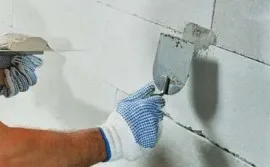
Properly finished aerated concrete wall surfaces will last for many decades
Walls made of aerated block on the outside can be finished with masonry materials, as well as facing materials and building products with mechanical fasteners. Such blocks can also be finished with plaster or paint compounds.
Aerated concrete is a material that easily allows moisture and air to pass through, so for its finishing it is necessary to use substances that do not impede natural ventilation processes. For finishing aerated concrete surfaces, it is not recommended to use cement-sand plasters, cladding with polystyrene foam boards, painting with film-forming dyes, or using facing materials that are attached with adhesive compounds. Properly finished wall surfaces will serve you for many decades.
For exterior finishing of aerated concrete walls, it is better to use:
1. Hinged ventilated facade systems cladded with decorative panels, siding, or lining.
2. Cladding walls with facing brick, with a mandatory ventilated gap of 30-40 mm between coatings.
3. Thin-layer plastering using special mixtures intended for aerated block. All compounds used for finishing aerated concrete surfaces must be modified with special water-retaining admixtures with 98% water-retaining capacity.
4. Grouting of block joints must be done followed by painting with textured paints with vapor-permeable properties.
Building facades are finished no higher than 2 stories; the basement and attic floors are not counted. The finishing masonry must be supported directly on the structure of the basement walls, plinth, or house foundation, so the facade cladding of aerated concrete must be planned in advance in the house design.
Finishing of aerated concrete walls with plaster mortars must be done when its moisture content is no more than 27%. Before finishing, all existing dents and chips on the aerated block are treated, filled with ordinary building mortar, any irregularities are rubbed with floats, then the resulting dust is removed with a brush. Only after preliminary preparation does finishing begin. For walls in wet rooms, specially developed waterproofing compounds are used.
If the thickness of the protective-decorative layer is less than 0.1 cm, it is not reinforced. If the layer thickness is from 0.1 to 0.15 cm, it is necessarily reinforced with fiberglass mesh. If the thickness is more than 0.15 cm, the layer is reinforced with steel mesh. A layer thickness of more than 0.2 cm is not recommended.
_