
And yet, by no means all of the 53 million foreigners who visit this blessed land every year come for the simple pleasure of splashing in the gentle sea. Active recreation is increasingly coming into fashion, offering the opportunity to broaden one's horizons and accumulate vivid impressions. Concepts such as educational, cultural, event, and even adventure tourism have come into common use. Spain offers every opportunity to try out any of these options.
In fact, we are talking about thematic tours. For example, you can choose a culinary or wine journey, a historical, literary, or theatrical tour, visits to nature reserves, a sightseeing cycle introducing you to painting or ethnography, and much more. A characteristic feature of our time is that 'herd' tourism with a standard program is increasingly giving way to individually designed routes that will be of interest specifically to you.
And Spain can certainly touch a chord in any discerning person. It is no accident that it inspired Mikhail Glinka to compose his brilliant 'Aragonese Jota' and picturesque 'Night in Madrid', inspired Prosper Mérimée to create the image of the proud beauty Carmen, and suggested to the jester Beaumarchais the philosophical playfulness of the characters in 'The Marriage of Figaro'.
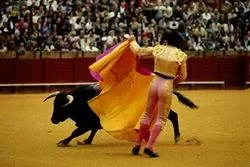
That this country has many faces is beyond doubt. But there is disagreement about its soul. Some consider flamenco to be the soul of Spain, others bullfighting. Interested parties have the opportunity to test both versions by developing an appropriate tourist route for themselves. Suppose the choice falls on bullfighting - Corrida de toros, which translated means 'running of bulls'. They say that in terms of excitement this spectacle surpasses the most amazing football match, and in beauty and plasticity of movement - the most refined ballet.
"Toreador, be brave!"
Bullfighting has existed in Spain since time immemorial, and since the 16th century it has accompanied all major holidays. Various Spanish cities claim the glory of being the 'discoverers' of bullfighting, but the most beautiful legend on this subject will be told to you in the city of Salamanca, which considers itself the birthplace of bullfighting, and for clarity they will take you to the University of Salamanca - the oldest among Spanish universities and one of the oldest in the world. In its inner courtyard, the walls are covered with red badges. Upon closer inspection, it turns out that the badges have the shape of the letter V - Victoria ('victory'). Since the Middle Ages, it has been the custom that university graduates who received a doctoral degree should 'mark themselves' in this way. Initially, the tradition required that a student who successfully completed his studies and passed a difficult exam also prove that he had become a real man, and to do so he had to kill a bull. The one who succeeded would use the blood of the killed animal to place his victorious V sign on the wall. However, it often happened that it was not the bull that died, but the man. This was a great loss for society, since university education was very expensive, and graduates were valued like gold. In violation of tradition, they began to be allowed to use a 'stand-in', who had to be paid for this. Thus, supposedly, bullfighting was born.
However, the small romantic town of Ronda, located in Andalusia, in the mountains between the coast and Seville, has no less reason to claim the role of the 'spiritual cradle of the art of bullfighting', and perhaps even more: after all, here is the oldest bullring.
The case for Ronda's 'candidacy' is also supported by the fact that a fanatical fan of bullfighting, the American writer and cult figure of the last century, Ernest Hemingway, came here and lived for long periods in one and the same local hotel. If you choose Ronda as the next stage of your journey 'in the footsteps of bullfighting', you will see here many traces of 'Ham's' presence - memorial plaques on buildings, photographs in restaurants and cafes. You may be interested to learn that the famous writer attended one and a half thousand bullfights over seven years and even tried to participate in one of them.
Once you find yourself in these parts, you cannot help but visit Seville, where next to the Golden Tower - an ancient Arab bastion - there is another bullring, as well as the Royal Society of Horsemanship - the 'cathedral' of Andalusian bullfighting. In general, the bull in Andalusia symbolizes a celebration. In small villages such as Grazalema (province of Cádiz) or Beas de Segura (province of Jaén), on holidays in the morning they organize the running of bulls through the streets. Several hours later these bulls take part in a bullfight.
In Andalusia they say that in its eight provinces there is a strong passion for the art of bullfighting, but it is in Seville, Córdoba, and Málaga that this art has become a passion.
The best bullrings in Spain are considered to be those of Madrid, Seville, Barcelona, Valencia, Córdoba, Zaragoza, and Bilbao. Colorful festivals with bullfights take place in June in Granada, in July in Pamplona, in August in Bilbao, but the main event of the bullfighting world is considered to be the 27-day San Isidro festival in Madrid, which takes place at the most famous arena in the world - Plaza Monumental de Las Ventas.
But in Pamplona, every year they celebrate the bright and crazy festival of San Fermín, which is at once like a drama and a farce, when the bullfight takes to the streets from the closed arenas. At eight in the morning the pens are opened, and the bulls rush through the streets toward the stadium, with people running ahead of them. Here is how Hemingway described this moment in 'Fiesta': "The crack of a bursting rocket woke me - the signal that the bulls had been released from the corral on the outskirts of the city. Now they will race through the entire city, heading for the arena. Suddenly the street was flooded with a crowd. People ran together, huddled in a bunch. They passed the hotel and turned toward the arena, then stragglers appeared, running at full speed. After them a small gap formed, and then along the street, tossing their horns, the bulls galloped past. A minute - and everything disappeared around the corner."
Several hundred thousand tourists come to this event every year. They are usually not advised to take part in the "run", because they are completely "out of the loop". The runners of Pamplona, on the other hand, know that before the race one must sleep very well, dress properly, and also spend a long time learning safety rules. Nevertheless, there are still casualties, although that does not stop the aficionados - those who are obsessed with bullfighting. Those who are interested in this Spanish tradition in a less extreme version can be advised to include in the program of their theme trip a visit to the Picasso exhibition, which opened in the artist's homeland, in Malaga, and will last until July 3. Picasso carried his passion for bullfighting throughout his life. According to the director of the Picasso Museum in Malaga, Bernardo Laniado-Romero, the fighting bull attracted the artist as an embodiment of vitality and energy, and bullfighting as the personification of the perfection of human plasticity.
Gastronomic Spain
I don't know if one can understand the national character of a people through the phenomenon of bullfighting, but gastronomic preferences indeed say a lot about traditions, family life, character, and even the places where Spaniards live. Spanish cuisine is no less diverse than the Spanish dialects, and the only thing that unites it is olive oil. Here, between the sea and the continent, different worlds coexisted for centuries - East and West, Christians, Muslims, Jews. And each contributed something to the local cuisine. Here paella and stuffed fish coexist, and fried rabbit is served with a garnish of pickled octopus.
The gastronomic geography that a gourmet needs to know in order to choose the right route is as follows. In the north, peppers and tomatoes are popular; in the south, rice and fish; in the center, meat, including pork; in the west, crabs, oysters, mussels, and squid. Madrid's cuisine has taken a little from everywhere, but it also has its own signature dishes: for example, "cocido madrileño" - a stew made from a mixture of vegetables and different kinds of meat, served in a pot.
Spaniards eat few fruits and vegetables because they are difficult to grow, but they make up for it with meat. It is most often prepared in the Arab way - soaked in dry wine, grilled on a skewer or on a large baking sheet. They do not spoil the "natural product" with sauces, preferring the natural taste of meat. As a side dish for meat, they may serve something sweet - for example, pancakes with jam.
In the south of the country, cold soups are very popular, for example gazpacho. Remember, in Pedro Almodóvar's film "Women on the Verge of a Nervous Breakdown", the heroine pacifies everyone by offering them gazpacho. This type of soup also plays a big role in real life. It is eaten as an appetizer and as a main course, at any time of day. Here is one of the recipes for gazpacho. Peel the tomatoes and remove the seeds, roast the red bell pepper in the oven, remove the skin. Peel the cucumbers and cut them into rings. Soak white bread in very cold water. Chop the onion and garlic. Put all the ingredients in a blender, add crushed ice and tomato juice, and blend. Croutons, boiled eggs, and olives go well with gazpacho.
Each region has its own cooking traditions. In Andalusia, meat is fried; in Castile and Aragon, it is baked; in the Canaries, they prefer to stew it. In the mountains of Asturias, they eat "fabada" - a thick stew made of pork, sausages, and beans. In Extremadura, the best "jamón" in the country is a cured pork leg, which is usually eaten with melon.
In Spain, they love to indulge in good food, and in that, Spaniards are similar to us (except, of course, those who are on a diet). They are ready to generously share their culinary inventions, so a gastronomic tour will not disappoint any traveler. Especially since a tasting is guaranteed.