
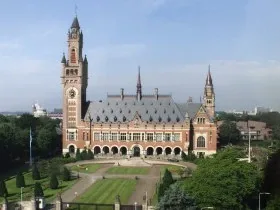
Many perceive The Hague as the capital of the Netherlands
150 international companies that have their headquarters in The Hague only enhance the city's resemblance to a capital. Peace forums and other similar organizations are almost constantly held in this city. Undoubtedly, because of the large number of such events, The Hague often looks very official. For the same reason, the city's hotels and restaurants often raise their prices, and nightclubs look a bit unnatural. But on the other hand, no other city in the Netherlands, not even Amsterdam, can boast of such magnificence of a true royal city as The Hague.
The city's appearance is very diverse – on one hand, its ancient architecture is preserved, and on the other, the city is being actively built up with modern buildings. However, recent constructions, which are predominantly skyscrapers, do not look too massive or eclectic compared to other Dutch cities. The ancient architecture dates back to the 19th century. It was at this time that the new state of the Netherlands was formed, and The Hague became its royal city. The industrial part of The Hague is located outside the city and includes environmentally friendly industries: printing, electronics, and electrical engineering. In the 1990s, even the city's leading enterprise, the Fokker aircraft plant, which was located in the Ypenburg area, a southern suburb of The Hague, ceased operations.
The Hague is surprisingly little like a truly Dutch city. It has many wide roads, rather low houses, and very few canals. Moreover, The Hague was never a fortress city with defensive walls, so there are no traditional boulevards along such walls either. The reason lies in the city's history, whose construction once became a kind of compromise in a dispute between two cities – Delft and Leiden. These cities could not decide which one was better and more important. So the city of The Hague was founded exactly midway between them, becoming formally the main one at that moment. However, at that time The Hague had the status of a village (and remained so until the 19th century), and therefore it was simply not allowed to build defensive walls. In the 16th century, this ban was lifted, but there was no longer a need for such walls, so all allocated funds were spent on building the town hall. And to this day, The Hague is a very peaceful city. This is confirmed by its symbol – the bird that brings children, the stork.
Interestingly, almost all street signs in the city feature a stork figurine. Another fact worth recalling is that in 1899, Russian Emperor Nicholas II organized a peace conference in this very city. Here, in The Hague, the headquarters of the League of Nations was located until 1939. After World War II, the city became a true international center of diplomacy and jurisprudence. Many world tribunals and arbitration courts, various international commissions and investigations are located here. And since there are many international organizations in the city, consequently, many guests from other countries live there. However, in Europe, Strasbourg, Brussels, and Zurich can also boast of this.
But why the city is called Гаага in Russian is completely unclear. After all, according to English pronunciation rules, The Hague is read as 'Heig', and according to Dutch norms – 'Den Haag', which translates to 'the hedge'. Actually, the full name of the city is 's-Gravenhage, meaning 'the count's hedge'. Moreover, each resident of the city is called a 'Hagenaar'. Long ago, in the 13th century, Dutch counts hunted in the local forests.
Then William II staked out this place for himself and in 1248 built a hunting castle here. Actually, the city's name and its history begin with this episode. However, William II did not manage to finish his castle, as he was killed. At all major events of The Hague, the population in one way or another honors the queen. For example, on the so-called 'Koninginnenacht' (Queen's Night, from April 29 to 30), city residents drink large amounts of beer, stroll around The Hague, and attend specially organized concerts. And the next morning, they take to the streets again in orange clothes. During this holiday, sellers do not pay taxes for their work.
However, the most important event is considered the opening of the parliamentary session. This happens annually on the third Tuesday of September. On this day, anyone can see Queen Beatrix, who traditionally arrives at the session in a golden carriage accompanied by elaborately dressed guards. Moreover, if you come to The Hague in the summer, you have a chance to attend one of the popular music events. For example, on the last Sunday of June, you can visit Parkpop – a large open-air pop music concert. On the first weekend of the month, there is an opportunity to see world jazz stars at the 'North Sea' festival. Also, The Hague has interesting traditions. One of them is the offering to the queen of the first barrel of 'new Dutch' freshly salted herring, which is held annually at the end of May. Additionally, The Hague can boast a large number of street organs, barrel organs, and currant buns, which are sold throughout the city and are called 'kak-keren' in Dutch.
The train ride from Amsterdam to The Hague takes 40 minutes. The most convenient way to get around The Hague is by tram. By the way, The Hague was the first Dutch city to introduce a tram. This event occurred in 1864. The route of the first tram passed through the city center and also the resort of Scheveningen.