
Several months before the World Cup, trade unions began negotiating with employers for a shorter working day (for the same money!) during the championship. For those who could not leave work early, the possibility of installing televisions or at least radios was envisaged. Employers had no choice but to meet the unions halfway. Who wants to be accused of lacking patriotism? Especially since the largest concerns of the Federal Republic became the official "sponsors" of German patriotism!
On the eve of the championship, such firms as Aldi and Lidl, beloved by every German citizen, held several special sales of football paraphernalia. T-shirts, caps, summer tables and chairs, beer mugs painted in the black-red-gold national colors, and of course the German flags themselves in various variations could be bought for symbolic euros. The usually expensive football merchandise was deliberately made affordable for the less wealthy segments of German society. And the results of this promotion were not long in coming.
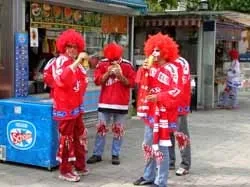
Almost every restaurant or ordinary pub in Germany now flies the national flag. Almost one in three cars has a special tricolor car flag attached. And the sheer quantity of shirts and T-shirts in the national team's colors is staggering! According to many experts, such "fan fervor" has never been seen in the history of Germany. It is noteworthy that the football holiday greatly united Germany's multicultural society. After all, almost every tenth resident of Germany is a foreigner or comes from migrant families.
All ethnic and religious contradictions are now forgotten and buried. Everyone is united by one passion – the World Cup!
In recent days, the head coach of the national team, Jürgen Klinsmann, has not tired of giving lengthy interviews on all German channels, explaining why he took one player and refused another. The whole country was eagerly discussing whether the team captain Michael Ballack would play in the first match and how serious his injury was. It seemed that there was not a single person left in Germany who did not know that the name of the country – the first opponent of the German national team in the subgroup – translates as "Rich Coast". It could not have been otherwise – television channels showed numerous reports from all the countries that are competing with Germany for a place in the round of 16.
And then came June 9 – the zero hour. The anticipation of the holiday was finally over, the holiday itself had arrived. When the national teams of Germany and Costa Rica took to the emerald-green pitch of the brand-new stadium in Munich, the streets of German cities became empty. Germans sitting at home or in pubs in front of TV screens eyed random passersby with suspicion. How, after all, can one not cheer for one's own team at such an important hour? Or maybe these are people not of this world? Bored store clerks gazed wistfully at empty sales floors, and total sales in Germany, as it later turned out, fell to almost zero!
But immediately after the end of the victorious match for the German national team, real madness began in the country! Crowds of jubilant people on the streets, small firecrackers and large fireworks, joyful chanting and the continuous sound of car horns. The whole country celebrated the victory of its favorites in a single outburst. The cautious voices of pessimists, who spoke of the complete failure of the national team's defensive line, drowned in the triumphant roar of those who from now on do not doubt the final victory of Klinsmann's team. Almost all leading German politicians hastened to express their admiration for the game. All the sociological surveys conducted on the eve of the championship, which claimed that only 7% of Germans were confident of the success of the national team, were completely forgotten.
Numerous tourists who came for the championship, held under the motto "The World at Home with Friends", also take part in the general celebration. Especially for foreign guests, German taxi drivers on the eve of the football battles feverishly memorized expressions in English, French, and Russian, and restaurant menus were rewritten into Chinese and Japanese. The World Cup has already created about 400,000 new jobs in Germany, and the direct spending of football tourists in Germany is now in the hundreds of millions of euros. It is clear that in this situation the voices of those who now say: "It's a pity that the championship will last only one month!" sound absolutely natural.
What terrible events did numerous experts not predict during the 2006 World Cup in Germany! The "softest" scenario was the forecast of enormous traffic jams that would block traffic in all major cities of the Federal Republic. And outright pessimists croaked about groups of Islamic terrorists intending to do their dark deed around the football arenas of Germany.
Even the main football expert in Germany – Franz Beckenbauer, or "Kaiser Franz", as he is respectfully called in the country, tirelessly insisted all recent months that the championship is a "terrible and dangerous" matter. Probably not by chance, the entire preparation process for the football holiday was taken under the personal control of the Federal Minister of the Interior, Wolfgang Schäuble.
German mass media also fueled the hysteria, giving the World Cup almost apocalyptic features. "Hundreds of thousands of wild fans are coming to us; isn't it time to bring the army and heavy weapons into the cities?" asked frightened newspapermen. And the question of using Bundeswehr units to maintain public order was seriously discussed at parliamentary sessions.
Fortunately, as the first weeks of the championship showed, almost all fears turned out to be groundless. The football battles themselves remain battles only on the field, and the atmosphere around the championship resembles ordinary folk festivities.
About 70 thousand English fans arrived in Frankfurt am Main for the match against Paraguay. The German police assigned special officers who mingled with the crowd and tried to initially extinguish any possible conflicts. This tactic was successful – only 12 Englishmen were arrested, and even then they were pointed out by the residents of the foggy Albion themselves, who were disturbed by their overindulging compatriots. There were no predicted traffic jams on the central streets of the cities where the championship matches are held. Even the complete closure of one of the main Berlin routes – June 17 Street, where the so-called "fan mile" with huge monitors and numerous beer tents was located – did not lead to traffic problems. For the sake of fairness, it should be said that the Portuguese national team, getting ready for the match with Angola, had to stand in a traffic jam on the A1 autobahn for about an hour. No football team at the championship has escort vehicles with flashing beacons. There is no one to blame for the wait in the traffic jam – the approaches to the Rhine metropolis of Cologne are traditionally congested with traffic.
Now about the national drink of the Germans, the sale and consumption of which they tried to prohibit during the championship matches. Two types of beer are sold at all stadiums – one American, Budweiser, and the second German, Bittburger. Both beer companies are official sponsors of the championship. The price for the foamy drink is uniform – 0.3 liters for €3,50, and 0.4 liters for ?4. Traditional German sausages are offered with beer for €3. Those fans for whom this price is somewhat expensive can look into the nearest supermarket before or after the match. By the way, during the championship, Germany abolished the law on the operating hours of stores, which provides for uniform working hours from 7 to 20. Now you can walk around large retail outlets for two hours longer, and on Sunday – as much as four hours – from 14 to 18, which for Germany is absolute nonsense!
There are no particular problems with entrance control at stadiums – queues move quickly, especially since many fans hurry to take their seats early. After all, many stadiums have just been built and are masterpieces of architectural and design thought. At the same time, as the championship organizers claim, the "occupancy" of football arenas is almost 99%. Buy an extra ticket on the eve of the match, unfortunately, is practically impossible.
It seems that the police are mostly inventing work for themselves – no major incidents have happened so far. Now the country has launched a discussion about whether it is allowed to hang "black-red-gold" German flags and other fan paraphernalia on government cars. The Berlin police president, for example, forbade this to his police officers, saying that this violates the principle of objectivity and independence of the capital's law enforcement services. But some German politicians, for example the transport minister, on the contrary, demonstratively attached a small state flag to their official car.
One of the Berlin taxi drivers was unlucky; the police stopped him to check the size of the German flag on his car. It turned out that the length of the flagpole was 46 centimeters, which is as much as 6 cm more than the norms established by the instructions. The hapless fan had to pay a fine – €25. Order must be, especially at the World Cup in Germany!
Vladimir GUSHCHIN.
Russkaya Germania