
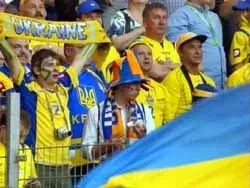
Photo: Ukrinform
To be honest, when the president of the Football Federation of Ukraine, Hryhoriy Surkis, announced his desire to submit a bid to UEFA to host the final stage of the European Championship on our land, the reality of this project seemed utterly unbelievable. It is extremely difficult to pull off such a large-scale undertaking as Euro 2012 alone, which requires about a dozen modern stadiums, hundreds of good hotels, a developed transport network, and much more. At this stage, Ukraine could not handle such a project on its own. But in partnership with someone, as Belgium and the Netherlands already did (Euro 2000) or Korea and Japan (2002 World Cup), and as Austria and Switzerland are preparing to do (Euro 2008), it is worth a try.
In the first round of the tender, quite a few countries participated, including Italy, Greece (which had recent experience hosting the Olympic Games), and Turkey. Only three bids were supposed to advance to the second round. And in early November 2005, Ukraine and Poland made it to the finals!
In the fall of last year, immediately after returning from Malta (where the UEFA Executive Committee was held), Hryhoriy Surkis shared his impressions: “We withstood very strong competition. At least, UEFA’s expert assessments were clearly not in our favor: by almost all indicators, the winners of the first round of the tender were supposed to be Turkey, Greece, and Italy. We decided to jointly submit a bid with Poland, although we understood that our country lacks developed infrastructure, lacks many things necessary to host such a major event. Both Turkey and Greece were stunned by the news that they did not advance to the next stage, even though these countries are practically ready to host the European Championship today. Of course, all applicants have shortcomings. On a ten-point scale, no participating country scored even nine points…
We prepared the bid very professionally and presented security guarantees at a decent level. But everything else indeed does not meet the tender conditions. First of all, this concerns the legislation of both Ukraine and Poland. It needs to be improved and harmonized within the framework of requirements for countries continuing the competition in the tender. For a year, we lived as if in a fairy tale; now we will try to turn this fairy tale into reality. I hope that many of the arguments I presented to my colleagues worked, because in the secret ballot our bid was supported. Italy received 11 votes, Hungary with Croatia – 9, Ukraine with Poland – 7, Turkey – 6, Greece – 2.”
After Ukraine advanced to the second round of the tender, it became clear that this is now a matter of national importance, and the government must give maximum attention to the project, which in any case should give an additional boost to Ukraine’s development. Can you imagine how much needs to be done to prepare for hosting hundreds of thousands of fans during the European Championship? How much the transport and hotel sectors, as well as service, need to be improved? How many new stadiums need to be built and old ones reconstructed?
Of course, compared to us, Italy looks much better in terms of preparedness. It is a developed country with many good arenas, from which a dozen can be selected for matches. There are no problems with hotels, tourist operations are well-established, and there is experience hosting major international competitions – the Olympic Games (Turin 2006), the World Cup (1990), and finals of European club competitions. But at the same time, there are some serious reasons that could work against Italy. For example, the huge scandal that erupted in Italian football and ended with Juventus being relegated to a lower division, and financial penalties for Milan, etc. Moreover, recently news reports about riots at Italian stadiums and violent fan behavior have been too frequent. Europe does not need a championship where anything can happen. Therefore, Italy needs to provide guarantees of maintaining order.
Another downside for Italy is the upcoming UEFA presidential election at the end of January. A downside because the main candidate for this post – the famous former French and Juventus player Michel Platini – intends to correct the imbalances in European football that have shifted towards wealthy clubs: “In my opinion, in recent years there has been a serious imbalance in world football. It was caused by two factors: the influx of very large money and the so-called ‘Bosman ruling’. I cannot calmly accept a situation where talents are bred solely for sale. I do not like that some young footballers are sold for big money even before they have played a single match for their home club. Earlier, when Real Madrid and Barcelona bought a rising star, it happened when the player was already about 25 years old. Now they often buy 14-year-olds. If we put an end to this, many clubs will finally find their own identity. This is one of the main points of my program.”
Platini intends to limit the representation of leading championships in the Champions League and raise the profile of the UEFA Cup, which is in the position of a poor relative. In short, to make European cups align with the philosophy of football, rather than becoming a trough for the rich. In other words, the Frenchman is going to support football in Eastern European countries.
The second candidate for the presidency – the current holder Lennart Johansson – speaks in much the same vein. He also proposes promoting football in Eastern European countries. Moreover, the elderly Swede is helping the region not only in words but also in deeds; the votes from this region will largely determine who will lead UEFA. Experts suggest that victory will go to the younger Platini, who promised Johansson the post of honorary president and promised to consult with the experienced Scandinavian. Surkis prudently maintains excellent relations with both candidates. Recently, both Platini and Johansson came to Kyiv for the opening of the House of Football, which will become the FFU headquarters. Lennart Johansson highly rated the chances of Ukraine and Poland to win.
But we are not the only representatives of Eastern Europe; there are also Hungary and Croatia. Some may consider these rivals unimpressive, yet they have many advantages. For example, Hungary is a full member of the European Union, and Croatia received candidate status in 2004. These countries have a developed hotel network and good transport. There are no problems in the area of labor law, although there are differences in the tax systems of Hungary and Croatia. However, Ukraine and Poland also have inconsistencies in this regard, and we also have a big problem with copyright protection. Overall, the Croatian-Hungarian bid received fewer criticisms than ours. Although the fact that Euro 2012 will be the next continental championship after the one in Austria and Switzerland speaks against our competitors. These countries are located too close geographically to Italy, Hungary, and Croatia. Ukraine and Poland are farther away, which is a plus.
But this alone will not help win the tender. First of all, stadiums are needed. The Poles included Warsaw, Wrocław, Gdańsk, Krakow, Poznań, and Chorzów in the list of candidates to host matches. Moreover, four cities already have arenas, while in Gdańsk and Poznań they are to be built by 2010. In Ukraine, the list of candidates includes Kyiv, Dnipropetrovsk, Donetsk, Lviv, Odesa, and Kyiv Oblast. But quite recently, representatives of Kharkiv came forward with a corresponding initiative, and apparently, this city will replace Kyiv Oblast. Admittedly, Kharkiv's capabilities are much higher, although stadium reconstruction is also needed there. Reconstruction is also needed for the arenas in Kyiv and Odesa. But in Dnipropetrovsk and Donetsk, construction of brand-new super-modern stadiums is in full swing, scheduled to be completed this year. Lviv promises to please with a new one in 2010.
In Italy, a European Championship could already be held in Bari, Bologna, Verona, Genoa, Cagliari, Milan, Naples, Palermo, Rome, Turin, Udine, and Florence. But Hungary and Croatia cannot show a single ready stadium. In Hungary, the Debrecen arena is under reconstruction; they promise to finish in Győr by 2008, and there is no data at all for Budapest and Székesfehérvár. In Croatia, only Split will be ready by 2008, while Zagreb, Osijek, and Rijeka will be ready only by 2010. In short, these guys are lagging behind.
Meanwhile, work in Ukraine does not stop. At the beginning of autumn, UEFA inspectors paid an official visit, familiarized themselves with the state of affairs, and noted positive developments. There is, of course, a shortage of hotels, but by 2012 it is planned to build five five-star hotels and about 30 four-star hotels. The cost of hotel projects in Kyiv is about 3 billion hryvnias, but it will be paid not by the state but by investors, who, according to economic publications, are very numerous.
The issue of transport remains open, since Ukraine and Poland are large countries, and the distances between cities are quite great. But a large territory and numerous population is also a plus, because there is something to show tourists, somewhere to go in free time from watching matches. The main thing is for the state to take care of the comfortable movement of foreign guests – both by air, water, and land. And then – you never know – big football might come to us!