
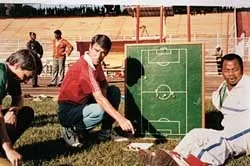
Exactly 20 years had passed by then since domestic specialists last took their teams to the quarterfinals of a world championship. The last time was in 1970, when the Soviet national team played in Mexico under the direction of the famous former coach Gavriil Kachalin. He, incidentally, reached that stage three times – in 1958 in Sweden, 1962 in Chile, and 1970 in Mexico. But the most successful coach of the Soviet team in the context of the World Cup is Nikolai Morozov, who in 1966 just missed the podium, finishing fourth.
However, that was a long time ago. Everything has already faded from memory; new generations of fans have grown up, and our teams have hardly delighted them at World Cups. In 1982 they performed dully, in 1986 the refereeing went against us, and in 1990 they got into shape too late. Then the Russian national team played, but even it in 1994 and 2002 could only manage local successes. Such as, for example, Oleg Salenko's five goals in the match against Cameroon in 1994.
No matter how you look at it, the most successful coach in the post-Soviet space over the past 25 years should be considered Valery Nepomnyashchy. But one had to learn about him mainly from news agency reports. After all, this specialist was never offered a job in his homeland – despite that very success with the Cameroon team in 1990. In that African country Nepomnyashchy was almost worshipped, while in Russia, to which he gravitated after the collapse of the Soviet Union, they tried not to notice him. Why? He himself does not know. And so he worked his entire life abroad – in Cameroon, Turkey, Korea, Japan, and China. And in January 2006 he took over the Uzbekistan national team (together with Tashkent's Pakhtakor), which includes Dynamo Kyiv forward Maksim Shatskikh. Moreover, Nepomnyashchy faced competition in Uzbekistan from another well-known specialist – Vitaly Shevchenko, whose track record includes Bolivia and Israel.
So that's what you're like, Cameroon!
Valery Nepomnyashchy was born on August 7, 1943, and ended his playing career extremely early – at age 24. As was often the case, injuries let him down, and the forward for Ashgabat's SKIF and Samarkand's Spartak had to move into coaching. Naturally, the young specialist's path was not strewn with roses. But already in 1970 he became the head coach of the football school of the Turkmenistan Sports Committee and held that position for eight years. In 1979, Nepomnyashchy tried his hand with a professional team, taking charge of Ashgabat's Stroitel, but in 1983 he returned to the football school of the republic's sports committee. It was from there that he was invited to Cameroon in 1988.
In the well-known book by Vladimir Abramov, "Football. Money. Money Again," the following is said about this departure: "And so the football coaches Brovarsky and Nepomnyashchy went to work in Cameroon. But, of course, not for $1,500 a month (that would have been outrageously high money for Soviet citizens at the time), but for $700, according to their fourth pay grade, in line with the salary scale for Soviet citizens working abroad approved by the USSR Ministry of Finance. That is, Nepomnyashchy received one and a half thousand in cash, kept 700 for himself, and immediately handed the rest over to the Trade Representation's cashier. Such were the rules then..."
Lev Brovarsky, a well-known former midfielder for Lviv's Karpaty, left a less noticeable mark in foreign football and soon returned to Ukraine. But Nepomnyashchy turned out to be a real messiah for Cameroon. At the same time, the coach himself claims that he could well have ended up not in this country, but in some other: "Cameroon was not the only option. I was processing paperwork for Algeria, Tunisia, Suriname. In African countries I was offered to head club teams. In Suriname – the youth national team, in Cameroon – the national team, which in 1988 under Claude Le Roy became the African champion. I remembered the Cameroonians from the 1982 World Cup in Spain, when they drew all three matches. I agreed to go there with great pleasure."
In professional terms, I wasn't afraid of losing anything. First, I wasn't going to unload cement from train cars, but to do professional work. It was important for me to enrich myself, and I consider myself a rich person professionally.
Many people are afraid of Africa – because of wild animals. In fact, Cameroon is not Kenya, where there was indeed danger. In our case, we only had to be wary of snakes. Fortunately, they didn't crawl into the house, but into the yard – quite often. Once I happened to kill a snake while taking out the trash.
But worse than snakes is the Cameroonian climate. There is never any heat there; the temperature is plus 19-26 degrees Celsius. Rainy seasons and pressure changes take a heavy toll on the body. Many people died after Cameroon. Or else there were malaria troubles. Malaria affects the weakest organs. Fortunately, after having it twice, I had no consequences. But my wife developed heart problems after malaria.
On the Brink of Dismissal
Getting used to the new climatic conditions proved to be no simple matter, but that is only one side of the coin. The second is the peculiarity of the training process in Cameroon.
"Africans are careless people," asserts Nepomnyashchy. "They significantly lack discipline. In China, for example, football players come to training in formation and report that they are ready for practice. But in Cameroon ... Once there was supposed to be a meeting with the president of the football federation. We agreed on the morning. Cameroon lives from six in the morning to six in the evening. I think: wake up at six, breakfast. By eight o'clock, then, the man should arrive. In the end I waited for him until half past twelve. I ask: 'Why did you come so late?' And he replies: 'We agreed on the morning...'"
The national championship match never started on time when I was there. A half-hour delay is mandatory. We were holding the final meeting of the Central African countries' championship. The start was at four in the afternoon. We were getting the players ready, the 80,000-seat stadium was packed to capacity. It turned out that at the same time a meeting of the presidents of these countries was taking place. While they discussed all business and had lunch, the footballers managed to have a nap on the benches. And the whole stadium waited for them to appear until seven in the evening!
Cameroon played the first two matches of the World Cup qualifying tournament unsuccessfully. In two games with Nigeria and Angola, only one draw was obtained. On the eve of the away match with Gabon, the situation was tense. Much depended on this result. The day before, after the evening training session, Nepomnyashchy was read a list of eight footballers compiled by a special committee under the country's president. They said that it was exactly these players that the national team lacked, and therefore they had to start in the opening lineup in the match with Gabon. Time for reflection was given until the morning. The Soviet coach, not wanting to aggravate the situation, selected three from the proposed candidates who could really be put into the lineup. And he won – 3:1, after which the Cameroonian team successfully passed the entire qualification and made it to the World Cup.
Interestingly, on the way to Gabon, Cameroon's Minister of Sports tried to negotiate with Nepomnyashchy: "Monsieur Valery, let's do this: if we lose, you will immediately fly to Moscow, and I will fly to Paris. Because after two consecutive defeats, it is better not to return to Yaoundé." The coach agreed and asked to arrange his wife's flight to Moscow through the Soviet embassy. Fortunately, extreme measures were not needed.
Order, street, telephone
And at the World Cup itself, the Cameroonians caused a sensation, almost breaking into the semifinals. Moreover, the heroes of the nation were not the players who performed in France and were highly rated, Omam-Biyik and Bell, but the 38-year-old veteran Roger Milla: "As a footballer, in my opinion, he is brilliant and should stand in the same row as Pelé, Platini, Maradona and Cruyff. Before the World Cup, Roger had not played for two years. He refused my requests to join the team and arrived at the training camp only after the president of the country addressed him. Milla came out for the first training session, received the ball, beat three players in one movement, and at that moment even a non-specialist would have recognized that he is a great player.
I gave him the opportunity to train on his own, but it was unrealistic to fully prepare in the remaining month. We agreed that he would come on as a substitute regardless of how the match went and play for 30-45 minutes. If Roger could have played all 90 minutes, we would have performed differently at that championship.
I consider the meeting with Milla, who, by the way, supported me in a difficult moment when a conflict broke out in the national team, one of the main events in my football life. When I was leaving Cameroon, Roger suggested at parting that we meet at World Cup 94. I did not believe that he could play for the national team at that age. But he again took the field and, by the way, scored a goal against the Russian team."
The Cameroonian players celebrated the defeat by England in the quarterfinals… with dancing. They danced all night. For them, this was and remains to this day the highest achievement. Incidentally, Nepomnyashchy years later compared the Cameroonians with the Koreans: "In Korea, defeats are experienced much more difficult. It is embedded at the genetic level: if they saw the coach's dissatisfaction, and even more so if he began to put pressure on them, then they will be terribly hard to recover from psychological shock. Only over time will they thaw out. By the way, the Dutchman Guus Hiddink perfectly mastered the art of bringing the Koreans out of this 'spin.' He performed a miracle. He freed them from the main Korean complex – the fear of losing…"
At home, the Cameroon team was met solemnly. A motorcade of cars drove around Yaoundé. The footballers were driven around the whole city, everywhere there were crowds of people, children. They pulled the players out of the cars, everyone considered it necessary to touch the celebrities, and on the Soviet coach they tore his jacket.
One of the streets was named after Nepomnyashchy – "Monsieur Valery." Cafes and restaurants also began to be called that. He was awarded the Order of the Legion of Honor, and the coach also entered the number of "untouchable" people: Cameroonian laws did not apply on the territory of their house. Valery Kuzmich did not receive bonuses, because it was not supposed to be under the contract. But he managed to get a telephone.
To meet with dog meat
In the same 1990, Nepomnyashchy said goodbye to the Cameroon national team. Until 1994, he worked in Turkey with the teams Gençlerbirliği and Ankaragücü, had offers from Africa on the eve of the 1994 World Cup, but refused and headed the Korean Yukong, which he managed for four seasons. Then there were Chinese Shenyang, Japanese Sanfrecce Hiroshima and Chinese Shandong and Shanghai Shenhua. In the last club, Nepomnyashchy worked until November 2005. By the way, he learned French (for communication in Cameroon) and Turkish quite quickly and easily. But the coach did not dare to conquer new heights and become a polyglot further. He did not study Korean, Chinese and Japanese languages. However, this did not prevent him from winning the Korean Cup, bringing Hiroshima to a record third place for it in the Japanese championship, being recognized as the best coach in China in 2000 and receiving the prize "For contribution to the development of Korean football."
Having worked in three countries located close to each other, Nepomnyashchy, who has plenty to tell about life in the Far East, noted some peculiarities of the Chinese, Koreans, and Japanese: “Football players in Asian countries are distinguished by discipline and diligence. That is indeed so. But there were exceptions. This is especially true of clubs from northern China. The influence of the Russian mentality is very strong there, so people drink a lot and do not like to work. Football players treat their business accordingly. However, similar episodes occurred in Korea as well. For example, during one training session, I yelled at one of the players through an interpreter, saying that he, like, does not run around the field at all. When the phrase was translated into Korean, one of my assistants suddenly ran up to the ‘slacker’ and hit him on the neck! I was shocked by such methods of upbringing, but for Koreans, as it turned out, assault is a common thing."
Interestingly, neither the players nor the assistants asked me any questions. They listened to instructions and carried them out silently. Only after six months did they begin to say: “Ah, now it is clear why we are doing such and such exercises today, and tomorrow we will work according to a different method.” But then questions did appear. Moreover, in different countries this happened differently. The Japanese, for example, first sent a delegation of several people, my assistants, to me. And only then did each one begin to come up and meticulously inquire about every little detail. And not only of me. That is why Japanese football progresses faster than Korean. And that, in turn, develops faster than Chinese. And do you know why? The Chinese mainly have questions like: “Why was I not put in the lineup? How am I worse?” And resentments, and corresponding statements in the press…”
But in China, Nepomnyashchy tried dog meat, quite by accident. The club buffet had a smorgasbord, and the Russian ate from it without a second thought: “The assistants are looking at me with wide eyes. But nothing, I swallowed it. It resembles turkey, rather tough meat. In general, we have a wrong idea of how Koreans eat dogs: it is a ritual. Nobody grabs stray mongrels on the streets. There are special kennels where they breed dogs similar to chow-chows. But we eat pork, and a pig is also a domestic animal! In Turkey, before some important moment, it is customary to slaughter a ram and distribute the meat to the poor, and in Korea it is approximately the same with dogs. Dogs are more often eaten in the summer. They say it helps to endure the heat, but in winter they do not touch them.”