
Photo: epa
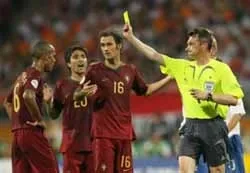
At the World Cup there is a scandal. Quiet, but extremely unpleasant and with far-reaching consequences. FIFA President Joseph Blatter issued a virtual yellow card to Russian referee Valentin Ivanov for the Portugal vs Netherlands match, during which Ivanov, having shown players 16 yellow and 4 red cards, entered the history of World Cups as a record holder. And although FIFA rejected the Portuguese complaint about Ivanov's refereeing, the aftertaste remained. Moreover, it was such that in all subsequent matches referees were simply afraid to show cards even when fouls were obvious. Nevertheless, in my opinion, Ivanov indeed failed the match, no matter how much the Russian and even international public defended him. If players fight on the field, the referee is always to blame. If on the television screen the referee appears more often than the footballers, that is also indirect evidence of a fiasco.
But the matter is not only about Ivanov. Blatter himself is also to blame for this failure, having shown the 'yellow card' not to Ivanov alone, but to football refereeing as a whole, and therefore to himself. Before the start of the tournament, referees received directives on the interpretation of rules, which in itself is highly curious. It turns out that for the same violation one can be punished differently, or not punished at all. That is where it all began. Referees were asked to be stricter and to punish particularly harshly for tackles from behind and time-wasting. In other words, everything Ivanov did was merely strict adherence to these directives, a kind of Japanese strike, when workers start doing everything according to instructions. As a result, all activity at the enterprise freezes, because instructions tend to contradict each other and common sense at the same time.
Perhaps the referee's skill consists in setting a certain level of strictness and making the players themselves understand it. But then directives are meaningless, and football will remain as it so often appears in recent years - a rather dreary spectacle with a minimum of goals. It is dreary because there is far more fighting than artistry, and defense prevails over attack, often by unfair means. Many clubs, including the grandees, quite officially and willingly use the so-called small foul tactic. The opponent is simply brought down on his own half of the field, before he has crossed into the other half. A paradoxical situation arises: a free kick is advantageous to the one who broke the rules, because while the ball is placed and put into play at a respectable distance from the goal, the violators all together move closer to their own penalty area, and it becomes much harder to score against them after that.
I believe that FIFA's directives were aimed primarily at this very evil. But the Netherlands vs Portugal match showed with complete clarity that if one officiates taking into account the new trends, a situation may arise when one of the sides is left with fewer than seven players, after which the match, according to FIFA rules, must be stopped. It turns out that one has to fight with a glance over one's shoulder, and the roughnecks sense that very glance perfectly. This is contradiction number one. The second is that referees, even the best ones, simply cannot keep up with what is happening on the field. At this championship, referees have already made a dozen errors that affected the results of matches. There are also simply wild blunders. The famous English referee Graham Poll showed two yellow cards to Croatian Josip Simunic in the match against Australia, but forgot to send the player off. The Croatian players tried to prompt the referee, but he could no longer do anything. Referees are strictly forbidden to admit their own mistakes, even such ones. As a result, an historic anecdote occurred: Poll warned Simunic for the third time and only then finally sent him off. There is no need to mention the smaller but significant absurdities. The English scored a winning goal against Trinidad and Tobago in violation of the rules. In the Korea vs France match, the referee did not notice that the ball had crossed the goal line of the Asian team. In the Ukraine vs Tunisia game, his colleague awarded an unjustified penalty against the Arabs and did not punish a Ukrainian player for handball in his own penalty area.
Had it not been for these and many other errors, the group tables would have looked different, and other teams could have made it to the playoffs. FIFA takes a philosophical view of such things. Referees' mistakes are part of the game, the football officials are wont to say. Although in relation to people who, perhaps for the only time in their careers, get a chance to play at a World Cup, such "unbearable lightness of being" is simply beastly. I am not even talking about the fans, who sometimes even die in front of television screens. It is common knowledge that during final tournaments the number of cardiovascular diseases sharply increases.
A legitimate question: how can errors be avoided? After all, man is not a machine and does not possess the eye of an eagle and the speed of a cheetah, yet the current state of affairs simply obliges referees to combine all these qualities. On the huge rectangular field there is only one head referee and two assistant referees, while a tennis match, taking place on a tiny court, is served by up to fourteen umpires (!) and an electronic system to boot. Why in hockey is there a special referee behind the goal watching only whether the puck crossed the line, whereas in football, for forty years now, they have been arguing about where the ball bounced off the crossbar of the Germany team's goal in the 1966 championship final, and whether the goal was correctly awarded? A man of advanced years, in order to keep up with the course of events, has to dash after guys who are much younger than him. It would be fine if it were just after the guys - but after the ball, which flies even faster. Is he truly capable of getting to the scene if a player has made a pass of some forty meters? Does anyone still wonder at the number of errors? And so we get a wild picture. In basketball, three referees oversee ten players, while in football the same number oversee twenty-two. This is an absolutely superhuman task, and the World Cup has once again proved it.
The spirit of the game and traditions are in some cases confused with plain stubbornness. FIFA clings with a drug addict's desperation to another ancient football attribute - "dirty time." Football is the only sport where the clock is not stopped during inevitable pauses. All this leads to ugly antics by some footballers who, eager to bring the final whistle closer, roll on the grass feigning unbearable suffering, then get up and, after limping for decency's sake, briskly dash forward. And what about substitutions a minute before the end of the match? The player coming on is unlikely to touch the ball, but while he comes on, a minute or two will be stolen from the spectacle in the name of the result. Have you ever seen such fakers in hockey? They say that "dirty time" exists thanks to television, which supposedly requires strict time frames for broadcasts. If so, why do we watch both hockey and basketball, where there is no trace of "dirty time"? Or tennis and volleyball, where there is no time at all, and they play by score. And how does stoppage time, extra time with a penalty shootout, which successfully breaks the broadcast schedule, fit into that argument? No way...
It is just that football rules are changed extremely reluctantly. Over the entire one-and-a-half-century history of football, this has happened essentially three times. In the mid-1920s, the offside rule was adjusted, and much later - in the 1980s-90s - two more changes were introduced: goalkeepers were forbidden from picking up the ball with their hands after a pass from their own player, and several balls began to be used to stop footballers from kicking the ball into the stands to waste time. FIFA does not decide on any other changes to the rules, including the main one - the use of video replays, which could resolve many questions. But it is better not to talk about this subject with football specialists and many fans. This is That-Which-Cannot-Be-Spoken. "Leave everything as it is," they insist. But every year the situation will become ever more complicated, because speeds increase, tricks become more sophisticated, and FIFA will still have to find a way out. The whole question is whether it is possible within the framework of the already well-worn and frayed rules of the great game.