
ADIEU, CONSTITUTION?
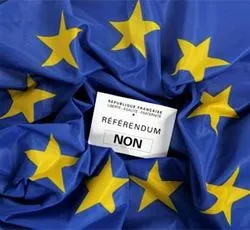
Chirac was helped neither by the most powerful advertising campaign nor by broad international support. In vain did German Chancellor Schroeder and Spanish Prime Minister Zapatero come to Paris on the eve of the referendum (the latter, as a representative of a people who had approved the EU Constitution in their own referendum, was supposed to inspire their neighbors by personal example). Neither the round dances of European Parliament deputies in front of the National Assembly building in Paris, nor the fiery appeals of the luminaries of European literature and philosophy changed the situation. The French "Non!" to the European Constitution turned out to be as final and irrevocable as the strike of a judge's gavel concluding the reading of a verdict.
There are many reasons for such rejection. It should be noted that in this case the victory in France is celebrated not so much by the right-wing radicals of Le Pen's Front National, but by the left-wing party bloc: socialists, communists, and independent trade unions such as Attac. It was their argumentation, which frightened the citizens of the Fifth Republic with dire visions of mass impoverishment, total dependence on "neoliberal bureaucrats from Brussels," and the loss of France's importance in Europe, that worked to the full extent.
For Chirac himself, who repeatedly stated that he "staked his good name and his political career on this referendum," no particular consequences are foreseen. The president remains a quite popular politician, and official Paris does not even hint at the possibility of his resignation. Everyone expects that for Chirac's miscalculations the quite unpopular prime minister of the French government, Jean-Pierre Raffarin, as well as several other ministers, will pay. It is they who are destined to become, in the eyes of public opinion, the scapegoats that the French president will sacrifice.
For the European Union as a whole, however, the consequences of the French referendum turn out to be far more severe. It can even be argued that a quite serious crisis has matured in the EU, the first since the "big enlargement." France became the tenth country out of 25 to decide on the European Constitution. Theoretically, the French "no" should automatically mean that the EU's fundamental law in its current form cannot be adopted as such. That is, all subsequent ratifications in the remaining 15 countries lose their meaning, including the result of the Dutch referendum on June 1.
Nevertheless, already on Monday, May 30, European Commission President Jose Manuel Barroso stated that referendums and votes in the remaining 15 countries will be held as planned. The entire process will last until the end of next year, after which, according to the head of the European Commission, "we will see where we land." When asked why it is necessary to hold seemingly useless events, Barroso replied in the sense that one should adhere to democracy and give everyone the opportunity to express themselves before making a final decision.
According to the fashionable prose writer Viktor Pelevin, modern democracy has nothing in common with ancient democracy. The name of the latter comes from the ancient Greek word "demos" - people, while modern democracy traces its etymology to the English phrase demo-version. These are exactly the thoughts that creep into one's head when one hears what decision was made in Brussels immediately after the announcement of the results of the French referendum. Voting will continue until the end of 2006, after which in countries that voted against the adoption of the European Constitution, repeated votes will be undertaken - the recalcitrant will be given, so to speak, an opportunity to come to their senses. It is clear that in countries that said "yes" to the Constitution, no re-vote is planned. Besides France, according to forecasts, at least Great Britain and the Czech Republic may speak out against the EU Constitution, and the results of the French referendum may have a decisive influence on the outcome of voting in these states.
With its decision, official Brussels seriously undermines confidence in the very foundations of European democracy. After all, the path of changing the text of the Constitution so that it becomes more acceptable to opponents of the fundamental document was immediately rejected by the European Commission.
The pressure that may be exerted in the future on countries opposing the European Constitution will become a powerful impetus for the development of centrifugal processes within the EU, while the constructive and only necessary processes for the very existence of the Community are exclusively centripetal ones. In the foreseeable future, one should not expect the collapse of a united Europe, but a rollback to the times when the EU was not so much a political as an economic entity is quite likely.
The referendum in France confirmed a conclusion that had been drawn more than once. The unbridled expansion of the EU to the East, the queue of new candidates (among which Turkey plays by no means the last role in frightening Europeans), the strengthening of the role of the Brussels eurocracy - all these factors negatively affect the image of a united Europe in the eyes of the Europeans themselves.