
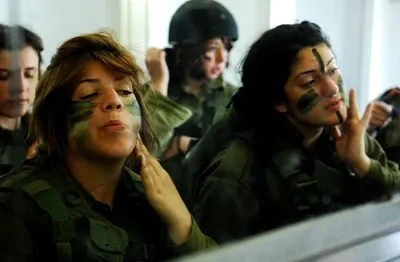
Women in the Israeli army will soon be fully equalized in rights with men
It is traditionally believed that women are conscripted into the Israeli army not exactly out of a good life – this is a consequence of the huge disproportion in the numbers of Jews and Arabs in the Middle East. In terms of population (and accordingly, the size of the mobilization resource) Israel is 35 times smaller than the Arab states bordering it!
However, having put women 'under arms' at the dawn of Israeli statehood, the country's authorities did not at all intend to fully equalize them in duties with their male colleagues. The conscription of girls into the IDF (Israel Defense Forces) increases the combat capability of the armed forces not through a mechanical increase in the number of people in uniform. First of all, it allows most guys to serve in combat units rather than hanging around in rear positions. Different service terms were established depending on gender: for women – about two years, for men – about three years.
However, times change. Just as in ordinary civilian life women increasingly dislike the role of housewives – keepers of the hearth – so in the army they are increasingly burdened by rear positions. The struggle for the right to serve on par with men lasted a long time. Only in 1994 did the Supreme Court of Israel rule that female soldiers could serve in a number of combat units. And only in 2000 were girls allowed to serve in infantry, artillery units and the navy.
Of course, the majority of female soldiers do not serve in combat units – according to statistics, no more than three percent of conscripted girls serve there. Sometimes it happens that a female instructor teaches guys how to handle a combat vehicle, but she is not allowed beyond the training ground. Many female soldiers hold positions as sniper instructors and parachute instructors, and often perform their duties better than men. For example, sisters Tanya and Alevtina Kovaleva, who moved to Israel from Mytishchi near Moscow, serve as parachute jumping instructors at one of the army bases. Their commander, Colonel Haim Kolon, in an interview with a correspondent of Novye Izvestia, praised the sisters for their special patience, accuracy, and ability to find an approach to each of their trainees.
Be that as it may, the IDF is the most feminized army in the world. Women make up at least a third of military personnel. Moreover, the awareness that serving in the army is prestigious is common not only among Israeli men but also among women. Even girls from ultra-Orthodox families (and ultra-Orthodox are exempt from conscription by law) sometimes become soldiers voluntarily, against their parents' wishes.
Not long ago, Israeli newspapers wrote a lot about an American woman, Sarah Ehrental, who literally ran away from her parents in Brooklyn to serve in the IDF. Her parents belong to the ultra-Orthodox Jewish community 'Neturei Karta'. Members of this community do not recognize Israel. According to their views, the Jewish state can only be recreated by the messiah, not by mortal people. Sarah Ehrental was not even stopped by the language barrier: members of Neturei Karta speak only Yiddish – the language of European Jews – while Hebrew, the state language of Israel, is declared sacred and used exclusively in worship.
The most famous modern female soldier outside Israel – Vancouver native Jill Rosenberg – is to some extent a legendary figure. She was born in 1983, graduated from the Faculty of Aeronautics and Aviation at the Technology School in British Columbia, Canada. In 2008, she moved to Israel and voluntarily joined the IDF. After demobilization, she went to Iraq at her own risk and fought for eight months in the ranks of the Kurdish Peshmerga militia against militants of the Islamic State. And she fought there on equal terms with men.
Of course, even with the introduction of the same service term, male and female soldiers will not be equalized one hundred percent. For example, the army regulations still provide for the immediate demobilization of a woman in case of pregnancy. If a girl arrives in Israel after the age of 17, she is not conscripted. It is believed that if girls are not brought up with readiness for army service from childhood, they may have many problems in the army, primarily psychological. In addition, the regulation has not been abolished: women are thrown into battle only as a last resort, when there is no other way to repel the enemy.
Finally, Israeli girls will not break the law if they choose alternative service over army service. This opportunity is often used by girls from Orthodox religious families. By the way, those who belong to ultra-Orthodox families often get married just at the conscription age, and for them even alternative service is optional.