
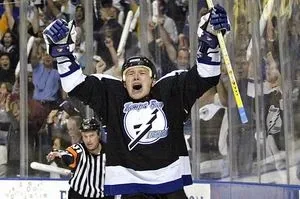
Ukrainians watched the fights of Tampa holding their breath, and fans fanatically devoted to hockey did not spare their time and tried not to miss the night matches (they began at three in the morning Kyiv time), in which a stubborn struggle unfolded. And although there were not so many clubs in Kyiv where at such a late (or early - as you like) time one could sit down and, with appropriate drinks, watch a live broadcast from 'there', the most persistent did not miss their chance.
And in the morning after the seventh decisive match of the final series, they grabbed mobile phones and with shining eyes told how Fedotenko, who was hunted by the enforcers of Calgary, still managed to find a moment to deliver two unstoppable shots at the goal of the Finn Kiprusoff; how Russian goaltender Khabibulin (nicknamed the Wall of Bulin for his reliable play) made incredible saves. Tampa won, becoming the second team in Stanley Cup history to come back from a 2:3 deficit in the final series (the score, I recall, is played up to four wins).
It is very pleasant that a Ukrainian hockey player made a significant contribution to the victory of the American team, which before the start of the season ranked only 22nd in the NHL in terms of payroll, and after winter transfers - 17th. Having significantly improved his scoring performance compared to the regular season (12 goals in 22 matches vs 17 in 77), Ruslan became one of the main heroes of the playoffs and did not receive the most valuable player award only because, in terms of total merit, this trophy went to his teammate Richards. Although, to be honest, many believed that the Russian goaltender Nikolai Khabibulin would become the winner of the honorary award.
It is a pity, of course, that Fedotenko was not honored, but that breakthrough into the ranks of elite hockey players of the strongest league in the world, the NHL, which he made, is worth a lot. After all, Ruslan, if you think about it, made it to the NHL exclusively through his own determination, persistence and hard work. Everyone knows the annual draft procedure - the actual distribution of the best young talents from around the world among the clubs of the National Hockey League. It is generally accepted that just being drafted already indicates the considerable potential of a hockey player, and those who did not go through this rite cannot be stars by definition.
Ruslan refuted all postulates. The front door to the NHL turned out to be closed for him for a number of reasons, and he decided to enter through the back door. The journey took a little over four years and ended with Fedotenko making his NHL debut in October 2000 as part of the Philadelphia Flyers in a match against the league's richest team, the New York Rangers.
The future Stanley Cup winner played little at home. If we do not take into account matches of youth championships and all sorts of Spartakiads, but take into account only games as part of master teams, then Fedotenko has only one season to his name. As part of the Kyiv Higher School of Sports Excellence, which has sunk into oblivion, he took part in the premier championship of the East European Hockey League, and also managed to appear in two games of the dying Interethnic Hockey League in the uniform of Sokil.
Every year, a large group of young (and not so young) guys from Kyiv and Kharkiv set off and continue to set off to different countries in search of their hockey happiness. Fedotenko's peers, among whom there were many talents (Alexander Zinevich, Konstantin Kasyanchuk, Dmitry Tolkunov, Alexander Yakovenko and others), chose one path, Ruslan - another. Quite unusual: at the age of 17 he went to Finland, where Ukrainian hockey players did not go then (and the situation has not changed now). He himself recalls the move: 'At that time my agent was Mark Gandler, who, given the low level of Ukrainian teams, advised me to move to the West. Like, Western scouts do not particularly track Ukrainian clubs. Gandler found me an option in Finland. And I was still a little boy then: they told me, and I went. It was hard: I lived alone, in a foreign country, without friends, not knowing the language at all.'
They say about Fedotenko that he was not an incredibly talented and super-productive forward. In youth teams he played in the second or third forward line, that is, he was not one of the first-rate players, and got his way through hard work.
In Finland, Ruslan met the legendary Ukrainian hockey coach Anatoly Bogdanov, under whose leadership Sokil in 1985 won the only medals in its history in the USSR championship - bronze, and the Ukrainian national team performed for more than one year in the elite division of world championships.
Anatoly Vasilyevich helped his compatriot as best he could - he gave professional tips, watching TPS's training sessions and games, taught him the intricacies of the Finnish language (especially hockey terminology), and assisted in solving everyday issues. In addition, the respected specialist reminded coaches of various youth and junior teams that there is a hockey player like Fedotenko, who is progressing while playing in Finland. And as a result, simultaneously with the Russian coach of TPS, Vladimir Yurzinov, the Ukrainian coach Anatoly Bogdanov advised Ruslan to move to Canada, to one of the youth leagues. Like, it is there that one can become a true master of one's craft, NHL club scouts will see him more often, and accordingly, he can get drafted.
The coaches' opinion, of course, can be disputed, because many Ukrainian (and Russian too) hockey players, having gone to North America in search of their Klondike, went missing, unable to cope with competition or unable to withstand the transition from our poverty to their satiety. The vast majority thought that they had caught the firebird by the tail, that they could stop striving for anything else. And with that, one could put an end to their hockey biography.
To our delight, Fedotenko turned out not to be one of those who settles for little or loses heart at the first difficulties. In his first season he showed quite high scoring efficiency. The next year, having changed teams, he raised the bar even higher. At the same time, he not only scored a lot, but also fought for his future, standing up to the local goons who were trying, "over dead bodies," to make a career for themselves as an enforcer ("policeman," or simply a hockey bouncer). In that championship he earned 139 penalty minutes, but he held his own.
The stubborn Ukrainian was noticed at the top. The management of Vancouver even intended to put Fedotenko through the draft sieve, but for some reason did not fulfill its promise. And Ruslan, confirming the folk wisdom that whatever is done is for the best, ended up in the training camp of Philadelphia.
Here is the player speaking: "Vancouver promised to draft me, but for some reason did not do so. I was already upset, but then Philadelphia invited me to a summer camp for rookies and free agents. Similar invitations came from the St. Louis Blues and the same Vancouver Canucks. At the same time, the Bluesmen wanted to see me at the main preseason camp together with the main roster, and the Canadian club, frankly, after the draft story, I did not quite trust. As a result, I went to Philadelphia, although if it hadn't worked out there, I still had the opportunity to try my hand in St. Louis. Their training camp started later."
Already after a season spent in the Flyers' farm club, Fedotenko received a call-up to the main team. His first season in the NHL turned out to be quite successful. For a rookie. And he managed to score his first NHL goal against the legendary Czech goaltender Dominik Hasek. "In my, if I'm not mistaken, third match in the league, we met with Buffalo, and I scored a beautiful goal against Dominik Hasek. I was going for the rebound, one of the defensemen tried to stop me, and I in a fall - I don't know how myself - managed to push the puck past the Dominator. One of my teammates immediately took the puck out of the net, and then the team presented it to me on a special plaque with an engraving. It was very pleasant. That plaque still stands at my home in a prominent place." In total, that season Ruslan hit the opponents' net 16 times and scored 36 points.
And later, coach Bill Barber and general manager Bobby Clarke expected that the team's successful find would show itself even brighter. But Fedotenko's next season turned out to be not the most impressive - only 26 points in 78 matches. Not surprisingly, on the eve of the 2002 draft, Philadelphia made a trade with Tampa: our Ruslan went to Florida, and the Flyers received a fourth-round draft pick. Philadelphia's new coach Ken Hitchcock knew practically nothing about Fedotenko, and therefore was not too upset by the departure of the dark horse. If only he knew when he would have to get closely acquainted with the Ukrainian forward...
When Lightning general manager Jay Feaster preferred Ruslan to the talented Finnish defenseman Joni Pitkanen, many could not understand what this man was guided by. However, now all questions have been removed. And recalling the moment of Fedotenko's transfer, Tampa's coach John Tortorella says that he listened to the opinion of that same Bill Barber, who shortly after being fired from Philadelphia was hired by... the Lightning.
Barber was convincing in his words: "You can't find a better option than Fedotenko! I really liked the guy. Sensible, he catches everything on the fly. He always carried out my instructions one hundred percent. It's just that it wasn't often possible to put him in the lineup - we had star upon star. Taking Fedotenko, you will get a talent that will reveal itself in the near future." Tortorella listened and did not regret it. And soon after winning the Stanley Cup, he even called Ruslan one of the symbols of the team: "He personifies the players thanks to whom we came to long-awaited success. In each subsequent match we needed someone new who would 'shoot'. Opponents never knew on whom to focus attention. The guys alternately put in super matches. We need guys like Ruslan!"
It remains only to add that in the Stanley Cup semifinal, Tampa met Philadelphia. The Floridians beat the Flyers, and Fedotenko reminded Bobby Clarke and Ken Hitchcock of himself with six (!) goals. Although he says that he does not hold a grudge against his former club...