
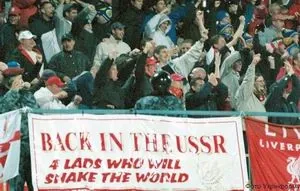
Football is a game of millions. Everyone is familiar with this thesis. Football matters are talked about, perhaps, more, more often, and more diversely than all other sports combined. And therefore, the antics of football fans inevitably attract the attention of the broadest segments of the population. As in their time - student demonstrations, semi-legal rock concerts, and other social phenomena. On the territory of the USSR, the fan movement began to develop rapidly only after the collapse of the Union (although in the 80s fan groups began to be created in Moscow, Leningrad, and Kiev). In Europe, active football supporters - namely, they are called fans - have a much richer and more ancient history.
British fans are shrouded in true legends. Moreover, English, Scottish, Welsh, and Northern Irish supporters - despite being citizens of one state, Great Britain - manage to selflessly root exclusively for their own compatriots. And when, say, England plays Holland or Germany, the Scots are ready to give their votes to both (but against the English!). Great Britain is sick with football. In the good and bad sense of the word. Only on the foggy Albion can they support their team like that, so harmoniously chant songs throughout the entire match. But in exactly the same way, the English and other Britons can be credited with an almost exclusive right to the ability to organize mass riots, which sometimes reached the scale of bacchanalias that defied control and understanding from the point of view of common sense.
A hefty, well-fed, endlessly self-satisfied, up to his neck in beer, self-confident and proud of the team to which he has given his heart - this type of English football fan has long been imprinted in the minds of those who are even a little interested in football matters. The invasion of English fans had to be survived like a natural disaster, like a locust invasion. True, sometimes these invasions were accompanied by tragic outcomes. As, for example, in 1985 in Brussels, at the Heysel Stadium, when in the final match of the European Champions Cup the Italian Juventus and the English Liverpool were to meet. British fans caused a gigantic crush on one of the stands, which led to the fact that a huge human mass piled onto those who were in the lower rows and were pressed against the metal bars of the fence separating the field from the spectator seats. One of the walls collapsed, 39 fans lost their lives, and the footballers, shocked by the terrible spectacle, barely decided to continue the match. English clubs were suspended from participation in European cups for five years, but, as you yourself understand, it was not so easy for the British to get rid of the stigma of incorrigible hooligans.
In England itself, they managed to cope with violent football fans. To do this, the police had to move from purely forceful methods, which often provoked retaliatory aggression, to more flexible ones. The introduction of informers into fan ranks, the creation of a database containing everyone who has ever distinguished themselves at the stadium or near it, and other strategic decisions made it possible to obtain a wide variety of information about planned actions and their main instigators. And to know, as the generals of antiquity said, is to half win. The violent behavior of the English gradually subsided (here it is also worth mentioning the fact that the fashion for too active manifestation of a feeling of hatred towards the opponent gradually passed).
But in Europe, rightly appreciating the “talents” of the islanders, they do not forget to hedge at every convenient opportunity. And fan groups from other countries, trying to outdo the English (remember, as in the USSR - catch up and surpass?) and prove their high class, every time found a way to start a fight. The British became victims of their own not-so-good fame - in a figurative sense. And, worst of all, in the literal sense. Now “hunting” for the English is a favorite pastime of fans from other countries. In Turkey, it even came to stabbings and fatalities. If earlier English officials tried not to let their fans out of Great Britain only because they could misbehave, now the English government began to issue recommendations: they say, it is unsafe abroad nowadays, think about your health...
Now in Europe one can fear everyone - especially immigrants from the former socialist camp and representatives of the emotional south. The only truly harmless representatives of the fan world are Scandinavians. In Portugal, one could admire the Danes and Swedes: slender columns of red-white or yellow-blue shades, not hiding their good mood after drinking beer or some mild drugs, paraded through the streets like detachments of pioneers from demonstration schools. The most genuine pacifists from northern Europe showed the whole world that you can root for your team without aggression towards the opponent.
However, at Euro 2004 all the fans behaved quite decently (well done organizers!). What else can be said if a group of English fans (imagine a squad of heavily drunk Britons) was terrorized by a single pickpocket thief from Ukraine?! What is left of the glory of British hooligans? Just a name, if a group of adult men, fearing one opponent, turned to the police for help. Unfortunately, the police also turned out to be helpless: not the best representative of Ukraine, without much hesitation, sent one of the Englishmen to heaven with a knife...
One could spend hours talking about the various "feats" of fans from different countries. At the same time, mass brawls involving hundreds of fans are child's play compared to the ingenuity of some groups. In Italy, at one match, fans brought with them... a moped (the police were conducting a thorough search!) and threw it down from the second tier. In Spain, no one is surprised anymore by stories of how entire groups of fans pelted the field with pig heads. Oranges, bananas, coins, lighters, and even mobile phones flying onto the field in Turkey are also no gift. But compared to a moped and pig heads, this is just child's play.
In Greece, fans of one club scattered several kilograms of nails across the field before an important match. One can only imagine how the athletes would have looked rolling on the grass if this had not been noticed before the game.
There are frequent cases where fans influence teams' transfer policies, forcing coaches and presidents to refuse players they need but who have not won fans' favor. And at the beginning of summer, fans of Athens AEK staged a real pogrom in the office of their beloved club, demanding... a change of president. Interestingly, they got their way. There probably are no madmen capable of opposing enraged masses. After all, there are dozens of examples where it is better not to stand in the way of furious Greek fans. In case of an unsuccessful game, the least a failed footballer can get away with is a car smashed by stones. It is better not to even think about maximum punishments.
Balkan fans are a separate topic altogether. During the time of Yugoslavia, antagonism between Serbs, Croats, and other peoples existed but was not so pronounced. The famous fight between fans of Zagreb's "Dinamo" and Belgrade's "Crvena Zvezda" in 1990 is considered by many to be the beginning of the Balkan wars. By the way, after the start of hostilities, many fans (the so-called "ultras") took up arms. One of them, Zeljko Raznatovic, known throughout the world as Arkan, was the leader of Belgrade's "Crvena Zvezda" fans. Moreover, he was a very authoritative leader: he helped organize away trips and provided overall leadership for various actions. When hostilities began, he assembled a 15,000-strong detachment from his comrades, which was named "Arkan's Tigers" and became notorious for extreme cruelty towards opponents of the Serbs. Children in Bosnia and Croatia were frightened with Arkan, his photograph was displayed in Interpol offices, and a very high reward was announced for his head. The national hero of Serbia was killed by one of his acquaintances in a Belgrade hotel and left the famous Serbian singer Ceca as a widow, whose wedding was covered by the mass media of many countries.
So, football fans are not just a crowd of narrow-minded and drunk teenagers, as they are often portrayed to the general public. Fan organizations, with their own charter, their own leaders, their own symbols, can serve as a tool in anyone's hands. The main thing is to wisely manage the available potential.