
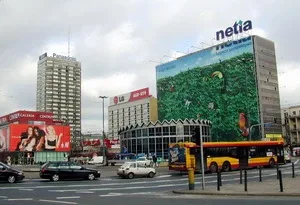
The situation changed radically with the coming to power of the socialists in Spain: one of their first decisions was to "give up" the Polish ally and refuse demands to change the draft EU Constitution. The proud Poles had no choice but to capitulate: on the eve of the meeting of EU leaders in Brussels, Polish President Aleksander Kwaśniewski solemnly announced a revision of demands for granting Poland more seats in the European Parliament.
Nevertheless, Poland should by no means be written off: more than half of the 75 million new citizens of the European Union joining the common European home on May 1 are Poles.
In fact, they have long since mastered the European Union. 35,000 Poles, in the literal sense of the word, define the face of Brussels: they clean apartments, repair and construct buildings... If necessary, around the clock. "Excellent quality for half the price!" - the wife of one high-ranking Brussels diplomat cannot stop rejoicing. In the evening, diligent hard workers have fun in nightclubs that admit only Poles. In the center of the EU capital, a Polish bakery has confidently established itself, next to it a Polish supermarket. And the marble-clad building of the Polish embassy to the EU on Avenue de Tervuren is considered the most beautiful of all diplomatic missions in the city. Polish Brussels, isn't it?
Upcoming events are piling up one after another: the giant enlargement of the EU, which will bring in Poland and nine other countries from the east and south of Europe, officially takes effect on May 1; in June Europeans will elect a new parliament, and in November a new, doubled-in-size European Commission will take over the management of the renewed Greater Europe. Moreover, "management" means above all "redistribution of money." Who should pay for the new Europe?
The heads of state and government of the EU will diligently sing praises to "15 + 10" in Dublin on May 1 - this will mark the beginning of a turbulent and hectic European future. The European Union is growing by 738,000 square kilometers and almost 75 million new citizens. In a month, the number of "euro-burghers" will reach 453 million - membership in the once "exclusive club" is thus becoming a mass phenomenon.
The 39 million Poles living between the picturesque Gdańsk Bay and the Carpathians are among the main protagonists of EU enlargement. After all, there are more of them than the citizens of all the other European new member states combined. The old Europeans still have reasons to worry: two million Polish peasants, a 20-percent unemployment rate in the country, dilapidated roads, a "museum-like" steel and mining industry - all of this makes Poland perhaps the biggest eater at the Brussels table.
Between 2004 and 2006, 12.8 billion euros will be invested in the reconstruction of the country, more than half of the entire monetary fund allocated for the structural budgets of all ten new EU countries. The EU is allocating 4.6 billion euros to small peasant farms selling cabbage at idyllic market stalls, but the same money will also fund the huge, unprofitable dairy plants left over from socialist times...
The expenses are, of course, great, but the opportunities opening up before Europeans are no less significant. Sales markets are expanding. Simply to bring Polish agriculture into line with the strict EU environmental rules will require no less than 50 billion euros in investment. The municipal utilities of more than 2,500 Polish cities and villages must completely modernize their water supply, energy supply, and waste collection systems: a profitable investment niche that, for example, the largest German water supply company Gelsenwasser is already targeting.
Medium-sized construction contractors like the German Jürgen Henschel from Bad Hersfeld in Hesse see in Eastern Europe an opportunity for rapid economic growth: "At the very least we can build autobahns here." Software experts from the company Thales E-Transactions Gruppe will keep their jobs in Germany, because this company is equipping Czech and Slovak supermarkets with modern cashless payment terminals.
Thus, many politicians in old Europe, and above all in Germany, are very optimistic. For example, Silvana Koch-Mehrin, a candidate for the European Parliament from the German Liberal Democratic Party, said: "Instead of singing funeral marches, Germans would do well to take advantage of the opportunities opening up. Well-educated and mobile young people can find their chance in Eastern Europe."
The young elite of Eastern Europe, however, is also well educated and highly motivated. Moreover, it is very self-confident. For example, Slovak Finance Minister Ivan Mikloš is convinced that Western European politicians have something to learn from him - above all, how to attract more investors to the country by lowering taxes. "Nothing sells as well as success," Mikloš praises himself.
Europe is excited and resembles a drunken and happy man. When will the hangover come? The EU's relations with Poland, for example, are already strained to the limit and carry all shades of bitterness and irritation. Not long ago, one well-known European strategist almost declared in his speech in Warsaw: "The Poles could thank God on their knees for being allowed to join the European Union!" His advisers removed this explosive phrase from the text of the speech at the last minute.
The Berlin leadership is also not particularly friendly: the government in Warsaw until recent days belonged to the main opponents of the first EU Constitution. Like the legendary leader of "Solidarity" Lech Wałęsa once at the Gdańsk Shipyard, Aleksander Kwaśniewski's team fought for Polish influence in Europe - proudly, stubbornly, and with full confidence in victory. As they joked in Brussels diplomatic circles: "It seems that it is not Poland that is joining Europe, but the other way around."
The "red-green" federal government of Germany was infuriated by this. Chancellor Gerhard Schröder resented ungrateful Warsaw, and German Foreign Minister Joschka Fischer saw a direct threat to his career and his ambition to become the first foreign minister in the history of the European Union.
Now, however, the situation seems to have normalized. Warsaw has signaled its readiness to compromise on the adoption of the EU Constitution, and Prime Minister Leszek Miller has paid for his own unpopularity: he is resigning as of May 2. Nothing now stands in the way of the Brussels diplomatic ritual of passionate kissing.
But even with the adoption of the EU Constitution, the political routine in Brussels will remain fraught with explosions, just as it was a couple of weeks ago after the explosions in Madrid. Then, in the capital of Europe, the justice and interior ministers of the EU countries hastily gathered - 50 people around a huge table. "In such a crush it is hard to make any decisions beyond the usual rhetoric," complains French Interior Minister Nicolas Sarkozy, and adds of the newcomers: "They have no information structure at all." Thus, after the snail's pace at which decisions have been made in the EU so far, the enlarged EU is threatened with a stop on demand.
Not everyone, however, shares this view: Günter Verheugen, for example, the architect of European enlargement and an EU commissioner, is among the convinced optimists: "May 1, 2004 will not be particularly different from April 30," he says, and adds: "Europe will not be presented with a greater chance to finally do away with the terrible legacy of the twentieth century."
Was it necessary to admit 10 new countries at once? Many of Europe's political "old-timers" complain about this "big bang." For example, former EU Commissioner Jacques Delors: "If things go on like this, in 15 years this Europe will be finished. We will enlarge ourselves to death." He is supported by German left-wing historians Hans-Ulrich Wehler and Heinrich-August Winkler, who warn against admitting Turkey to the EU. Josef Janning, deputy director of the Center for Political Research in Munich, advises urgently abandoning outdated ideas about the system of distributing funds: "We can concentrate the efforts of the restructuring funds only on those who actually need them." Simply put, Europe must regulate impoverishment: the East is catching up, the West is slowing down.
And the next candidates are already on the doorstep: giants like Ukraine, the Balkan countries Croatia and Macedonia, even "minnows" like Moldova and, oddly enough, Belarus. Economically, this simply means a one-sided game: the ten new countries, with their 433 billion euros a year, currently produce barely a twentieth of the EU's total gross national product. The German Economic Institute in Cologne has calculated that it would take 44 years just to halve the current gap.
Brussels, however, continues to act under the slogan "Could we have a little more?!" Of course! 100,000 square meters of new offices are being built right next to the huge new European Parliament building, a giant railway station next to the renovated European Commission palace, a large Council of Europe building, a special palace for summit meetings, a fourth European School...
Bureaucratic commanders and their armies have calculated to the third decimal place who will receive how much more in salary. Ten new EU commissioners, 106 new MEPs, six thousand additional EU employees... Office rental prices in Brussels' European Quarter have jumped by more than 50% over the past five years. Incidentally, an additional 808 million euros has been allocated just for translators of the EU's 20 official languages.
And what will change for ordinary European citizens, whose opinion - at least in Germany - no one has bothered to ask about EU enlargement? Not much so far. For example, anyone who thinks they can now officially register their pretty Polish nanny for residence is sorely mistaken: even as a citizen of the EU, she will not be able to work officially in the old European countries for at least another seven years...