
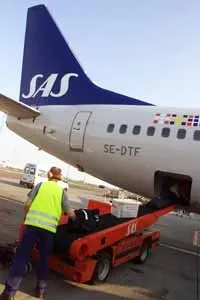
Many passengers at European airports are forced to stand for hours near the baggage carousel waiting for their belongings. However, as Gazeta.Ru notes, far from everyone is reunited with their suitcases. “On average, seven passengers of German Lufthansa or Spanish Iberia lose their bags on one flight of a standard Boeing 747, which carries 350 passengers. Six meet such a fate on flights provided by Luxembourg's Luxair and Austrian Airlines. Five unfortunates lose their baggage on British Airways and Air France flights,” calculated the Association of European Airlines.
The association collected statistics in the first quarter of 2006. Only the traditional 25 airlines were taken into account, since discount carriers were not among those who voluntarily agreed to the “inspection”. In total, per 1,000 travelers in January-March 2006 there were 15.2 lost bags, whereas in the same period of 2005 there were only 14.7 lost items. “With the arrival of summer and the holiday season, one can expect only a further deterioration of the situation in crowded airports,” predict the Association of European Airlines.
A representative of British Airways blamed the congestion of Heathrow Airport and the complicated delivery scheme that complicates matters. “Heathrow has three different baggage terminals, which together with the airport's increasing overcrowding can cause additional difficulties for connecting flights,” she admits. “We have to transport bags through tunnels 1.5 km long. In 2007, when Terminal 5 opens, we expect the situation to improve, since all baggage of transit flights will be in one terminal,” promises the British Airways representative. These arguments are reasonable: Heathrow was originally designed for no more than 50 million passengers a year, and in 2005 it received more than 70 million people.
However, Simon Evans, a representative of the air passengers' council, is not sure that the problems lie only in airport congestion. In his words, airlines spend insufficient time and money to solve the baggage service problem: “Lost baggage is an eternal problem. We receive a huge number of complaints year after year. This makes one doubt that airlines are really doing everything possible to resolve the issue,” he notes.
Similar baggage problems arise not only in Europe. US airlines in 2005 lost 10,000 bags a day – a record number since 1990.
Lost baggage is also dangerous because it affects the work of the security service. One of the main pillars of aviation security was the rule that a person and their belongings fly on the same plane. But last year, one of the Heathrow airport workers admitted that Terminal 2 does not always follow this instruction. Once, about 750 bags from Saudi Arabia were delivered to the London airport unaccompanied, many of which also had no tags.
Some airlines pin their hopes on high technology. The new baggage tracking technology RFID (Radio Frequency Identification) is already being tested in several airports, including Hong Kong and Las Vegas. The International Air Transport Association (IATA) said that initial testing showed that 99% of bags pass automatic identification without problems. Adam Dalby, manager of I-trak, a company involved in baggage coding, however, considers the talk about RFID premature: “At the moment, using RFID is about the same as having a mobile Nokia N86: the technology is amazing, but being outside the network coverage area means having no service. Introducing such a system would require the deployment of a large-scale infrastructure at every airport. I doubt that the loss-making industry can afford it today,” he adds.
So far, the losses are borne by airlines. British Airways, which claims that almost every lost bag is found and returned to its owner within no more than 48 hours, admits that this is a rather costly business. The 30 million bags lost every year cost the company £1.4 billion (almost $2.7 billion).