
European museums will feature many graphics and sculptures in March
AUSTRIA
Austrian watercolor painting, March 5 – May 24, Vienna. "Hidden Treasures" is the name of the new exhibition at the Leopold Museum in Vienna, which was opened in 2001 based on the collection of Dr. Rudolf Leopold, containing about 5,700 works of art, including about a thousand watercolors. The exhibition is timed to the 85th anniversary of the museum's founder, for which 150 best watercolors from the museum's collection have been selected. Many of these works will be exhibited for the first time, as watercolor requires special storage conditions due to light sensitivity. In essence, visitors will be given a unique opportunity to get acquainted with the 200-year history of Austrian watercolor painting.
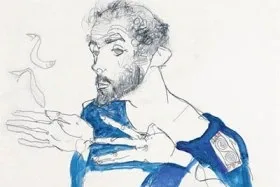
The exhibition opens with works by the famous Viennese watercolorist Rudolf von Alt and painters of the Biedermeier period Karl Schindler and Thomas Ender. Then follow works by Austrian impressionists Maria Egner and Eduard Zetsche, while Viennese Art Nouveau and early Expressionism are represented by works of Gustav Klimt and Egon Schiele. The period of the 1920s-40s is reflected in watercolors by Herbert Böckl, Oskar Laske, and Josef Dobrowsky. The exhibition concludes with a section dedicated to modern Austrian watercolor painting. //www.leopoldmuseum.org
Retrospective exhibition of Markus Lüpertz, March 11 – June 6, Vienna. The Albertina Gallery in Vienna will soon open a retrospective exhibition of one of the most famous contemporary German artists Markus Lüpertz (born in 1941). For many years Markus Lüpertz was rector of the Düsseldorf Art Academy, but the master's main passion remains music – he still performs as a jazz pianist. The exhibition will present works by Markus Lüpertz from the 1960s-2000s, which reflect the artist's path from abstractionism to neo-expressionism, including "Hymn to the Smoke Stacks" (1969), "Colossus" (1973), and paintings from the "Daphne" cycle (2003). //www.albertina.at
GREAT BRITAIN
Henry Moore, February 24 – August 8, London. This spring and summer, visitors to the London gallery Tate Britain will have the opportunity to view the work of the famous English sculptor Henry Moore (1898-1986) in historical and artistic contexts. Participation in World War I battles, where he was gassed, fascination with the sculpture of Ancient Greece, the Etruscans and the Maya, psychoanalysis, surrealism, Roger Fry's idea of "truth to materials" – these are just a few of the influences on the sculptor's work. Henry Moore considered the main method of creativity to be "releasing the artistic image contained in the material" – whether wood, stone, bronze, reinforced concrete, lead, or terracotta. The exhibition will present more than 150 sculptures and drawings by the artist from various museums and private collections. //www.tate.org.uk
Paul Sandby and 18th-century watercolors, March 13 – June 13, London. The Royal Academy of Arts is preparing an exhibition for the 200th anniversary of the death of one of its founders - the famous 18th-century watercolorist who participated in the "discovery of Britain", creator of the topographic landscape genre, creator of watercolor landscape as an independent form of painting Paul Sandby (1725-1809). Paul Sandby's paintings depicting British provinces are distinguished by cartographic accuracy. In 1751-71, Sandby traveled around Great Britain, painting picturesque country houses and landscapes. This period of his work also includes the most beautiful maps of large estates in England, Scotland, and Wales.
It was in the 18th century that watercolor revived as an indispensable "technique of travelers," coinciding with the established fashion of English aristocrats for traveling around the country. The best watercolors were engraved, published in collections, and interiors and porcelain items were decorated with views of England. That is why, parallel to the Paul Sandby exhibition, the Royal Academy will host the exhibition "18th-Century Watercolors from the Museum Collection" (March 9 – May 16). //www.royalacademy.org.uk
GERMANY
CeBIT World Expo, March 2-6, Hanover. About half a million people annually visit the largest exhibition of "digital solutions," information technology and telecommunications, which takes place in March at the Messegelände exhibition center. For everyone interested in the latest achievements in IT, more than 6,500 exhibitors from 70 countries will present their newest developments in the following areas: information technology, networks, automation of data collection and processing, software, Internet, integrated solutions for design and production, telecommunications, banking technology and security systems, office automation, scientific research and technology transfer, consulting. Within the framework of the exhibition, conferences, expert presentations, discussions, and forums will be held. A single ticket to the exhibition costs €38, a season ticket costs €81. The special guest this year is Spain. //www.cebit.de
Titian "Portrait of a Lady in White," March 20 – June 27, Dresden. A whole exhibition at the Dresden Picture Gallery (Semperbau) is dedicated to the story of one painting by the famous Italian artist Titian (1488-1576). "Portrait of a Lady in White," created probably in the 1550s, still remains a mystery to researchers. Who is depicted in the painting? Was it painted for himself or for the Duke of Ferrara? And finally, in what year?
There are different answers to all these questions, so the exhibition organizers placed the painting in a cultural-historical context - these are portraits by Titian himself, created in different periods of his work, and portraits of his contemporaries, artists Veronese, Tintoretto, Varotari, Bassano, created in Northern Italy in the late Renaissance. The second part of the exhibition is devoted to the study of costume and the symbolism of white color. Historical costumes and accessories of the 16th century from the collections of European museums will be presented there. //www.skd-dresden.de
FRANCE
Lucian Freud, March 10 – July 19, Paris. The Pompidou Center in Paris has prepared a large exhibition of the English painter and sculptor of German origin Lucian Freud (born in 1922), grandson of the famous Sigmund Freud. The artist moved to England in 1933, where he studied at the London School of Arts and Crafts. His early works are executed in a strict realistic manner, then his art develops under the influence of the "New Objectivity" and evolves towards static surrealism.
The exhibition will feature about 50 works by the artist from different periods, and the main theme will be the image of the artist's London studio, a kind of "creative laboratory," which will allow visitors to immerse themselves directly in the creative process of many of Freud's works. The centerpiece of the exhibition will be Freud's painting "Large Interior," created in 1968, as well as a series of self-portraits by the artist. //www.centrepompidou.fr
Crime and Punishment, March 16 – June 27, Paris. A new philosophical and cultural exhibition "Crime and Punishment" will open at the Musée d'Orsay in mid-March. It will be dedicated to the history of the death penalty, which for many centuries was an inevitable punishment for crimes committed. Chronologically, the exhibition covers the period from 1791, when Le Peletier de Saint-Fargeau, presenting the draft Criminal Code, opened his speech with the question: "Will the death penalty be retained?" to 1981, when it was abolished.
For 18th-century France, the death penalty was hardly questioned and for most its justification seemed self-evident. Montesquieu argued that the death penalty "follows from the nature of things, is drawn from reason, from the sources of good and evil." For Diderot, "since life is the greatest of goods, everyone agrees that society has the right to deprive of this good someone who would deprive others of it." The death penalty was first significantly limited in the early years of the Revolution – the 1791 Code reduced to 32 the number of crimes punishable by death, while previous legislation had provided for 115 such cases.
How did people's attitude towards the death penalty, the problem of evil and violence change over the 19th and 20th centuries? Answers to this main question will be provided – in the paintings of Goya, Géricault, Picasso, Magritte, in film and music, which are actively used in the exhibition. //www.musee-orsay.fr
Read also material on the topic: "THE APOSTLES" BY EL GRECO LEFT TOLEDO