
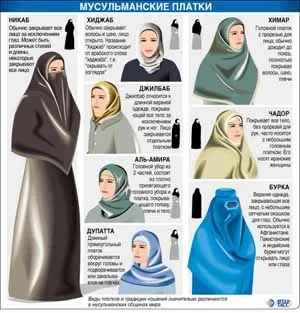
It all started in September 2004, when the mayor of the small Italian town of Drezzo, with a population of 1,000 people on the border with Switzerland, forbade one of the local female residents to wear a hijab and fined her. 34-year-old Sabina Varrone married a Moroccan in the mid-1990s and converted to Islam. In 2003, she performed the Hajj and since then has been dressing in the Arabian style with a half-covered face. To her misfortune, there are four other Muslim women in the village, but they do not observe the religious dress code as strictly. That pleased the local authorities, who reasoned: since the others can do without hijabs, then let Sabina 'not stand out'.
Three years later, Italian Interior Minister Giuliano Amato recalled this old story and, apparently under the impression of recent unrest in France, issued a non-binding directive that clearly states: no hijabs or burqas in Italian society.
Thus, the Italians threaten to follow the most radical example of solving the 'hijab problem' – the Dutch one. Last year, the Dutch government banned any appearance on the street in Muslim clothing. Moreover, in some cities, women who cover their faces may be completely excluded from social life. For example, the Utrecht city council has already announced that it will not pay unemployment benefits to those representatives of the 'fair sex' who come to an interview with a potential employer wearing hijabs. Let us recall that the first country to raise the issue of hijabs at the national level three years ago was France. Since then, wearing this clothing has been banned in schools there.
However, during exams at the Free University of Brussels, there is a procedure for identity verification in which a female Muslim student is asked behind a screen in the presence of only women to temporarily uncover her face. In principle, the law in Belgium does not prohibit wearing even the full female Muslim attire (niqab). But this is a very rare phenomenon. True, a public debate continues, related to increased security demands after September 11, 2001.
In March, the UK Supreme Court banned schoolgirls from wearing the niqab in classes and gave schools the right to permit or prohibit the jilbab – a long Muslim dress that reaches the ankles – instead of the accepted school uniform. As for the hijab (covering only the hair and neck), attitudes towards this widespread clothing accessory in most European countries are still generally liberal. Recently, German Interior Minister Wolfgang Schäuble spoke out decisively against niqabs, but about hijabs he said banning them is not a matter for politicians and authorities.
According to many observers, the patience of Europeans, who have always been famous for their tolerant attitude towards different religions and cultures, began to run out after the terrorist attacks in New York. And when the scandal over cartoons of the Prophet Muhammad rocked the world in early 2006, European leaders openly went on the offensive. And this inevitably provokes a reaction in the Islamic world. As Abdallah Iesa, head of the Moscow bureau of the Arab-Iranian TV channel Al-Alam, told NI, the current policy of Europe will not bring two completely different cultures closer together. 'The leaders of European powers constantly declare that they want to conduct a dialogue with the Muslim world, but at the same time they act in such a way that no dialogue can be possible,' Iesa emphasized.
Artyom OPARIN, Alexander MINEEV.
Novye Izvestia