
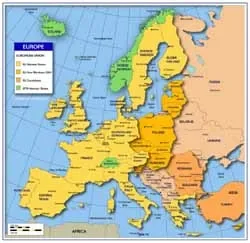
However, the Council of the European Union of Foreign Ministers will decide how to deal with Turkey without waiting for the formal deadline to expire. The problem threatens to split the ranks of a united Europe. Turkey has been persistently knocking on the door of the EU for four decades now. In October 2005, negotiations on its admission finally began. They are designed for 10-15 years without a predetermined outcome and are accompanied by a number of conditions.
Last week, the European Commission recommended partially suspending the negotiation process because Ankara has not fulfilled the main condition: to open harbors and ports for the Republic of Cyprus, which it does not recognize, but which has been an EU member since 2004 and, consequently, part of the EU-Turkey customs union.
In the EU, calls have already been made to temporarily suspend negotiations with Turkey on joining the organization. This opinion was recently expressed after their bilateral meeting by German Chancellor Angela Merkel and French President Jacques Chirac. They proposed an 18-month pause. That is, only after a year and a half could the EU return to the question of resuming negotiations with Turkey, depending on its behavior regarding Cyprus. This statement was made despite the fact that Turkish Prime Minister Recep Tayyip Erdogan had specifically called Merkel beforehand, warning against 'making such a mistake.'
Even the European Commission considered the German-French proposal too harsh, reminding that setting ultimatum deadlines in the past had not been beneficial. 'We need to find a balanced solution that, on the one hand, shows the possible consequences for a country that does not fulfill its obligations, and on the other hand, preserves the negotiation process, especially given the strategic importance of Turkey,' said Kristina Nagy, spokesperson for Olli Rehn, the European Commissioner for Enlargement.
The 25 EU countries are not obliged to follow the recommendation of Brussels, nor the opinion of Chirac and Merkel. Differences over Turkey are strong. But something must be done.
Europeans fear that a 70-million Asian power will change the very character of the European Union. They have already felt the results of the 2004 accession of ten Central and Eastern European countries — far from the richest and not known for mature democracy. A July opinion poll showed that only 39% of EU citizens would support Turkey's admission, and 48% would be against it, even if Ankara fulfilled all the conditions set. In Austria, Germany, Luxembourg, Greece, Belgium, and Cyprus, the overwhelming majority are against. Leaders cannot ignore public sentiment.
At the same time, everyone agrees that Turkey has important strategic significance as a bridge between Europe and Asia: a NATO member, a secular state with a predominantly Muslim population. According to experts from the Brussels Centre for European Policy Studies, this significance will grow as Europeans become more concerned about the reliability of oil and gas supplies from Russia. If the EU wants to diversify its energy import sources, it cannot do without Turkey, which opens the way to the resources of the Caspian, Central Asia, and the Middle East.
There are fears that European intransigence will provoke a rejection reaction from the Turks, and Ankara will slam the door itself, walking away from negotiations. Polls in Turkey showed that at the end of October, only 32% of the population was in favor of joining the EU, compared to 57.4% a year earlier and 67.5% in 2004. Instead of a difficult ally, there is a risk of gaining a hostile neighbor.
The United States, perhaps more than the Europeans themselves, would like to see Turkey in the EU, believing that this would strengthen the West's position in the Middle East and its influence in the Muslim world. US Deputy Secretary of State Nicholas Burns, on the sidelines of the OSCE ministerial session held in Brussels, said that 'the decision taken by the European Union to open the door to Turkey was strategically important.' 'And now it is being called into question, and European leaders are starting to say that the door must be closed. In our opinion, that would be a serious strategic mistake,' the American noted.