
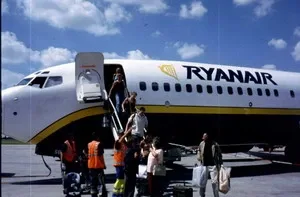
Irish airline Ryanair is threatening to leave continental Europe. Or rather, as Gazeta.Ru notes, a significant part of it. Large airlines such as Air France are very pleased with this decision, while ordinary Europeans are frightened and look to the future with uncertainty.
A few years ago, no one knew about Ryanair. Now it is one of Europe's largest air carriers. This is linked to the boom in ultra-cheap air travel - a service that appeared about eight years ago in the British Isles and, at the beginning of this decade, spread to the continent.
In the late 1990s, several new companies in the UK and Ireland decided to challenge traditional operators in the local air travel market. The new firms built their strategy on radically reducing the cost of flights. Passengers lost many services, but ticket prices fell by tens of times. For example, from London to Manchester you can now fly for a dozen pounds.
The fact that the plane became cheaper than the bus attracted a huge number of new customers to the sector; companies grew like mushrooms and soon turned their attention to the mainland. Europe initially resisted, trying to save national carriers like Air France or Alitalia from competition, but soon began to give up one position after another. First, cheap British airlines were allowed to fly from European capitals to London, and since the year before last, cheap intra-European routes began opening one after another.
Europeans also mastered the British model of the airline business, and budget airlines appeared in Germany, Italy, and Spain. Flying from Paris to Barcelona today costs about 29 euros, and a ticket from Frankfurt to London can be bought for as little as nine euros. True, you have to pay for the cheapness: tickets must be purchased well before departure, planes usually land at not the most convenient city airport, and also you don't get fed in flight. But, as the slogan of low-cost carriers goes, "if you want to have lunch on the plane, pay an extra 300 pounds and fly British Airways."
Small regions were most pleased with budget airlines. They saw them as an opportunity to attract more tourists and generally revive the economy. Therefore, the municipalities of towns in France, Italy, Spain, and the Benelux began to attract low-cost airlines in every possible way.
Local airports began to give them not only discounts but also cash subsidies, just so they would open their terminals there. The largest of the budget airlines, Ryanair, was especially active in making such deals. The subsidies were targeted - for infrastructure development and advertising of new routes in the press, but airline giants like Air France saw unfair competition in this and filed a complaint with the European Commission. With private airports, the complaint had no prospects: joint-stock companies give subsidies to whomever they want, and they cannot be held accountable for this. But in France and the Benelux, most airports belong to municipalities, and here subsidies become an expenditure of taxpayer money.
In October, the European Competition Commission already ordered Ryanair to return $500,000 to Strasbourg and canceled all benefits granted to the company. Ryanair was forced to close the Strasbourg-London route. True, Air France, which they had displaced a year earlier, immediately returned to the place of the Irish. Residents of the region felt the effect of fair competition: tickets immediately began to cost 800 euros instead of 19.
But the most powerful blow to the Irish was struck the other day. The European Commission ordered the company to return part of the subsidy it received from the government of the Belgian region of Wallonia. The subsidy was 15 million euros and was allocated to attract the carrier to the barely surviving airport of Charleroi. Local authorities not only allocated money to the airline but also reduced airport fees for it: the Irish paid one euro for each passenger, while other companies paid 8-13. Ryanair made Charleroi its main transport hub on the continent, and traffic grew several times.
But since the airport was municipal, major national carriers filed a complaint with the European Commission demanding the cancellation of unjustified benefits. The case dragged on for several months. Dozens of local municipalities came out in defense of Ryanair, and the company itself even gave away a thousand free plane tickets to those willing to support it in court. But even that did not help. The Commission ruled that the company must return 4 million of the 15 million euros received to the Walloon authorities.
Ryanair's management is furious. The company's head, Michael O'Leary, threatened to wind down operations in Belgium, especially since the company is already building a second European super-terminal near Frankfurt. O'Leary also said that in the future the company would likely cooperate only with privatized airports. And finally, he said he would file lawsuits against large airlines that received state aid, and in that case no one would get off easily: in fact, all European governments sponsor their flagship carriers, and Air France, for example, received $3.5 billion in subsidies from the French government in the middle of the last decade.
Other low-cost carriers, however, look to the future with optimism. The CEO of EasyJet, the second-largest company in this sector, Ray Webster, welcomed the European Commission's decision and pointed out that Ryanair had managed to retain most of the subsidy - the money spent on infrastructure development. Webster also noted that EasyJet, unlike Ryanair, always involves the European Commission in concluding deals with European airports, such as in the ongoing negotiations with Berlin's Schönefeld Airport.