
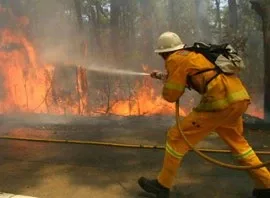
In European zoos, animals are regularly doused with cold water and given chilled food; people have to seek salvation themselves. So far, according to the EU, forest fires represent the greatest danger, but the states of United Europe have closed themselves within their borders, refusing to help neighbors. Particularly hard hit was Portugal, which turned into a battlefield enveloped in smoke. The country's government appealed to NATO with a request to provide helicopters with special equipment, but was refused. "States that have such equipment are keeping it for themselves," comments NATO spokesman Yves Brode.
All these disasters are but a harbinger of even more terrible upheavals. As meteorologists predict, the real heat will hit Europe in August, and then the number of victims could be in the many thousands.
The sun has been beating down on the Old World for the second consecutive year. In 2003, 45,000 people died in Europe from heatstroke and heat-related illnesses, with 20,000 of them in Italy and 15,000 in France. Last year's figures were somewhat lower, but after 2003 few people trust official statistics, because the publication of accurate data could have led to a political crisis. That happened two years ago, when in France, after the release of information about the number of heat victims, many officials responsible for the functioning of social services and health authorities were forced to resign. They were accused of ignoring experts' warnings about the danger of high summer temperatures for pensioners and people suffering from cardiovascular diseases. Additional hospital places had not been prepared, a considerable part of clinic staff and ambulance crews went on vacation, and no information was provided in the media about measures to prevent overheating. The Italian government, frightened by the scandal that broke out in France, initially announced 4,000 dead, and only a year later did the world learn that there were five times as many.
The authorities of European countries have drawn conclusions from the lessons of two years ago, in particular by distributing summer vacations for medical personnel, police officers and fire services more rationally, but these measures are clearly insufficient in the fight against the raging climate. According to a study conducted by the American analytical organization Earth Police Institute (EPI), Europe must prepare for a twofold increase in deaths over the next 20 years due to unusual summer heat. The experts' calculations are based on statistics showing that the average temperature on Earth is steadily rising. Over the past 25 years it has increased by 0.6 degrees, and in 100 years, as mathematical models predict, it will rise by 1.4-5.8 degrees.
Especially dangerous are cities, which are turning into peculiar heat accumulators. Due to the abundance of heat sources absorbing solar energy, dark roofs and road surfaces, the temperature in megacities can exceed that in the nearest countryside by 10-12 degrees. Periods of stable hot weather in areas with humid climates are an especial danger. Already on the second day, 40-degree heat begins to have a destructive effect on the weak organisms of the elderly, the sick and children, who are not capable of the necessary 'self-cooling' to a temperature below 37 degrees. 'Heat is a silent killer that claims more victims than all other natural calamities, including hurricanes, earthquakes and floods,' scientists at EPI believe.
Scattered feverish actions by authorities to reduce the number of victims of the inevitable summer heat are not enough. A comprehensive long-term program of action is needed. So far, of all European countries, only Sweden - where not a single resident of this northern country has become a direct victim of 'summer baths' - has shown a willingness to arm itself for a meeting with the new climate reality. The government has just announced the creation of a commission under the leadership of Governor of Skåne Province Bengt Holgersson, whose task will be to study society's vulnerability to climate change. Experts are to give recommendations to the government in a whole range of directions, from preparing water supply systems for the coming climate changes to protecting people from new types of living organisms that have already come to Scandinavia or may appear here in the near future. The directive given to the commission states that even a sharp reduction in emissions of greenhouse gases into the atmosphere is no longer capable of stopping climate change on the planet. And therefore one must prepare for the inevitable...
While most of Europe is languishing from heat and drought, its eastern part is fighting another scourge - floods. As Novye Izvestiya writes, the heaviest rains have not ceased here for the past two weeks. Rain is falling in Hungary, Slovakia, Bulgaria and Romania. The Romanians have been the least fortunate - the country is flooded. Such a rampage of the elements has not been seen here in more than half a century. Twenty-one people have already died, dozens are missing without a trace. Thousands of houses have been destroyed, tens of kilometers of roads washed away, agricultural lands flooded. Marauders are looting homes abandoned by their owners. Romanian President Traian Băsescu has appealed to the European Commission with a request to provide his country with $20 million in assistance. Some optimism is provided by meteorologists' forecasts. According to their data, as early as this week the weather pattern should change - there will be significantly less rain.