
“Big Bang” of the European Union
Two years ago the European Union underwent the largest enlargement in its history: 10 new countries joined the Community and became full members. If the EU were a state, it would rival the largest countries of the world in size and population. Journalists called this event the “Big Bang” and it will most likely go down in history under that name. However, as is well known, after the Big Bang the Universe keeps expanding, and stars and galaxies are fleeing ever farther from each other.
Does this physical law apply to the political space of the European Union? Which forces will ultimately prevail – centrifugal or centripetal? And can old Europe, which has not yet fully “digested” the new members, take into its close-knit family the next “relatives” who persistently knock on its door – Romania and Bulgaria, Turkey and Croatia, and in the future Ukraine, Moldova, Georgia, and even completely non-European Morocco?
It is no secret that very many Europeans are not at all delighted that the EU is destined to continue expanding. Dissatisfaction has grown so much over the past two years that more than 70% of EU citizens are resolutely opposed to the admission of new members to the Community: this is evidenced by numerous polls regularly conducted by various sociological services in EU countries. Politicians, having sensed which way the wind blows, promise from high platforms that after Romania and Bulgaria join the EU, which is to take place in 2007, there will be no new “adoptees” for a long time. It would be nice to deal with those already here... However, they are all being disingenuous: the leaderships of some EU countries already have their own protégés whom they wish to take into the European family at all costs.
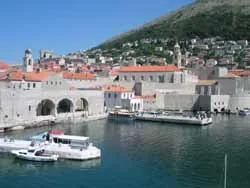
For instance, Croatia’s stock is currently high in Brussels: in May, Europe’s Christian Democrats are holding their meeting not just anywhere, but in sunny Split. The congress of the European People’s Party (EPP) is an unambiguous signal to the Croatian leadership. Encouraged by political celebrities, the Croats already see themselves as members of the European Union as number 28 and, for their part, are sending ever more diplomats to the EU capital.
In principle, nothing stands in the way of their desire: this country of 4.5 million people currently has a gross national product of €6.2 thousand per capita – a quite respectable figure. For comparison, in Ukraine it is €1.1 thousand. Croatia’s GNP growth is 3.8% per year. The political situation, unlike that of its neighbors – the Serbs, Bosnians and Macedonians – is quite stable.
Nevertheless, no one dares to speak openly about Croatia’s imminent entry into the EU. Instead, the European political beau monde is exercising the rhetoric of “closed doors.” The European Parliament openly demands an official pause in the admission of new members, while French President Jacques Chirac goes so far as to call for a complete halt to admissions. Germany’s ruling Christian Democratic Union is also seeking an end to the granting of full EU membership. At least in words.
Europe’s Sweet Hypocrisy
All of them are being disingenuous to one degree or another. Because in reality the situation looks like this: no politician is interested in stopping the admission of newcomers. Austrian Chancellor Wolfgang Schüssel is using all six months of his country’s presidency of the European Council to “pull” the Balkan states as close as possible to Europe. The five republics of the former Yugoslavia would like to have the prospect of joining, as they say, “yesterday” – and this was promised to them, by the way, back in 2003. Croatia is merely the first in line. Prime Minister Ivo Sanader is counting on a ticket to Europe as early as 2009, and Austria’s foreign minister declares: “Without the Balkans, Europe is incomplete.”
Bulgaria and Romania have already received their tickets. The European Commission intends to officially propose admitting them to the EU on January 1, 2007. Neither London, nor Paris, nor Berlin intends to raise any objections – nor, for that matter, do the other EU capitals. Angela Merkel is preparing to assume her country’s presidency of the European Council in January, which will already have 27 members.
However, there is still a chance to stop the process: in September, Germany’s Bundestag will be the last of the European parliaments to vote on the two countries’ applications. If the German parliament says “no,” that would be enough. Yet such an outcome is possible only theoretically, although there are plenty of reasons for such a “no.”
The European Commission’s conclusion, submitted for consideration to the European Parliament, contains a huge number of flaws and omissions, indeed simply serious discrepancies between Bulgarian and Romanian legislation and European law. Corruption, the criminal situation and even hygiene standards – on all points the two countries are completely incompatible with the EU.
For example, more than half of the hotels on the Bulgarian Black Sea coast lack sewage systems. Since 2001, more than 150 people have died in Bulgaria in shootouts between various criminal gangs – and, according to Europol, many of the “showdowns” were... over control of European subsidies! The Bulgarian justice system drives Brussels diplomats to bitter sarcasm: “If Sofia connects to our data bank, it would be easier to simply hand over all our databases to the mafia and not accept a whole country for that.”
Executives of Western companies cooperating with Romania say: “Bribery is so widespread here that it has become part of the local culture.” The economic situation in both countries is simply catastrophic. Hourly wages sometimes do not reach €2 – which means that the labor markets of the more prosperous European states (including newcomers like Poland and the Czech Republic) are under threat. Just to the agricultural sector alone, more than €8 billion will have to be “pumped in” by 2013.
The Process Is Underway?
And processes, as Mikhail Sergeyevich Gorbachev used to say, have started. The new EU Enlargement Commissioner Olli Rehn, without much ado, recently gathered representatives of the Balkan states in Brussels and told them: "Now our efforts will be focused on the peaceful unification of southeastern Europe." At the same time, the EU does not even try to pretend that it is making any firm demands on the "newcomers." Macedonia received the candidate label without fulfilling a single condition set for it. The European Union is single-handedly tearing down any obstacles in order to maintain the right tone over the next 20 years for those seeking to join its ranks. Brussels is conducting negotiations with Turkey on full membership, while that country does not recognize the Republic of Cyprus – an EU member. Cypriot planes are not allowed to use Turkish airspace and are forced to make a considerable detour over the sea to get to Europe, and Cypriot ships cannot enter Turkish ports – even when in distress.
Another EU country is eager to play the role of "godfather" for newcomers – Poland. Not yet settled into the new family, led by a party coalition that includes the odious Andrzej Lepper as a minister – a far-right nationalist populist and staunch opponent of the European idea as such – Warsaw intends to serve as a kind of guide for Ukraine.
Britain is lobbying for Turkey's entry into the EU, France promises support to Morocco and Algeria – even these North African countries intend to "move to Europe."
And in order not to frighten their citizens too much, European politicians are talking about a certain "third way": without accepting more full members, they propose to provide "applicants" with access to European subsidies and the European internal market. In practice, this means nothing other than an attempt to simply buy off the annoying candidates.
Boris ALTNER.
IA Rosbalt