
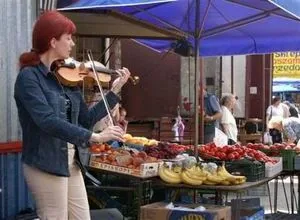
The truth is that residents of Germany's border regions became the first Europeans to begin "integrating" nearby Polish cities and their residents into the EU in a unilateral fashion. They started doing so even before the formal accession of their eastern neighbor to the common union space. As early as March of this year, the first weekend cross-border bus service with German border towns began operating in the Polish city of Szczecin.
A luxurious Mercedes bus picks up German passengers on weekends from their towns and brings them directly to the largest hypermarkets in Szczecin. This service has become so popular that the bus has to make four round trips on each of the two weekend days. The very need for regular bus service arose because residents of the eastern German states and even Berlin increasingly come to Poland for cheaper purchases and services. The ride from the nearest German town of Schwedt to Polish Szczecin costs only 11 euros. Germans compensate this expense tenfold due to the price difference for goods and services at home and in the eastern neighbor.
Since the moment German citizens realized that just a hundred kilometers to the east, in Polish border towns, services and goods are no worse than theirs but on average four times cheaper, a real weekend boom of German trips to Poland began, say German journalists from border editorials. Local sellers are very pleased with German customers, because unlike Polish consumers, foreign guests purchase the most expensive goods and order the most expensive services, which Poles themselves often simply cannot afford.
The Germans' calculation is very simple - the more expensive the service or product they order, the more they save. For example, a technical inspection at an Opel service station in Szczecin costs 140 euros, while in Berlin it is 300. A festive hairstyle in a German city costs an average of 40 euros, while in Polish cities it is 10. Prices for household appliances and dental services differ in the same proportions. At the same time, the quality of services and materials used for them has been identical for several years.
The point is that in Poland utilities are still relatively cheap, as are premises rental costs and medical staff salaries. As directors of some private clinics in Szczecin, Wroclaw, and even Poznan (which lies farther from the border) admit, foreigners (overwhelmingly Germans) already make up 30–50%, and in some cases 80% of patients. The situation has been developing especially dynamically since Poland became an EU member, which allows Polish medical institutions to sign contracts with medical insurance companies from any EU country to reimburse the cost of treatment for their clients.
According to Polish businessmen, other neighbors have followed the Germans to Polish shops and salons - more and more often on weekends you can see groups of so-called shop tourists from Denmark, Sweden, and the Netherlands on the local streets.
Foreign clients have also begun to appear in Polish cities farther from the border, where the choice of goods and services is even wider and sellers are still less spoiled. Therefore, it is not excluded that other bus routes will appear soon. The bus idea turned out to be very successful, the owners of the Szczecin cross-border route are delighted, because previously Germans came to Poland for shopping in their own vehicles, but always feared Polish car thieves, and now they only have to watch their pockets and bags.
Only two months have passed since Poland acquired EU membership status, but the economic and social consequences have already become quite tangible, Polish newspapers write. At the same time, the expansion of Western European firms into the Polish market and the rise in prices for some goods in Polish stores are not something unexpected, because analysts predicted this long before integration. However, public concern, especially in the regions of Poland bordering Germany, is caused by certain trends that the forecasts did not address.
For example, Gazeta Wyborcza wrote that in the western regions of Poland after May 1, butter prices rose by 30%, sour cream by 20%, other dairy products by 5-10%, and they continue to rise further. The reason for the rise in prices for a number of goods was the massive hoarding of milk and meat by food production companies from Germany and the Netherlands. This fact, extremely pleasing to Polish milk and meat producers, does not at all please local consumers, because due to it prices are also rising in Polish stores.
Some Polish dairy producers in the first month and a half of the country's EU membership increased their export capacity by 15-20%. And the record holders even produce 60% of their output for export.
The head of a dairy plant in the small town of Gostyn near Bydgoszcz, Grzegorz Grzeskowiak, says that his enterprise has already increased the price of export goods by approximately 25%, and this is not the end. "Demand in the European Union is so great that we could increase production even two or three times," believes Grzegorz Grzeskowiak.
Vice President of the National Union of Dairy Cooperatives of Poland, Waldemar Bros, admits that no one expected such aggressive expansion of Western competitors in Poland. "If we do not stop this process," he says, "our dairy plants may run out of raw materials."
Odd shifts are taking place on the Polish food market. Firms from central and eastern regions of Poland, where agricultural products are abundant, increasingly sell their goods to retail chains in the west of the country and wait for representatives of Western concerns to get to them as well. The same, for obvious reasons, is expected - only with apprehension, not hope - by ordinary Polish consumers.