
As the single national currency of the USA, the dollar appeared in 1861, when, at the initiative of the American Congress, so-called demand notes were printed for a total of 57 million. Denominations - $5, $10, and $20. All banknotes issued since then possess face value and circulate in the States on a par with freshly printed ones.
The first dollars were in many ways similar to current banknotes. Before the Civil War of 1861-1865, known to us from the novel "Gone with the Wind", money of dark gray color was in circulation across the ocean. After the outbreak of hostilities of the corrupt Yankees against the true patriots of the South, the need arose for a new issue. Specialists of the American Bank Note Company, which was charged with the task, settled on green paint, because there was simply no other paint in the warehouses. On the reverse side of the $10 bill of the 1861 issue, a bold Roman numeral ten - X - was displayed. Because of it, the tenner was nicknamed sawbuck (that is, "sawhorse"). Hence the slang designation of the US currency - bucks. The notes of the Northerners in army jargon are greenbacks ("green backs" - that was the color of the reverse sides of the banknotes). The money of the Southerners was called graybacks ("gray backs").
The special status of the dollar as a world currency explains the constant attention of counterfeiters to it. The improvement of copying and duplicating technology on the one hand, and the comparatively weak protection of current paper dollars on the other, whose appearance, by the way, has changed little over 60 years, have led to the fact that in various regions over a hundred million counterfeit $50 and $100 bills are produced annually.
The name "dollar" comes from the German word "taler" - a reduced form of the phrase "Joachimstaler Münze" ("coin from the valley of Saint Joachim"). The fact is that 500 years ago silver coins were minted in Joachimstal (now Jáchymov in the Czech Republic). The birthday of the currency of the United States is considered to be July 6, 1785: on that day the Continental Congress officially legalized the monetary unit consisting of 100 cents. The slogan "In God We Trust" ("We believe in God") by law (Supreme Court decision of 1977) is reproduced on all US banknotes.
According to the US Treasury Department, from 1929 to 2003, dollar banknotes were issued into circulation totaling nearly $650 billion. Up to 42% of the dollar cash in circulation circulates outside the USA.
A counterfeiter's find
All current banknotes are 6.6 x 15.6 cm in size. The weight of one banknote, regardless of its denomination, is 1 g. There are 454 g in a pound. Thus, one pound of banknotes is 454 notes. Dollars are printed on special paper. It is 3/4 cotton and 1/4 linen. Through a magnifying glass, you can see red and blue silk fibers embedded in the paper. The special paper is produced in Dalton, Massachusetts, and the law categorically forbids anyone anywhere else in the States from making such paper pulp.
In the bureau of the Federal Bank in Washington, 14 machines print banknotes with black and green ink of a top-secret composition. The presses press the dyes with enormous force. This technology makes counterfeiting difficult: the letters become ribbed and so distinctive to the touch that cashiers immediately identify a counterfeit made from different material. Portraits, rosettes, vignettes, and ornaments are printed so that the lines of the designs are raised, and this is noticeable to the naked eye. Such irregularities cannot be reproduced by modern, even the most advanced, Kyocera FS copiers. If you touch the genuine designs, they feel rough, and the inscription at the top of any banknote will feel slightly raised. The paper of genuine dollars is quite elastic to the touch, but in addition it also crunches, which counterfeits lack. Another sign of authenticity of banknotes: the denomination of the banknote, placed to the right of the portrait in words over the seal of the US Treasury, is transparent - you can see the seal through the denomination, which counterfeits usually lack, where the seal obscures the inscription or, conversely, the inscription obscures the seal.
The $ sign is a product of the evolution of the Latin letters P and S. The latter were used for the abbreviation of the monetary unit peso. Gradually, P was leveled to a vertical line, and S began to be written over this "castrated" P.
On average, the life of a dollar bill lasts about 18 months, and a hundred-dollar bill lasts 20 years. In addition, almost 30 thousand Americans annually send to one of the 12 federal banks bills that have been accidentally burned, eaten by animals, buried in the ground for a rainy day, or damaged in a more exotic way - 23 specialists are engaged in their revival. If the number can be recognized, the citizen will receive a new banknote instead of the unusable one. In total, 95% of printed money is intended for replacing worn-out notes. Each federal bank exchanges huge amounts daily. Only in the New York State Bank do about 30 counterfeit bills appear per day - they are marked with a "counterfeit" stamp and transferred to special services.
Dollars issued after 1990 are supplied with a protective inscription around the portraits: "The United States of America", made with microprinting so that a magnifying glass is needed for reading. With its help, one can also detect another means of protection - a polyester thread pressed into the currency paper, 10-15 microns thick, on which the letters USA and the denomination of the banknote in words are printed. All these new measures protect bucks from reproduction on copying equipment.
Record abuse of officeInitially, American dollars mainly featured images of the first state figures: presidents, secretaries of state, senators, high-ranking military officers, and senior financial officials. But there were exceptions: the two-dollar bill of the end of the century before last was adorned with portraits of the inventor of the alphabet named after himself, Samuel Finley Morse (1791-1872), and the builder of steamships, Bob Fulton (1765-1815). A little later, the five-dollar banknote featured the image of the chief of the Sioux tribe, Vanpepe. On banknotes (silver certificates) in denominations of $1 issued in 1886, 1891, and 1896, a portrait of the wife of the first US President, Martha Washington (1731-1802), was printed.
In the United States, the common banknotes are denominations of $1, $5, $10, $20, $50, and $100. Since 1929, portraits of the same historical figures have been reproduced on the currency.
One-dollar bills (sometimes called "singles") and fives are suitable for tips. On the obverse side of the $1 bill is a portrait of George Washington (1732-1799), the first President of the United States. On the reverse side is the so-called Great Seal of the United States. On the left is its obverse side with the Latin motto of 13 letters, Annuit Coeptis - "He has blessed our undertaking." On the right is the other side of the seal, which also has an inscription of 13 letters: E Pluribus Unum - "Out of many, one." The constellation of 13 stars above the head of the eagle, which clutches in its talons 13 arrows, an olive branch with 13 leaves and 13 fruits, symbolizes the 13 American colonies. The pyramid, whose summit is crowned by an eye, is actually a Masonic sign: Masons included both one of the authors of the American Declaration of Independence, Benjamin Franklin (1706-1790), and the first US President George Washington. According to the official version, the pyramid symbolizes the foundation of development.
The five-dollar bill features a portrait of Abraham Lincoln (1809-1965), a national hero and US President. On the reverse side is a memorial dedicated to the memory of the same Lincoln. The sixteenth president became the only figure immortalized on currency during his lifetime. The thing is that in 1863, when five-cent notes (exactly cents, not dollars) were issued, a scandal broke out that today would be called Clarkgate: an issue of banknotes glorifying the explorers William Clark and Meriwether Lewis was planned, but a US Treasury official, Spencer Clark, decided that he himself was good enough to appear on the bill. The print run was made, and Congress initiated a law prohibiting the appearance of portraits of living officials on securities.
Previously, each bill, in accordance with the law, had to be signed by hand by representatives of the registration department of the Treasury and the Treasurer. But since 1862, printing of signatures on banknotes has been provided. Since February of that same 1862, the Secretary of the Treasury of the United States has been responsible for the design of banknotes, including the choice of portraits. The design of the pink bills was approved by former Secretary of the Treasury Paul O'Neill. But the bills will be signed by the current secretary, John Snow.
Ten-dollar banknotes featuring Washington's secretary Alexander Hamilton (1757-1804) are good for small street purchases. On the front is a portrait of Hamilton, one of the prominent participants in the War of Independence, later Secretary of the Treasury. On the back is the US Treasury building.
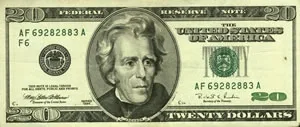
On the front of the twenty is the co-founder of the Democratic Party, Andrew Jackson (1767-1845, President No. 7, "ruled" from 1829 to 1837). The back depicts the White House.
Civil War hero General Ulysses Simpson Grant (1822-1885) shed so much blood of noble Southerners that he not only deigned to become President No. 18 (1869-1877), but also adorned the $50 bill with his portrait. On the other side is the Capitol building, the residence of the US Congress.
And finally, the image familiar to our compatriots of an honorary member of the St. Petersburg Academy of Sciences, Benjamin Franklin: the $100 bill.
From two to a million
Currently in America, banknotes of $2, $500, $1,000, $5,000, $10,000, and even $100,000 are in circulation.
Two-dollar bills have long become a rarity due to their limited print run. This note features a portrait of Thomas Jefferson (1743-1826). On the reverse side is the estate of the illustrious US official Monticello (from the Italian "Little Mountain"), built according to his own design. On Jefferson's birthday (April 13) and in honor of the 200th anniversary of the United States (1976), an issue of commemorative banknotes was made, the front side of which remained the same. But on the reverse side is a reproduction of the painting "Declaration of Independence of the United States." In 1995, another release of such banknotes was made. These notes are of no particular interest to numismatists: they can be purchased for about five bucks.
In 1969, treasury notes of $500, $1,000, and $5,000 were withdrawn from wide circulation - respectively with portraits of Republican William McKinley (1843-1901, 25th President - from 1897 to 1901, killed by an anarchist), Democrat Stephen Grover Cleveland (1837-1908, twice President - from 1885 to 1889 and from 1893 to 1897), and the author of the US Constitution and President No. 4 James Madison (1751-1836) on the front sides. Any of these banknotes, should it surface somewhere, would immediately go to the Federal Reserve Bank, which would send it for destruction. The need for large denominations is small, and they were not issued later. If you are lucky, you might still encounter a banknote with a portrait of Salmon Chase, who headed the national treasury during Lincoln's time, on a $10,000 denomination. And only if you are pursuing a career in banking do you have a chance to hold in your hands a bill of $100,000 adorned with a portrait of Woodrow Wilson. This is the so-called gold certificate of the 1943 series, which was used in settlements for transactions between Federal Reserve banks and the Treasury.
However, in the fine resort town of Clearwater on the Gulf of Mexico, for $17 you can also buy a $1 million banknote. These tickets are produced by the International Association of Millionaires. A nice souvenir from Florida with the inscription on the back: “This certificate is backed only by the solvency of the American dream.”