
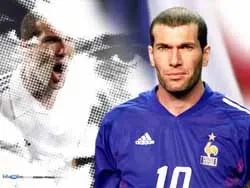
Two weeks ago, the FIFA disciplinary committee in Lausanne put an end to the 'Zidane - Materazzi' affair. Both players, one might say, got off lightly: Zidane was symbolically banned for three matches (he has finished his career) and fined $6,000. Materazzi will miss the next two matches with the Italian national team and will pay $4,000 for verbal insults. The main thing is that Italy retained the World Cup title, and Zidane kept his 'Golden Ball' - the prize for the best player of the World Cup. And yet, fans will long remember the headbutt that the Frenchman delivered to the Italian defender in the World Cup final.
Many were shocked by the French striker's action, because everyone was used to a different stereotype - the image of a cool, dignified macho, a virtuoso who does incredible things with the ball... Unlike, say, David Beckham, Zidane never made a show of his life. At Real Madrid, there was no theatrical hype around Zizou; he warmed up in the company of football millionaires with the dignity and slowness of a first violin. Even the tabloid press broke their teeth on Zidane: the tabloids tried to attribute stormy affairs to 'the most gifted footballer of his generation.' But his wife Veronique, of Spanish origin, stated that she trusts her husband one hundred percent, and attempts to dig into Zinedine's personal life stopped.
It would seem Zizou had everything - worldwide fame, multi-million dollar contracts, and enormous love from fans. And suddenly he committed an act that did not fit this charismatic image: that's how thugs fight in the Parisian suburbs. Or maybe Zidane, despite all his millions and trophies, remained in his soul the son of downtrodden immigrants from Castellane, the most disadvantaged district of Marseille?
Southern Blood
The parents of the 34-year-old footballer still live in Castellane. But now not in a small apartment, but in a large house, a gift from their famous son. The Zidanes originate from a small Berber village located in the Kabylie region of Algeria. Family legend has it that Zinedine's father Ismail came to Paris in the 1950s seeking a better life and settled in the suburb of Saint-Denis, where the famous Stade de France, the arena of the French national team's triumph at the 1998 World Cup, is now located. A few years later, the family moved to Marseille; the atmosphere of this Mediterranean port was closer to the elder Zidane. Ismail worked as a warehouseman and was often busy at night, which meant little Zinedine - a 'delicate and sensitive child' - could not sleep. However, when it came to a football, there was no trace of delicacy: often all the light bulbs at home were broken. They played football everywhere in Marseille, not only with balls, which were a luxury for many, but also with any other objects - cans, bottles. There were enough difficulties in the life of immigrants, so the father taught his five children a simple philosophy: work twice as hard and never give up - only then could they survive. And already in childhood, Zinedine stood out for his indomitable desire to win. At school, the future captain's grades were, to put it mildly, not brilliant, so Yazid (his second name) concentrated all his efforts on football.
When Zidane was 14, football luck smiled on the boy. A persistent kid was noticed by a perceptive football scout and recommended to the academy of the club 'Cannes', where he could play from morning to evening. However, Zidane had one problem - a hot temper. Jean Varraud, the first coach of the future star at Cannes, later said that his protégé reacted very painfully to offensive remarks from peers and was ready to immediately rush into a fight. The mentor tried to channel the boy's outbursts of aggression into the game and did so, it must be said, successfully. At not quite seventeen, Zinedine Zidane played in the first team of the club. True, according to Varraud's recollections, the future star spent his first weeks at Cannes washing dishes in the kitchen and tidying up the club. That's how they punished those who used their fists. The newcomer beat up a player who made a sarcastic remark about his Algerian origin. Keeping himself in check and not reacting to insults was beyond his strength.
Roland Courbis, coach of Bordeaux - the club Zidane moved to in 1992 - had quite a time with Zizou. It was especially difficult in the first two years. 'We immediately understood that we had an outstanding talent in our hands,' recalls Courbis. 'But sometimes we also felt helpless. There were moments when nothing could be done with him. I couldn't lend Zizou my head! And he had no shortage of stubbornness.'
Vivat Zizou!
Meanwhile, Zidane's football career was racing ahead at full speed. At Bordeaux, he tasted his first international success in the 1995/1996 season, when the club reached the UEFA Cup final. And two years earlier, Zizou's performances for the national team began. In August 1994, Zidane was brought on as a substitute in a match against the Czechs, and he immediately scored two goals. Unsurprisingly, at the 1996 European Championship, French coach Aimé Jacquet showed great trust in the player from Bordeaux and gave him plenty of playing time. 'At that time, he was distinguished by his magnificent technique and an irresistible desire to break through at all costs - qualities without which a top-class footballer is impossible,' recalls Jacquet. Zidane's fame grew, and soon leading European clubs began to hunt for Zizou's golden feet. In the summer of 1996, the player moved to Juventus and immediately won the Intercontinental Cup with his new club. The 'Old Lady' then defeated the Argentine River Plate. Moreover, Juventus became Italian champions two years in a row (in 1997 and 1998). But Zidane's finest hour awaited him at the Stade de France, where in the final match against Brazil he scored two goals. France became world champion, and two years later also won the European Championship.
Fame changed Zizou's character little. He still adored his hometown, often visited Castellane, and repeatedly said that only in the Marseille slums did he feel at home. One of Zizou's brothers, Farid, coached the local football team, which elected Zidane as its lifelong president. Zidane could spend a long time kicking a ball around with the boys to feel like a carefree kid again. He missed this so much in Italy, where paparazzi watched his every move. Popularity began to bother him. Véronique, who grew up in hot Andalusia, also complained: she didn't like the humid Italian climate and the fact that the children were constantly sick in winter. Juventus president Agnelli then lamented for a long time that he couldn't keep Zidane: 'The wife rules everything there, and that's the whole problem.' It must be admitted that from the beginning of their marriage, Véronique took control of the family into her own hands. A former dancer, she perhaps asserted herself in this way. In the end, the move to the Pyrenees happened. Zizou accepted an offer from Real Madrid, which offered the star a salary of between $5.6 and $7.2 million per year (figures vary across sources). Who could resist such an offer?
The move to Madrid allowed Zidane to breathe freely. He organically fit into the star-studded Real Madrid team, which gathered the greatest players in the world - Luís Figo, David Beckham, Roberto Carlos... Zizou's exquisite play helped Real Madrid win the 2001/2002 Champions League final against Bayer Leverkusen - this title was exactly what was missing from Zidane's award list. Everyone admired Zidane's fantastic talents: FIFA named him Player of the Year three times (in 1998, 2000, and 2003). But his play for the French national team seemed to not go well. At the World Cup in Korea and Japan, an injury prevented Zidane from playing, and he appeared only in the last three matches. A bitter disappointment was the French team's defeat to Greece at Euro-2004. After that, Zidane decided to end his appearances under the national flag. But a year later, it became clear that Raymond Domenech's charges were doomed without their captain's help, and Zizou returned. As a result, the French team showed excellent play in Germany. On the eve of the final, the French swore: 'We will die together.' They really wanted to win, and when the tension is so high, it's hard to show the best result. Zidane dreamed of leaving undefeated after his last, 108th match for the national team... But after the fateful headbutt to Materazzi's chest, the entire French team was knocked out. Although Lilian Thuram, the French team defender, believes that the captain's expulsion did not affect the final result of the match. But for Zizou himself, it undoubtedly tarnished the triumph: 'I'm not surprised by his reaction, but he shouldn't have done it on the field! Zizou made a mistake and he knows it.'
The Dark Side of Strength
Zidane's football career only looks glossy at first glance. It also has dark spots. Few people know that Zizou was sent off fourteen times! Apart from the Materazzi incident, the most shocking was the clash with Jochen Kientz of Hamburg during a Champions League match in 2000. For that outburst of anger, Zidane was suspended for five matches. He also distinguished himself at the 1998 World Cup, when in a game against Saudi Arabia he attacked Fouad Amin and was also 'neutralized'. As a respected English newspaper wrote, apparently Zidane's fits of rage arise from a conflict of two cultures. Hot Algerian blood does not allow him to tolerate insults, while European rules of decency require constant self-control. As Zidane's agent Alain Migliaccio put it, 'he is usually silent, but sometimes the cork flies out of the bottle with a pop.' This time, the 'pop' was deafening.
What now? France will most likely forgive its idol, or has already forgiven him. Especially since Zizou apologized to the fans live on air. Simply and in a manly way. Zidane's sponsors assure that this act will not affect the footballer's contracts. Advertisers agreed that the scuffle with Materazzi was 'a childish gesture, so now the star will be closer to the people.' Last year, for example, Zidane's earnings from advertising contracts amounted to €8.6 million - more than his 'main job' salary at Real Madrid. At the dawn of his career, the unsociable and taciturn Zizou was of little interest to advertisers. But in recent years, the advertising business has appreciated the modest charm of the French national team captain.
Although Zidane firmly announced the end of his career, Real Madrid will continue to pay him a salary because the footballer's contract ends in a year. Zizou postponed the final decision - whether to play or leave. And yet he put an end to it. He wanted the club management to know in advance in order to find a replacement. However, now, after Juventus's defeat in the Italian football corruption trial, stars like Cannavaro and Zambrotta will most likely end up at Real Madrid. So the royal club will have enough stars.
Zizou speaks cautiously about his future. He wants to spend time with his family in Madrid (he and Véronique already have four sons - Enzo, Luca, Theo, and Elyas, who is not yet a year old). Especially since the president of Real Madrid offered the footballer a project related to youth football. True, his French national team colleagues are sure that 'kindergarten' is not his scale and he will definitely return to the team, say, as head coach. However, Zidane doesn't want to look that far ahead. Summer holidays are ahead, and many things can be thought over leisurely.
"I never stopped fighting. This need has been inside me since deep childhood. Every day I remember where I come from and what I have achieved: a boy from Castellane, an Algerian from Marseille, a Frenchman who is now recognized on the street... There is something to be proud of," muses the great footballer, who was recently named the most popular Frenchman of all time. Zidane's fame in France today is so great that the popular slogan "Zizou for president!" is no longer seen as a joke. Does Zizou have a chance to occupy the Elysee Palace? Why not, the devil knows!.. But what if the President of the French Republic, Zinedine Zidane, loses his temper and headbutts one of the G8 leaders? That would cause a stir!..