
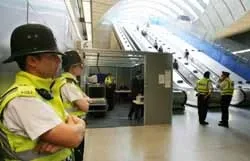
It should be noted, however, that Scotland Yard, contrary to the tradition observed by all police forces around the world, is not being stingy with information this time. And it is no surprise – the 'bobbies' have something to be proud of. A major terrorist attack, quite comparable to the one that occurred in New York in September 2001, has been prevented. 24 people have been detained (another two with British passports were arrested by Pakistanis), five are wanted. Almost all are young 'third-generation emigrants', that is, born in Great Britain not even children, but already grandchildren of Pakistani refugees. One is a so-called 'white mujahid' – a young Englishman who converted to Islam and joined a terrorist organization.
According to British intelligence services, the London police 'tracked' the terrorists until the very last moment to be able to catch them red-handed. The alleged attack, in their words, was actually just a 'dress rehearsal', and the explosions themselves were to occur in a couple of days. There is more than enough evidence of the crime: two suicide bombers even recorded farewell video messages on Thursday, August 10.
This incident alarmed a great many people across Europe. Airports immediately tightened checks on passengers traveling to the US. It is now forbidden to take liquids, bottles of creams, colognes, and other perfumes into the cabins. In addition, transporting mobile phones, laptops, and cameras in carry-on luggage has been banned. Recall, the terrorists intended to make explosives from two types of liquids carried on board separately, which in pure form pose no danger. An ordinary flash bulb was to serve as a detonator. All this led to numerous flight delays, queues, and cancellations. But passengers do not complain – life is more precious.
Among security specialists, the London events sparked a lively discussion. In the opinion of most of them, this attack is not directly related to the ongoing military conflict between Israel and Hezbollah. However, the terrorists' actions bear the characteristic hallmark of Al-Qaeda. One of Germany's leading anti-terrorism experts, the head of the Essen Institute for the Study of Terrorism and Security Policy, Rolf Tophoven, stated: 'A typical Al-Qaeda parallel operation was planned, simple to execute and therefore difficult to uncover.' In his opinion, the main target of the terrorist strike was the United States, the 'Great Satan' of Islamists worldwide. Nevertheless, he and his colleague Klaus Hirschmann believe that the order to carry out the operation did not necessarily come directly from Osama bin Laden.
The main problem, which emerged a year ago after the attacks on the London Underground, is that we are dealing with so-called 'homegrown terrorists' – young Muslims, natives of Europe, who joined the radical camp, as they say, 'on the spot'. They have British citizenship by birth and know European society from the inside. They are well integrated. Therefore, they are incredibly difficult to identify. These are very young guys who know about Al-Qaeda from TV shows and the Internet. For them, this organization embodies, above all, the idea of the so-called 'jihadist international'. It is easy to recruit such people – their heads are already filled, by the time of 'conversion', with romantic notions about 'Allah's warriors' who defeat diabolical monsters – America, Israel, India, Europe... at the cost of their lives, whichever 'teachers' conveniently at hand point them to.
According to experts, no country of the European Union, including newcomers, can feel safe. The situation is particularly serious for Great Britain and Germany – as recognized 'American sidekicks'. Moreover, Germany got onto this list not after the coming to power of Angela Merkel's government, but much earlier, in 1999, when it sent its sailors and marines to catch arms dealers on the so-called Horn of Africa, and Bundeswehr soldiers to Afghanistan. For a long time, terrorists regarded Germany as their 'sleeper car' because the rules for accepting political refugees were perhaps the most lenient and vague in the entire EU.
However, the situation has now changed. Therefore, Tophoven believes, the question is no longer whether something similar could happen in Germany. The question is when it will happen. Part of the answer was given last week, when two primed propane bombs were found in two regional trains traveling through Dortmund and Mainz. However, despite the fact that in one of the packages the police found scraps of a bag from a Beirut supermarket, the German Federal Prosecutor's Office cannot yet give a precise answer as to who is behind this attempt. Nevertheless, everyone acknowledges that Islamist groups exist in the country, they are strong and numerous. And in connection with the events in Lebanon, the German Federal Office for the Protection of the Constitution officially warned the government that members and supporters of Hezbollah, which is considered a legal socio-political organization in Germany, may 'undertake attempts at illegal violent acts'.
One of the main 'birthmarks' of modern Islamist terror, experts believe, is its focus on causing large-scale damage. 'Today's terrorists are primarily interested in the number of potential victims – five or six killed is not enough for them,' Tophoven believes. 'The more victims, the greater the shock society experiences. Piles of corpses have a terrible demonstrative effect.'
Despite the success of the British police, absolute security was and remains an illusion. It is impossible to protect all possible targets. The only way to reduce the level of threat is to intercept terrorists before they can do anything. However, preventing terrorist attacks is becoming more difficult: the time gap between the recruitment of terrorists and "targeting" is becoming shorter. This can be seen in the example of the London events: as the British police report, all the terrorists had recently been in Pakistan, and literally a couple of weeks later they received money transfers to buy plane tickets for the planes they intended to blow up. The plan of the attack itself is simple – complex, comprehensive planning is easier to detect. So in the future, terrorists will most likely "go into action", so to speak, overnight.