
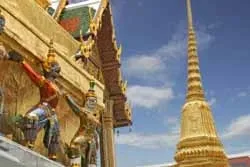
Bangkok is still quite young by historical standards. For example, it is 79 years younger than Saint Petersburg, although its residents can be proud of something else - the full name of the city is listed in the Guinness Book of Records as the longest place name in the world.
Once upon a time, Bangkok was a small settlement. Merchant ships entering from the Gulf of Siam into the mouth of the Chao Phraya River would carry out customs and border formalities, and on European nautical charts this point was marked as a village where wild fruits vaguely resembling plums grow - that is roughly how 'bangkok' can be translated.
Now, everyone who has purchased tours to Thailand and used the services of international airlines flies to the new Bangkok airport Suvarnabhumi. Four years after the start of construction, at the end of 2006, thirty kilometers east of the capital of Thailand, on the site of Snake Swamp (as the name of the place Nong Ngu Hao translates), one of the largest airports in the world appeared, capable of handling up to 7 flights per hour on two parallel runways. It was created according to designs by designers from the USA and Thailand, so in the grand complex of glass and steel, located on an area of 3,100 hectares, one can find features of both Eastern and Western architecture.
Slinging my backpack over my shoulders, I exited the seven-story passenger terminal and headed for the free shuttle bus going to the bus station, and from there I took public transport to Bangkok.
Meeting the whole world
I stayed in a place where 'the whole world meets.' That's the name of a café located on Khao San Road. Although Thailand loves grandiose names, in this case the café's name is justified - any foreigner, an independent traveler, upon arriving in Bangkok, will first show up on Khao San, where the cheapest hotels - guesthouses - are concentrated.
It's immediately obvious from newcomers where they have returned from: if a T-shirt with a skull and crossbones and the inscription 'Caution, Mines!' - from Cambodia, if with a red star on a khaki background - from Vietnam, and if it says Beer Lao - naturally, from Laos. In the evening, when the heat subsides, it's pleasant to stroll along the walls of the Royal Palace and the naval base, encountering angelically sweet, giggling young female cadets with slanted brown eyes, who giggle at the sight of tall, wide-eyed, long-nosed farangs, i.e., foreigners. To leisurely parade to Wat Pho, with its 46-meter statue of the reclining Buddha, preparing for parinirvana. To descend to the pier, where at sunset a charming view opens onto the Temple of Dawn, Wat Arun, standing on the other side of the river in the Thonburi district, which during the reign of King Taksin was the main monastery of the state.
But these are places that can be found in any guidebook. Every time I come to Bangkok, I visit Wat Phra Ruettharam. This place is not touristy. Here lies, propping up its head, the second largest Buddha after Wat Pho, and grows an ancient sacred Bodhi tree, once brought from Ceylon - under which the prince of the Gautama clan attained 'enlightenment'.
And also in the monastery are kept the holy incorruptible relics of a Buddhist monk - a meditation master. And on Sunday evenings, dozens of his followers gather here - parishioners who come to practice Vipassana meditation, trying to escape from worldly bustle even for a few hours.
South of the City of Angels
On Monday I head south. The first day of the week colors Bangkok yellow - on this day the current King Rama IX was born. According to Siamese tradition, each day of the week corresponds to a specific color, and yellow is the king's color. Sincerely wishing a long life to their monarch, who is over eighty years old, people dress in yellow. And the more yellow, the stronger the king's health will be, the longer the years of his wise reign.
Slowly getting out of the gas-filled, overcrowded metropolis, an hour's journey from Bangkok I find myself in another world with a different pace of life - a small sleepy town called Samut Sakhon. Old men sitting in the shade of an awning by a store play improvised checkers - one has bottle caps from Pepsi, the other from Coca-Cola. A war of giant corporations on Siamese soil. Not waiting for the historical finale, I - a fan of native kvass - move towards the exit past the fish market.
The next stop is Phetchaburi, but this name in the mouths of Thais sounds like Pitburi. At the entrance to the city stands the building of the TAT agency (Tourist Authority of Thailand), and a smiling Thai woman, in a tonal mutant of English, long and diligently tells about the city. Foreign tourists are rare guests here, and she is clearly pleased to demonstrate her knowledge: you need to go to the caves outside the city, and very close, on a hill, stands the royal residence Phra Nakhon Khiri Palace.
Although you can go up by cable car, I heroically climb the steps on foot, repelling the attacks of insolent monkeys that rule the mountain. In Wat Suwannaram, which, as the brochure promises, has well-preserved frescoes from the Ayutthaya period, I linger briefly. Near the temple there is a holy place. This is Tham Khao Luang cave. Its entrance is locked, but in Thailand, as in our country, after moving a few dozen meters to the side, almost always you can find another open door (except, perhaps, the Royal Palace in Bangkok). I enter from the flank, find an alternative side passage, and descend.
Among the Sea Gypsies
On the way to the city of Phang Nga, surrounded by high cliffs, I met a toothless, cheerful Thai man who, clearly not expecting a positive answer, invited me to his village as a guest. When I accepted the invitation, his joy was exuberant.
My new acquaintance lived in a village of sea gypsies, who made a living by fishing and transporting tourists on 'longtail' boats to the island of Phi Phi, celebrated in the cult film 'The Beach' starring DiCaprio.
Along a long wooden gangway, we climbed up into the stilt house, took off our shoes, leaving sandals on the porch next to large plastic barrels that serve as a shower. The interior of the house was gypsy-Spartan: a spacious room divided by a partition into two spaces — one a bedroom, the other a hallway. An old color TV, a kitchen — a table, a gas cylinder with a stove — that, in fact, was all the furnishings of this dwelling, built of bamboo and palm mats.
Dinner was ready, and the hostess began to treat us to what either Buddha or Allah had sent: rice, packet noodles, cucumber salad, and for dessert bananas in coconut milk syrup and seeds. After dinner, the host took me — his 'catch' — to show off at the local club, a karaoke bar.
As an overseas guest, I was seated next to the host at the best table, next to the TV. At his command, all three beautiful daughters, who also worked as waitresses, began to fan me with cardboard menus — there was no fan in the establishment. The other customers looked enviously in our direction. The pride of the establishment's owner was only somewhat dampened by the fact that, due to my ignorance of Thai words, I could not join in his swan song to the melodious Thai karaoke tunes.
That night I dreamed of gypsies dancing in a circle around a fire, Nikita Mikhalkov scooping green tea from a large tub and singing Thai songs arm in arm with the karaoke bar owner. And in the morning I woke up and went on to Krabi, continuing my journey through Thailand.