
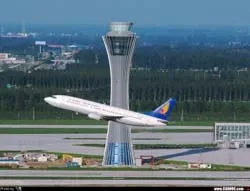
As Novye Izvestia notes, the grandiose in concept and scale Terminal 3 began accepting its first flights in February. According to its creators, the new air gateway of the Celestial Empire is the largest building on Earth. Beijing Capital Airport, which ranks among the top ten largest airports in the world, is located in the northeastern part of Beijing, 25 kilometers from the famous Tiananmen Square. It is not just China's main air gateway and a "window to the world." The airport is the hub of the radial route network of the country's entire aviation. Every day, it handles an average of 1,000 flights, and this summer there will be almost twice as many. It is undoubtedly the largest Chinese airport with the widest range of services in the country and the highest traffic volume.
Notably, throughout almost its entire history, Beijing airport has been constantly expanded and reconstructed. The latest construction work here was completed very recently — on the eve of the Beijing Olympics. But who can say for sure that this is the end of the endless process of reconstruction and modernization? In a country with the most dynamically developing economy and a steadily growing population, the airport must meet the needs of people and society, and therefore regularly break records in expansion. Fortunately, if anyone cannot complain about a labor shortage, it is China.
Even Two Terminals Turned Out to Be Not Enough
Beijing Capital International Airport, under the control of the Civil Aviation Administration of China, officially opened in 1958. Terminal 1, covering 60,000 square meters, as well as adjacent auxiliary areas including a parking complex, began operations in 1980. It was designed to handle 60 flights daily. All structures of Beijing International Airport meet the standards of the International Civil Aviation Organization (ICAO).
Soon, the development of the country's aviation business, the increase in air passengers, and the growing volume of cargo transportation forced it to expand. Due to the continuous growth in the number of foreign airlines served at the main Beijing airport, as well as the increasing density of flight schedules, another large-scale reconstruction was undertaken in Terminal 1 in 1995-1999. As a result, in 1999, Terminal 2 was opened, which today occupies an area of 336,000 square meters. It can rightfully be called a true masterpiece in the high-tech style! The maximum capacity of Terminal 2 is 26.5 million passengers per year.
The Largest Terminal in the World
In February 2008, Terminal 3 opened at the airport, designed by the star of world architecture, the Briton Norman Foster. Foster's architectural firm is known for projects such as Hong Kong's Chek Lap Kok airport and London's Stansted. In Russia, Foster is known as the developer of the ambitious project of the 120-story "Russia" tower in Moscow City (600 meters, considered the tallest building in Europe). But let's return to Beijing.
Terminal 3 stretches almost 4 km. From above, its silhouette resembles a flying dragon from Chinese folk tales. At the same time, the recognizable folk tradition is amazingly combined here with high-tech geometry — mesmerizing intersections of straight lines, symmetry of light and reflection. It is worth visiting this terminal just for a tour, bringing a camera.
The new terminal consists of three large sectors – C, D and E (sectors A and B remained in the first and second terminals). Sector C is dedicated to check-in for domestic and international flights, and there are also more than 40 boarding gates for domestic flights. Sector E houses immigration and border control, pre-flight screening, and customs. Behind them is a huge waiting area with endless cafes, restaurants, and Duty Free shops. Also in sector E is a spacious transfer zone for passengers making a connection in Beijing and waiting for their connecting flights. Terminal 3 was conceived, among other things, as the largest international hub (today the leading transfer hubs in Asia are Seoul and Singapore). It is through Beijing that transfer routes pass from Siberia to South Korea, Malaysia, Vietnam, Singapore, Australia, New Zealand, the Philippines, and Bali. Plus the entire Pacific coast of America and Canada.
And finally, sector D is temporarily closed to regular passengers. This is where charter flights with athletes, coaches, and fans for the Olympic and Paralympic Games in August and September respectively will arrive.
The new air harbor, which accepted its first flights on February 29, became the largest airport terminal building in the world. Its internal area is 1.4 million square meters, which is 60% larger than the previous volume of the entire airport. It is no wonder that about a dozen nearby villages had to be demolished for its construction.
Construction of Terminal 3 lasted four years and cost the Chinese a hefty sum – $3.65 billion. Almost immediately after its opening, the terminal began serving flights of six leading airlines – British Airways, El Al Israel Airlines, Qantas Airways, Qatar Airways, Sichuan Airlines, and Shandong Airlines. At the end of March, Terminal 3 began operating at full capacity. According to the airport management's plans, all 26 airlines will move here from Terminal 2 this year. Among them are Finnair, Japan Airlines, Chinese Air China, Shanghai Airlines, Dragonair, Air Macau, and Russia's S7 Airlines.
Terminal 3 houses 64 restaurants with national Chinese and Western cuisine, and 84 stores. In addition, it is equipped with the most modern baggage handling system costing $250 million – the latest development from Siemens AG. This system can process almost 20,000 bags and suitcases per hour. The new runway allows it to handle all types of modern passenger aircraft, including the double-decker Airbus A-380.
Do not lose vigilance
In Beijing airport there are many Duty Free shops, but planning serious (and especially souvenir) shopping there is hardly worth it: prices on local goods are sometimes ten times higher than in markets and souvenir shops in the city. This rule applies not only to branded clothing and accessories, but also to so-called consumer goods like copper enameled cats or paper fans. But what is really worth buying are traditional silk scarves and handmade shawls. In airport shops you can purchase a truly original, beautiful item at a not exactly low, but quite reasonable price. We strongly recommend: during shopping, vigilantly watch your personal belongings. One of the authors of these lines had to involuntarily part with his favorite camera at Beijing airport – an item carelessly left on the store counter will most likely be gone forever. In any case, the seller is unlikely to run after you shouting 'Madam, you forgot!' as happens in similar situations in Europe or America.
Thanks to the convenient geographical location, 66 airlines currently fly from Beijing Capital International Airport, of which 11 are Chinese and 55 are foreign. From here, more than 5,000 regular routes go to 88 Chinese cities and 69 foreign destinations. The airport's capacity is 76 million passengers per year. 50 million passengers use it annually; in 2008 the airport plans to bring this number to 60 million.
Beijing airport can boast very convenient transport connections with the outside world. Shuttle buses constantly run between terminals collecting passengers. From the airport by shuttle bus you can go to the areas of Fangzhuang, Xidan, Yabaolu, Gongzhufen, Zhongguancun, as well as get to the city's railway station. Distances are minimized: the longest bus route takes only 30 minutes, and shuttles depart as they fill up. Travel time to central Beijing by monorail is 18 minutes.