
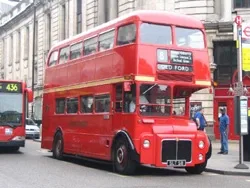
As a workhorse, the Routemaster (or RM for short) took on the lion's share of passenger traffic in the European metropolis. According to statistics, out of 8.5 million trips that city residents make daily on public transport, 5.4 million are by bus (for comparison: a million are carried by rail and another 3 million by the underground). In London, bus routes, if added together, stretch for 3,730 kilometers, of which 205 are specially designated "exclusive" lanes. In short, for Londoners, the RM and its brethren are not a festive delicacy but an everyday staple, part of daily life, business routine, and ultimately a way of life.
In its time, the Routemaster appeared as an advanced intellectual product, created by postwar pragmatists who recognized the urgent need to find a worthy replacement for trams and trolleybuses. Moreover, a replacement that could also compete in comfort with the rapidly multiplying cars of such popular makes as Austin and Morris. The creators did a splendid job: to this day, the RM remains relatively quiet, and in terms of the number of innovations, albeit looking somewhat archaic today, it even surpasses its descendants in some ways.
The lighting was soft, unlike today's fluorescent lamps. There was a standard basket for used tickets. Passengers on the lower deck can adjust the cabin heating, and if they want to find out whether there are free seats on the upper deck, a large mirror attached to the staircase is at their service. Under the stairs sat the conductor's seat, nicknamed "cubbyhole" - that is, a snug, cozy spot. On the upper deck, the last row was unofficially considered a "lovers' corner," and everyone respected their undeniable right to occupy it.
But the most attractive feature of the RM was the open platform at the rear, where anyone could jump on while moving and just as quickly leave the vehicle if they suddenly saw a kiosk passing by and they had forgotten to buy an evening paper or noticed a sign in a shop window about a sale. Now, as Travis Elborough laments, "by the time you get off at the other end of Oxford Street (London's main shopping street), you are unlikely to want to walk back." The freedom of choice - getting off when you see fit - was also valued when there was a traffic jam or a traffic light stuck on red for a long time. The friendly atmosphere on board was created by the crew: the driver plus the conductor, and the latter not only sold tickets but also seated elderly passengers and mothers with children, advised which stop to get off at, and how to reach one's destination.
Oddly enough, at first almost everyone met this creation of engineering and design thinking with hostility. Only the fourth version - improved taking into account all the complaints - began to be produced on an assembly line in 1959. In total, British craftsmen assembled 2,900 Routemasters. Each was designed for a service life of up to 17 years. As a BBC commentator touchingly put it, it was "a triumph of pragmatic engineering, which meant they were easy to maintain in a technically sound condition, they were cheap to run, and they were sturdy and durable."
The last RM "left the slipways" as far back as 1976. So those that have survived to this day can rightly be compared to dinosaurs. This is insistently hinted at by proponents of technological and other progress. A certain Fabien on the BBC website paints a very bleak picture: "These buses were quite uncomfortable and unfriendly when it came to the elderly, people with children and strollers, and the disabled. Conductors were usually rude and useless. Although I do admit that some people even now regret that steam cars and horse-drawn carriages have become a thing of the past..."
In fairness, we must admit that the open platform is a source of increased risk. Under the new safety standards adopted, including in the European Union, it is nothing less than a dangerous atavism from an era when the internal combustion engine was considered the pinnacle of scientific discovery, and the number of "self-propelled" carriages was in the thousands, not tens of millions. Now you can use this type of transport even if you are in a wheelchair - everything is provided for. However, voluntary advocates of the Routemasters countered these arguments: the old-style conductor could help people with physical disabilities, and the "jumpers" run little risk, given that in conditions of immense congestion on the capital's highways, the average speed of any wheeled transport does not exceed an average of 16 km per hour...
However, back in 1967, Transport Minister Barbara Castle issued a verdict that was not subject to appeal: the Routemasters had exhausted their shelf life and outlived their time. The entire enterprise was nationalized, conductors were eliminated "as a class" - leaving only drivers (they were sometimes called "Lennon and McCartney on the road") - and the government promised subsidies to those who were ready to offer a standard bus with a rear-mounted engine. In the 90s, several hundred surviving RMs were given a shine and polish and allowed to continue driving. And that is what they do. They were replaced by single-deck "bendy" buses, which carry not 64 (maximum 73) passengers, but as many as 140. They are more economical and are less likely to be involved in accidents: to be precise, four times less often.
...Farewell to the Routemasters (they were also called "diesel Beefeaters" - guards of the Tower of London fortress) has been going on for years now. Many traditionalists have not come to terms with it. Phil Wilson, representing the association of RM owners and drivers, speaks disparagingly of the successors, which externally "resemble square boxes, as if their authors consider a brick to be their ideal." Graham Harper is more emotional, for he drove these living legends around the city in the 80s-90s: "First they drove the pigeons off Trafalgar Square, now they are getting rid of the RMs. What next? Maybe we'll turn Buckingham Palace into a five-star hotel or casino? Or turn the Tower into an amusement park? How about renaming the Thames?"
Don't be sad, Graham: for the RM there is life after death. When regular service ends, several of these aluminum rarities will operate on tourist routes for those who, as one skeptic Ted Cardiff put it on an internet forum, “would like to stay in the past.” If that is not enough for someone, they can preserve the relic for personal use: the antique “horseless omnibus” is already being bought for 2-12 thousand pounds sterling to convert into a bar, restaurant, or office. Others rightly argue that the “Routemaster” will also adorn a country plot. All that remains is to electrify it, buy reliable voltage stabilizers, and connect water supply...
And the future belongs to buses of a fundamentally different technological quality - for example, the environmentally friendly Citaro model developed by the Mercedes concern. These smart machines run on hydrogen obtained from natural gas (six cylinders are mounted on the roof), and the only emission into the atmosphere is... water vapor. There is nothing the RM could oppose to this.