
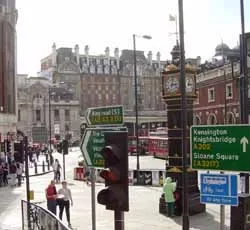
"Girls for work as masseuses. Experience not required. Salary up to 400 pounds," – twenty-five-year-old Tomasz Maszkiewicz translates for me, chuckling, the advertisement written in Polish. The ad, on a sheet of bright green paper, is stuck on the window of a newsagent's shop in the London district of Hammersmith. This is the local "Wailing Wall." Not the Jewish one, as in Jerusalem, but a Polish one – in London. It all started with a few ads in Polish that the shopkeeper allowed to be stuck on the window a couple of years ago, hoping that it would attract customers. His calculation proved right: today the whole window is covered from top to bottom with colored papers, on which hundreds of advertisements for offered work or job seeking are written by hand in English and Polish. At the "Wailing Wall" stand dozens of men and women of different ages with notebooks and pens. They diligently copy the phone numbers of potential employers.
"Four hundred pounds – in Warsaw that is a very good monthly salary," says Tomasz. Ten days ago he arrived at London's Victoria coach station by bus from Warsaw, which he reached after several hours from his native Płock in central Poland. Tomasz did not come to London with nothing – his older sister has already been working there as a waitress for over a year. But he does not want to become a waiter: "I could find that kind of job in Warsaw too." In London he hopes to find an office job – so that four years of studying economics and languages at university would be put to use.
London today is full of people like Tomasz and his sister Monika. As early as the summer of 2004, the composition of checkout staff in supermarkets changed dramatically. The dark-skinned, Eastern-featured Ali, Mehmet, Samira and Zukhra disappeared somewhere, and their places were taken by light-eyed and fair-haired Adam, Lech, Danuta and Monika. Polish names and accents almost instantly became typical in London's service sector, and a little later throughout Britain. Today, two years later, when ordering coffee, hiring a cleaner or calling a plumber, a British resident will most likely encounter a recent labor migrant from the East – one of more than three hundred thousand Eastern Europeans who came here after the EU expansion on May 1, 2004, in search of a better life. Many in Western Europe feared this day. In "old Europe" politicians, economists, journalists, trade unions, and ordinary people seriously feared that immediately after EU enlargement hundreds of thousands of Eastern Europeans would flock there, ready to work for pennies and take away jobs. Therefore, 12 of the 15 countries of the "old EU" introduced restrictions on labor migration from the new member countries.
Countries with regulated labor markets demanded that the previous rules be preserved for Eastern Europeans: they could work only with the appropriate permits. The European Commission agreed to delay the decision (the transition period is seven years). For now, only three countries – Britain, Ireland and Sweden – have opened their labor markets to Eastern Europeans. They believed that migrants would benefit flexible labor markets. Indeed, in less than two years more than five hundred thousand people from Eastern Europe moved to these three countries (significantly more than expected before EU enlargement), but no catastrophe occurred. On the contrary – the experiment turned out to be quite successful.
The Migration of PeoplesLabor migrants literally flooded the British Isles. At the beginning of 2004, Britain's Deputy Home Secretary Tony McNulty, who oversaw migration, said that between 5,000 and 13,000 migrants from the new EU states would enter the country annually. The Conservatives, who criticized the government, cited much higher figures – up to 70,000-80,000 a year. In reality, the influx turned out to be even larger: from May 2004 to December 2005, 329,000 migrants entered the country. By April 2006, this figure is expected to reach 400,000. That is, 200,000 people enter Britain from the new EU countries each year.
Quite a few Eastern Europeans also came to neighboring Ireland – in the twenty months since EU enlargement, 160,000 migrants (about 90,000 a year). For a country with a population of 4.8 million, this is a lot – today those who came from the new EU countries account for 2.4% of all working-age residents. As for Sweden, only 10,000 people came in a year and a half. "Britain and Ireland are English-speaking countries, and English is the most popular foreign language in Eastern Europe. There are more vacancies in these countries than in Sweden. It is easier to find work. It is also easier to quit, if necessary. Plus, in London, Manchester and Dublin there were already communities of Eastern Europeans that new migrants could rely on at first," says Martin Ruhs, senior researcher at the Centre on Migration, Policy and Society (COMPAS) at Oxford University.
The main supplier of migrants was Poland – the most populous of the new EU countries with an unemployment rate exceeding 18%. According to official data, in less than two years 270,000 Poles arrived in the British Isles (two-thirds to Britain, a third to Ireland). Many labor migrants came from Lithuania, Slovakia and Latvia (from the Czech Republic, Hungary, Estonia and Slovenia – significantly fewer).
Young Eastern Europeans – 83% of migrants are young people aged 18-34 – are especially ready, at least initially, to take any job, even if their level of education and skills would allow them to do something more qualified. Irina Chernyak, 22, who came to London from Tallinn after graduating from university (her diploma speciality is "marketing and advertising"), initially worked at a real estate agency and in a shop. But after a few months she was able to find a job in her field; now she does marketing research and, as she admits, is generally satisfied: "In Estonia, finding such a job right after university would have been harder." Different migration
Contrary to the gloomy forecasts of opponents of open borders, migration did not lead to an economic catastrophe. In February 2006, the European Commission published a report in which it assessed the effect of migration from the east to the west of the European Union as “exceptionally positive.” Migration contributed to economic growth and an increase in the total number of employed people. At the same time, it did not lead to higher unemployment or increased social benefit payments in the countries to which immigrants flocked. The newcomers did not take jobs away from locals; they filled existing vacancies, especially in sectors and regions that were unpopular with native workers.
According to data from the British labor ministry, since May 2004 the overall share of employed people in the economy has grown by almost 3%. Officials explain this by the fact that many Eastern Europeans who had previously worked in the country illegally came out of the shadows and registered officially. Only 1,200 out of 300,000 migrants received social benefits in Britain. Speaking about migration in early 2006, Tony Blair praised Eastern Europeans for their strong work ethic, which British employers are very pleased with. “We opened the gates for those who wanted to work, and the new migrants have shown that they really come to work and increase prosperity,” the British prime minister said.
In Britain and Ireland there are hundreds of thousands of vacancies, especially in remote rural areas, that have gone unfilled for years. These are usually positions that did not appeal to local residents – construction workers, bus drivers, agricultural laborers. According to the British labor ministry, 24% of new migrants found work in hotels and restaurants, 14% in agriculture, 9% in construction, and 8% in the food industry. The average earnings of arrivals were $7.9–10.5 per hour – slightly above the British minimum wage ($7.9 per hour). And even for these earnings, which are low by local standards, migrants are willing to travel to the most remote corners of the country. By the beginning of 2006, Eastern Europeans accounted for more than 1.5% of all employed people in the North of Scotland, West Wales, and rural areas of Eastern England.
Professionals are also heading west. Imre Bohn, a 33-year-old doctor from the Hungarian city of Miskolc, received a letter from British headhunters in early 2005. They invited him for an interview in Budapest. After Bohn was offered a job, he spent three months on special preparatory courses in medical English, which were paid for by his future employer. He now works at St. Mary’s Hospital in London – one of the institutions of the British National Health Service (NHS). British recruitment companies report a whole wave of requests to search for professionals – doctors, architects, financiers, engineers – in Eastern European countries.
Among the migrants there are also entrepreneurs. One of the features of migrant integration in Britain is that many of them start their own businesses. The share of entrepreneurs among newcomers is almost twice as high as among the local population. In London, businesses are actively growing, either serving new migrants – for example, grocery stores with Polish, Lithuanian, and Hungarian products – or providing them with jobs – construction companies, car repair and electrical equipment repair firms.
However, not everyone manages to find a job. About 15% of those arriving in Britain and Ireland return home after just a few months. At the “Wailing Wall,” they tell stories of dishonest employers who refused to pay, problems finding housing, and difficulties opening bank accounts. Since new migrants do not have access to social benefits, they cannot immediately use homeless shelters or look for vacancies in state employment centers after arriving in the country.
Pressure drops
The outflow of labor to the West has also benefited the countries migrants leave: unemployment has begun to decline almost everywhere. “The chance to go to Britain or Ireland has eased pressure on labor markets in Poland, Slovakia, and the Baltic states. Especially in depressed regions – where heavy industry has closed and finding work is difficult. Migration has reduced the overall unemployment rate and led to employers valuing their employees more. After all, if they are unhappy with their working conditions, they can go to Dublin or Newcastle. That is why wages are rising and working conditions are improving in these countries,” says Katinka Barysch, chief economist at the London Centre for European Reform.
Of course, unemployment in the east of Europe will not decline indefinitely. In the former socialist countries there is a large group of unemployed people who find it difficult to get a job even when unemployment is low. These are mostly people over 45 whose previous qualifications are no longer needed due to the closure of heavy industry, and who find it hard to acquire new skills. The departure of young people, especially from certain sectors, has led to a local shortage of workers. As a result, Poland and the Baltic states have been forced to import workers and construction workers from Ukraine, Belarus, and Russia. Thus, today at the Gdańsk Shipyard, where Poland’s Solidarity was born, almost a third of the workers are Ukrainians.
The migration flow has led to a redrawing of Europe's economic map. With EU enlargement, Eastern European countries experienced a boom in low-cost airlines. Irish airline Ryanair now flies to 15 cities in the region, and British Easyjet to 14. Fast business aviation is also developing at an accelerated pace in Moscow and other major cities.
I send my parents $400 every month. Thanks to this, they were able to rebuild their house and afford a higher standard of living," says 28-year-old Malgorzata Motshitska from the Polish city of Legnica. According to estimates by the London-based Economist Intelligence Unit (EIU), the total volume of money transfers from Britain and Ireland to Poland in 2006 will amount to $6.5-7 billion. Part of these incomes will be spent on consumption, part on investments. The same Malgorzata came to London in September 2004 and found a job in a tanning salon. A year later, Motshitska, who has a degree from Wroclaw University, became a salon manager. Now she is saving money to return home in a few years and open her own tanning salon, for which she plans to allocate the first floor of her rebuilt parents' house.
Vaccine against multiculti
Such sentiments are already reflected in the migration policies of European countries. Britain, for example, announced a new points-based system for assessing migrants in early March. This innovation will practically close the door to low-skilled migrants from outside the EU. The Indian and Pakistani communities, for instance, are unhappy about this, but according to polls, more than 80% of voters believe that only highly qualified specialists should be allowed into the country.
Eastern European migrants often end up in established diasporas. For example, a community of 100,000 Poles lived in Britain even before 2004. Part of it existed since the late 1940s, when Poles fled from Poland to escape the socialist authorities. Part are migrants from the 1980s and 1990s, as well as those who arrived very recently – some with work permits, some illegally. Over just two years, the Polish community has tripled. Today, three Polish newspapers are published in London, and cultural centers and new schools are being built. Polish Catholic churches, which were relatively empty five years ago, now hold Sunday mass in three shifts. And even then, some parishioners have to pray on the steps of the churches.
An unexpected consequence of migration from the new EU member states has been the sharp growth of the Russian-speaking community in Britain and Ireland. Up to half of migrants from Lithuania, Latvia, and Estonia are Russians and Russian-speakers who hold citizenship of these countries. Many of the "Baltic Russians" see no prospects for themselves in their homeland – some because of national policies, some because of the small size of the states themselves – and therefore try their hand in the British Isles in a variety of roles, from builders and nannies to programmers and financiers. According to some estimates, of the approximately 200,000-250,000 Russian-speaking residents of London, about half are migrants from the Baltic countries.
More mobility
The success of Eastern European migration to Britain and Ireland has become further proof of the superiority of their labor market model over the continental one. "This experience shows that the enlarged EU is approaching a more market-based labor market model, in which mobility grows and the supply and demand for labor are subject to market laws rather than the strange decisions of Paris and Berlin, which try to avoid participation in the single labor market and actively protect their labor market under the pretext of protecting workers' interests. As a result, they get high unemployment, declining employment, and low growth. That is, exactly the opposite of what countries that opened their labor markets received," says migration specialist Danny Sriskandarajah of the London-based Institute for Public Policy Research.
In its February report, the European Commission recommended that other EU countries not wait until 2011 and lift the moratorium on labor movement earlier. The authorities of Spain and Finland have already announced their intention to open their markets to Eastern Europeans in May 2006. Portugal, Greece, Belgium, and the Netherlands may also lift the moratorium in the near future. However, Germany, Austria, France, and Italy insist on maintaining the current system. They believe their labor markets are not ready for a large-scale influx of Eastern European migrants. So these states will drop out for several years from the emerging highly mobile labor market that increasingly links European countries.
Meanwhile, already today about a hundred thousand Britons leave to live in Spain every year. Approximately the same number of Spaniards head north to London, Dublin, Stockholm, and Amsterdam. Many of the Eastern Europeans who have flooded the British Isles do not intend to stay there forever. Some want to return home in the future with experience, language, and capital. Others plan to live on the warm shores of the Mediterranean Sea. The mobility of Europeans has significantly increased, and the labor market is becoming more competitive and flexible. This brings the EU closer to its long-cherished goal – competing with the highly mobile US labor market. Americans are much more inclined to move thousands of kilometers in search of better working and living conditions. Now Europeans are ready to follow the same path – at least those who do not rely on help from trade unions and the state.