
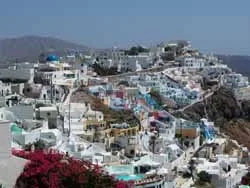
That is what the Venetians who landed here called it – the island of Saint Irene. And in Greek it is called Thira – the same as the town considered to be its capital. I'll end the historical-geological prelude here – this information can be read anywhere. I'm about something else.
About the first of the two hotels we stayed at, it was written that it is two hundred meters from the sea. When we got off the bus in the square of the town of Perissa and asked where Villa Clio was, we were told: 'Two hundred meters that way...' In reality, 'that way' was no less than a kilometer. And from our villa to the sea it was also by no means two hundred meters. Throughout our entire stay on the island, these 'two hundred meters' haunted us. Whatever you asked about, everything was two hundred meters away. 'Two hundred meters,' even if you shoot yourself.
The thing is that these 'two hundred meters' are just a mockery, an excuse, a way to get rid of visiting fools infected with arithmetic, whom all of human experience has not taught that distances cannot be measured by a number of some conventional segments. Here, in the cradle of civilization, it has long been understood that distances are not described by numbers.
Depending on the weather you plan to go, on foot or by donkey, young or old, whether you can see the sea from your path, whether you are in a good mood in the morning, and many other things. The main thing, however, is that the Santorinians, unlike the inhabitants of the plains, live in three-dimensional space and walk up and down more than along and across. For example, from the port to Fira there is no distance at all on the map. Fira just hangs over the port from above.
When you approach the island, it looks like a piece of black bread sticking vertically out of the horizon, sprinkled with sugar in places. That snow-white scatter is the Santorini towns. There are two ways from the port to Fira: a cable car and a donkey path. And the Church of Saint Epiphany, for example, is simply inserted (how?) into a small niche in the middle of a vertical cliff, at equal distances from its base and top. How many meters to it? A stupid question.
On Santorini they receive tourists and make wine. The wine is not exported anywhere; it is drunk right there. They don't transport it because it is too delicate for that and because there is simply not enough of it. The island is only 15 by 5 kilometers, may the Santorinians forgive me for using numbers.
Grapes are grown here with great difficulty – strong winds blow away the thin layer of soil on the volcanic ground. Therefore, there are no familiar vineyards here. Each vine, producing two or three bunches, lies right on the ground in a hollow, surrounded by a wicker fence. They care for it individually and painstakingly. The wine, mostly white, has a completely unique taste and aroma. It should be drunk in wine cellars scattered in abundance around the island, and traveling from one to another is best done on a quad bike. On the left is a cliff, on the right is an abyss. The main cultural institution of the island is the Museum of Winemaking. We looked for it for a long time, and then it turned out that we were zipping past it almost every day on our four-wheeled Yamaha. That building simply has nothing resembling a museum – no portico with columns, nothing.
A cool underground room, a long bar counter with a bartender-guide. You have to wander through the catacombs with a telephone handset that tells how it's all done. Then return to the bartender-guide for a tasting. He asked us where we are from, who we are.
- Americans, – said my wife.
- Russians, – I said.
- € – said the bartender-guide.
I had to explain for a long time that I am a Russian Jew, my wife is Russian Russian, and together we have been US citizens for a long time. The bartender-guide looked sympathetically at people who cannot properly explain who they are. To change the subject, I nodded at the speaker from which music was coming:
- Mario Frangoulis?
- Ye-e-es… – the bartender-guide said in surprise.
Frangoulis was followed by George Dalaras, and then Haris Alexiou. I solemnly announced the name of each performer. The thing is, when I travel, I shoot amateur video and overlay a soundtrack of local music, and I prepare the music before the trip to feel what and how to shoot. When it came to Yannis Ploutarchos, the stunned bartender-guide approached a small Greek family of about 15 people, perched at the other end of the counter, and loudly whispered something to them, pointing at us with his eyes. In the whisper I heard the familiar word 'xenos' – foreigner, foreign. The family moved closer to us, and the tasting smoothly turned into a demonstration about filoxenia.
The word xenophobia – hatred of the strange – has firmly entered the Russian language, but its antonym – 'filoxenia', hospitality – has not, which is a pity. Villa Filoxenia…
In Greece you feel how much Greek there is in the Russian language. All signs are understandable – 'Ceramics', 'Typography'. 'Polemiko' means something military. There are, however, slip-ups. 'Yes' in Greek is 'ne'. Open? – Ne. You leave, then realize and come back. Is this seat free? – Ne. Is there beer? – Ne. We got used to it, but it was already time to leave. And 'no', as it happens, is 'ochi' in Greek. You can just feel how a person laments that something is missing: – Ochi, ochi, ochi…
Having learned at the museum how, what and with what to drink, we continue the race around the wineries, but now with knowledge. In the cellar you take a large tray laden with filled glasses and go up to the veranda. You must drink only on the veranda, because drinking is accompanied by looking around. Each of these two processes is good on Santorini in itself, but when combined, they produce an unexpected devastating synergistic effect. You don't understand what makes you more drunk. These verandas were wisely placed in the highest spots, so you can look at the island and the sea for hours.
At the same time, you need to alternate wines correctly. First - white 'Butari' and 'Nikteri' from unripe grapes, then - rosé sweet 'Visanto'. Snack on various types of cheese, of which the most exquisite is goat 'chlóro'. And when you get tired of that, you can also have 'kalamata' olives. When alternating varieties, you should chew a specially made cracker that neutralizes the taste of the previous wine – God forbid one flavor overpowers another. And carefully look around. Over there to the southwest you can see the town of Akrotiri – they are conducting excavations there, trying to understand whether Atlantis was here or not. There in the middle of the island the town of Pyrgos gleams white. Under a little tree sit several deeply tanned gray-haired men, fingering dark purple rosary beads, staring at the dazzling white church wall. The wall serves as a backdrop for a little girl in a red dress riding a gray donkey along it. This function of the wall plays no less important a role in Greece than simply separating the church from the outside environment and supporting its dome.
Further north you can see the town of Firostefani and our hotel Margarita. A sun-drenched square paved with white stone is slowly crossed diagonally by a woman dressed all in black. She is very old, leaning on a stick, but her back is straight. My eyes, trying to make out the black, set such an aperture and exposure on the retina that the square begins to glow with unbearable white radiance, as if you are looking at the sun. The woman moves toward a bench standing under a skinny olive tree. There is her face. How old is she? Two thousand? Four? The face seems carved from the local brown lava, just as pitted, but divinely perfect. In these parts, old age looks no less beautiful than youth. What is her name? Gaia? Athena? Hera? Aphrodite?
Quiet music comes from the cellar. Another glass and we change from close-up to wide shot. If you peer at the horizon to the north, far, far away in the haze you can see the island of Ios. To the east – Anafi, to the west – Milos. To the south should be Crete, but it's not visible – too far. To see Crete, you have to soar higher. I'll have to go down for the next tray. Butari… And there, Crete appears. You drink in this beauty with your eyes, and your soul peers into the cool molecules of grapes that have mysteriously formed into Santorini wine. Gradually you understand why the ancient Greeks had so many gods. One alone could not create such perfection around. Of course, a whole workshop of designers was at work – Zeus, Cronus, and Helios. Another tray and silly thoughts come to mind. For example – why am I not an ancient Greek... That means it's time to find my motorcycle...
We took a boat to the island of Nea Kameni. This is the central part of the crater of the very volcano that, as many researchers believe, destroyed Atlantis. And Santorini is the peripheral part of the crater. There is also a version that the famous powerful eruption caused the disasters that befell Egypt and forced the pharaoh to let Moses and his people go into repatriation. But not another word about history.
No one lives on the island, and the volcano is smoking in places. It's September, but it's hot. After half an hour of scrambling up steep slopes, the accompanying lady allowed us to stop and drink. It turns out we should have brought water with us, but the previous lady from whom we bought the boat ticket didn't mention that. Beyond the ridge of the mountain we finally climbed, the next one appeared, then the next, then the next… That's how this damn volcano is built. The heat intensified. I remembered the film 'The English Patient'. That episode where he drags the body of his beloved wrapped in a parachute through a similarly hilly desert.
I wonder what they do with the bodies of those elderly or weak-hearted people who didn't know and voluntarily came on this excursion. And what happens here in August, for instance? No phones, no pharmacies, no water sources… Though there it is, the hot volcanic vent. Now it's clear where the victims of thoughtless tourism go. Ne...
We returned to the port and decided to go up to Fira not by cable car, as we came down, but on donkeys. One adventure was not enough for us. About the donkeys: men stand there, all somehow over seventy, although Greeks look so young that maybe these are all ninety. They all stand in blue satin caps and shout in bad English: 'Donkey, donkey, donkey!' Donkeys, they say, citizens, donkeys. And they shout so piercingly that, for example, it's impossible to sit quietly on the shore in a restaurant. You walk through a line of barkers and show with your submissive look that you agree to a donkey. They put you on a stone fence and bring up a donkey. You climb on.
Actually no, I forgot. First we pay. The fare is €3.5. Exactly the same, by the way, as the cable car. Exactly three and a half is what few people have, and everyone shoves any bills and waits for change (fools). The old men in blue caps say that change will be given at the top when we arrive. One American, looking like he's from the middle states where they vote for Bush, gives a twenty and doesn't move a step away from the donkey driver. We line up in single file. We start moving. The hell begins.
Some particularly piercing little bells ring deafeningly, and the excessively lively century-old drivers shout at the donkeys in good Greek like Jericho trumpets. The road is incredibly steep and winding, and the drivers walk on foot. Because the donkeys absolutely do not want to go in single file, but on the contrary, want to go in a line abreast. They find it more fun. But the road is one and a half donkeys wide. Those unfortunates who end up on the donkeys at the ends either rub their legs against the rocks or hang over a bottomless abyss. The little fence separating the donkey from the abyss does not even reach its knee (do donkeys have knees? Well, never mind, no time for that now).
You dig your nails into that donkey fur until they bleed. Oh, what a sadistically brilliant idea to give change at the top. After all, hardly anyone gets there! The serpentine path dizzyingly twists into knots: you no longer understand where the rock is and where the abyss is—they constantly swap places. Up there is my wife on a brown donkey—look, she's still holding on! But the most amazing thing is those two-hundred-year-old Methuselahs. The donkeys are already at their last gasp, panting, barely moving their knees, stumbling, stopping, while the old men, in some endless syrtaki, holler, hop from one donkey to another, yell at riders—no, what riders, there are no riders on donkeys, just some sacks of sawdust.
We arrive. We collapse on the ground. Change, we just want change… No way. The old men visibly age before our eyes and don't return the money. They theatrically wipe sweat from their foreheads. Breathe heavily. They explain that this particular ascent was incredibly steep, and only a complete scoundrel would take away their last money, earned by such inhumanly hard work. An American from the middle states, where they traditionally vote for Bush, calmly explains to everyone that he will of course tip, but not sixteen and a half euros. You can see in his eyes that he's converting euros to dollars, and it comes out even more. Nah. We only gave ten euros, so three went as a tip. You have to vote for Democrats, sir.
We watch from above the cheerful old men galloping down for new victims. Roguish cavalry. Though what cavalry, they're donkeys. However, interestingly, there are only two types of civilization: equine and asinine. The equine are aggressive: Budyonny's cavalry, Genghis Khan, Huns, Cossacks, cowboys... But on a donkey, you can't charge into battle with a saber drawn. And it's hard to slash heads off from the shoulder and burst into burning villages.
But on a donkey, it's more convenient to circle a vineyard. A donkey belongs where there are olives, sea, music. Of course, there are more famous people among riders than among donkey riders. But they're all kind of... Napoleon, Alexander the Great, Charles V, Vasily Ivanovich... And then equine civilizations ended badly. Where are they all now? Cowboys seemed to last longer, but it all ended with a change of sexual orientation. And the exact same thing happened with the Cossacks. Who would have thought.
But asinine civilizations live and prosper. There are fewer heroes on donkeys, of course, but what names: Jesus Christ, Sancho Panza, Molla Nasreddin. By the way, if mullahs hadn't gotten off their donkeys, fewer troubles would have been caused. The Pope too would be better suited riding a little donkey than a Mercedes. Somehow he would be closer to the one whose deputy he considers himself. Nah...
There are many churches on Santorini. Divinely beautiful, snow-white, with blue domes. Of course, we must go to church.
Sunday, 'kyriaki' in Greek, I put on long pants, my wife ties a scarf on her head. The closest church is closed, so is the next one, and all of them. We ask why they're closed. Well, it's kyriaki today, they answer. Strange, they're Orthodox. Simera, Monday – the same. Paraskevi. Friday. We drive to the Monastery of Prophet Elijah on the highest mountain of the island. Behind the fence is a small church. At the entrance sits a man in a baseball cap and shorts, and he won't let people in shorts into the church. Later we were told that indeed many churches on the island have closed. Parishes are simply emptying, fewer and fewer people attend churches.
Taverns, on the other hand, are always full. Among the waiters, there are many from Eastern Europe—you can always speak Russian with them. They told us that it's impossible to stay in Greece permanently and become a citizen if you are not Greek by nationality. So much for filoxenia...
We sit in the evening in a restaurant with live music. Accordion and bouzouki. Bouzouki is an essential instrument, and the second can be any: violin, guitar, accordion. Suddenly the lights go out. All over the island at once. Only on the highest mountain, the Monastery of Prophet Elijah is lit. Next to it is an air defense radar station, they have their own wind turbines, of course. They explain that this is a common occurrence on Santorini. Everything here is imported—from fuel to drinking water. Therefore, firstly, everything is expensive, and secondly, there are interruptions with anything.
The restaurant workers run to their cars, arrange them in a semicircle and turn on the headlights. The evening continues. Also filoxenia... But the feeling is eerie. We always dined at the same tavern on the shore. Around the fifth or sixth day, my wife, dreamily gazing at the horizon, asked: 'Why yesterday we had dolma with wine, and earlier souvlaki, but today only beer with olives, and the bill is always around 22.30? I leave them 25 on the saucer, but it's strange, why is the price almost the same every time?'
We have it that my wife handles the finances. I say: 'Show me the bill.' Indeed, 22.30. In large digits. I start examining the receipt. I look smaller in the corner, it says €6.20. Damn, 22:30 is the time. Yeah, that's when we usually finish. No wonder the waiters liked us so much.
A fairytale island. All cruise ships sailing the Eastern Mediterranean stop here. Santorini cannot be missed.
We, feeling like locals after a couple of days, know that you can't go up from the port in the morning—it's packed with cruise passengers. Same in the evening in the opposite direction. The line for the cable car gets enormous. But the main pilgrimage is to Oia, a town on the northwestern cape of the island. From there you have to watch the famous Santorini sunset. To the left and right, snow-white villas, churches, and hotels are 'glued' to the slopes of dark brown volcanic cliffs, which are quickly repainted by the sun first into pink, then into crimson colors.
Almost instantly, the nearby islands below are painted with ink: Nea Kameni, Palea Kameni, Thirasia, and Aspronisi. The sun sets between Thirasia and Nea Kameni. People stand shoulder to shoulder. The sunset is beautiful, but in such a dense crowd it doesn't work.
We, however, are not tourists; we live here. On our four-legged Yamaha we find amazing places for both sunset and sunrise. For example, Amoudi Bay with its deserted black beach right below Oia.
Beaches on Santorini are named after the color of the lava that makes up the surrounding cliffs and sand. Besides black ones, there are red and white ones. Santorini is ready-made painting. That is probably why so few artistic masterpieces have been created based on the local landscapes. The painter simply has nothing to do. Everything has already been done. Sometimes this powerful color expression even tires you. Well, in Santorini, as in the rest of Greece, as is known, there is everything. You can leave the sea and the cliffs with little houses and go deeper into the plain part of the island. A monochrome scorched landscape, dry dust covered with gray thorns, a lonely fig tree with an old forgotten chair underneath. A different kind of beauty.
On the first day of arrival in Athens, when we had just driven away from Eleftherios Venizelos Airport, on the very first fence we read the inscription 'fuck capitalism!'. Well, well, I thought, you guys haven't tasted communism. Then, after spending half a month on Santorini, I realized that this inscription contains no ideological content. It is not because they don't like capitalism (some, at least) that they want something else, but because they don't want anything at all. Nothing connected with numbers, rules, work, and other boring things that restrict a person's freedom. Olives, wine, bouzouki, the sea.