
Conclusion. Beginning in No. 27 (338).
A Doctor of Philosophy's Girls' Universities
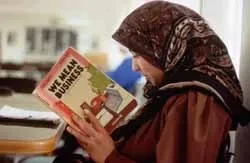
The famous women's university in Qom bears the name of Fatima, the daughter of the Prophet Muhammad. Near the fence of the old madrasah building, in unimaginable heat, a car is waiting - Mrs. Mianji, Doctor of Philosophy, one of Qom's best teachers, a specialist in Koranic sciences, a woman of high political standing, has come to pick me up despite the day off.
She informs my escorts that she is taking me. Men like them won't be allowed into the madrasah anyway, and there will be no problem with translation, since the whole world and all languages are represented at the madrasah.
On the back seat is her younger daughter. She is ten years old, so she already wears a tiny chador - with the same grace as her mother. Dr. Mianji has three children in all; her eldest son is already married. It is hard to believe - the fragile scholarly lady wrapped in a chador looks too young. Her husband is also a Doctor of Philosophy.
We drive to a new, spick-and-span, huge educational complex. At the gate two guards ask for a pass, although they know Mianji well. "The peace of women in Iran is especially protected. A woman may enter wherever she wishes. But a man cannot enter a women's territory," she says. "A woman can get into any train car, a man - only into the men's car, this is how it must be according to Islam, but not all Islamic countries follow the rules. Our women are under the protection of the law, not under its oppression; many foreigners simply do not understand this. Women in Iran hold on to Islamic rules; these rules give them many rights, more than a woman in the West has - until you understand this, you will not understand Iran."
Men never go past these gates except on Saturday morning. At that time electricians, computer specialists and other craftsmen are invited in while the girls are in class. At the entrance, girls in black stroll about. But inside the complex, the same students run, jump, play and do sports - girls in ordinary clothes and without any headscarves. Most are in jeans and T-shirts; Pakistanis and Afghans wear national dresses with flowing scarves; Americans wear skirts (which you rarely see in America - there it's mostly jeans and trousers).
They surround me. We exchange handshakes and kiss three times. The girls eagerly ask questions and tell stories; the whole conversation is translated into Persian and English.
At the madrasah there are 200 unmarried girls and 600 married women. The unmarried live here in the educational complex, in spacious bright rooms that are surprisingly cool, although outside the heat is terrifying. In the living rooms carpets with cushions are spread out: each can easily accommodate twenty-five people. Everything is very elegant and looks least of all like a dormitory. For married women a separate family dormitory has been built.
Study, accommodation and food - all free
We get acquainted. Amina, an American - a white Anglo-Saxon - converted to Islam in the States, worked as an elementary school teacher in Los Angeles. "How did you convert? By the will of Allah!" she smiles. "I read the Quran and understood that the truth is right here. By the will of Allah, I will return to America." She intends to work as a teacher.
She cannot understand what I am talking about when I ask whether she will have difficulties at home: "With Islam? No. With the hijab? No. Of course, I will be able to teach at school in a hijab - we are not persecuted for that, inshallah! My relatives are still afraid of my choice and of the fact that I am studying in Iran. But that's just their heads filled with propaganda."
I ask whether it is easy for an American woman to enter Iran. She answers so calmly, as if nothing special had been required of her: "I waited for a visa for two years in America. Then another two months in Syria. I came here two months ago. If by the will of Allah I ended up here, then by the will of Allah everything else will work out too."
"Excuse us, our wushu lesson is about to begin" - a group of girls runs off to a shady area where a teacher is already waiting for them. Physical education is three times a week; they can play volleyball and basketball. They learn to drive a car; everyone is learning to use a computer, as well as many of the languages that this community speaks.
For six months after arriving they study Persian, then a five-year course begins, including Arabic, philosophy, logic, Islamic and Koranic sciences, Sharia and many other subjects. One can stay for another two years and obtain a degree.
"So you are in a country where everything is ruled by women?" I ask. Mrs. Mianji corrects me: "No, women rule the family, and the country is ruled by Allah."
In parting, Mrs. Mianji invites me to her home - to stay, live a while, talk. "It is no coincidence that you came to the Fatima madrasah during the days when her death is mourned; you cannot even imagine how the girls were waiting for you. We usually do not receive journalists," she says.
But I have to go to Tehran. Again threefold kisses, handshakes, exchanges of addresses. And then I am seen off by stern figures in black chadors.
Who Knows More Poems
I am riding in a taxi. My translator in the front seat is animatedly talking to the driver. I listen closely and realize they are speaking in verse. "Well, yes," the young man answers me carelessly. "We are playing to see who knows more poems by Saadi and Hafez. When he starts losing, he recites his own. You are in a country of poets, get used to it - every second person here writes poems."
Shocked, I text my colleagues, who sternly admonish in reply that two guys in a country of 70 million don't change the weather, that a plowman and a worker have no time for poetry. And in general, all people on earth are the same. Everyone wants money, good things, and to have their nose in snuff...
But it is enough to look around, standing at any point in Tehran, to stop trusting this everyday wisdom that levels everything and everyone. I persistently ask everyone I meet about poetry. Khayyam, Saadi, their own poems, poems by contemporary poets. Farhad and Shirin, Leyla and Majnun... If only we knew Pushkin and Yesenin that way!
Cucumbers and Samovars
A typical Friday scene: a carpet is spread on the grass in the shade, a family or just a lone Iranian sits beside it, and a samovar is nearby. Just like a Tula samovar, polished to a shine, with a tap and a teapot on top. Iranians drink black tea with sugar, nibbling the sugar as they drink, just like in our villages. True, not from huge mugs, but from small transparent glasses.
I go into a diner to eat. In general, eating here is somewhat of a problem. For example, it is difficult to eat and drink tea in the same place. Tea is served in teahouses. Food is in cafes. There are restaurants with dastarkhans, mainly for tourists. For Iranians and for those who prefer to eat sitting down, there are tables with chairs. You are served a mountain of rice, under which a huge kebab is "buried" - long cutlets made of lamb, beef, or chicken. I ask to have the kebab brought without rice. The waiter cannot believe his ears, asks again. And he brings the kebab separately, and separately the same mountain of rice. They don't understand how one can eat without rice.
In less pretentious cafes, you will be served a half-meter-long lavash with shashlik or the same kebabs. Along with that, they will bring a pile of fresh mint and cabbage with carrots. Pickles are served with any dish! A hamburger at a fast-food place is a patty, potatoes, and pickles, a popular meal for eating on the run. Although "fast" is only in name. You have to wait about twenty minutes.
I was walking through the bazaar in Tehran. The bazaar is a huge city quarter with its own mosques, restaurants, a special life, and trading routine. Next to the ancient entrance to the bazaar is the newest and cleanest metro.
The first person I met spoke to me in English: "From Moscow? I have an uncle who works at the embassy there!" He gives me his business card - indeed, I know his uncle. "Would you like to see real carpets?" I tell him that I am not planning to buy carpets and am in fact in a hurry to photograph a procession taking place through the bazaar on the day of Fatima's death. "Yes, they will go, but later." He leads me to his warehouse and there simply shows me carpets, explaining how they differ in quality and finish, without any attempt to make me buy them. Surprisingly, in the bazaar, as a customer, you are of little interest to the sellers - this is completely unlike the familiar image of an Eastern bazaar with inevitably pushy shopkeepers.
Black Queens
The more an Iranian family is oriented toward the West, the more ephemeral the headscarves, the tighter the trousers, and the shorter the dresses. But the more obligations a woman has. That is the paradox of Iranian life.
Women in Tehran carry nothing heavier than a handbag and, at first glance, do almost nothing. Outside Tehran, they prefer to wear white gloves as well - a subtle detail that emphasizes who is the boss at home. In their black coverings, which are not attached to anything yet do not slip even in the wind, Iranian women stride along, holding up their hems or clenching the chador in their teeth. Their husbands, meanwhile, carry children, bags, food, work, and take the family on picnics.
Women sit only in banks, pharmacies, fashion stores, and offices, where they shuffle papers and talk on the phone. Men do everything else. They even work in lingerie shops, which does not embarrass female customers in the least.
Persians are great patriots of their country. "Why did I come to Iran? Because I love Iran! Why do I live in Germany? Because my son is studying there," says a woman who sat down at my table in a cafe. "I don't have a job in Iran," says a theatrical designer living in Paris. "I would not have left anywhere if I could do here what I want. Why do I come back? And why shouldn't I come? I love Iran!"
Youth has the right
In any cafe-shop - that is what they call a European-style cafe with Western music and iced coffee - teenagers of both sexes hang out. Some girls are made up, some girls smoke at the back of the cafe. Many smoke at home, but not on the street, not on the go, and not in public. In cafe-shops, there are especially trendy young men, some with neat beards or sideburns, slicked with pomade and coiffed with special chic.
No one sits embracing or sprawling anywhere. Parks in Tehran and Isfahan are full of couples strolling or sitting on benches. No one arrests or harasses them - at least, none of my interlocutors could tell me anything of the sort from their own experience. In general, it is not customary in Iran to walk arm in arm or embrace. But pairs of girls or boys often walk hand in hand - this is an expression of friendship, not a sign of belonging to sexual minorities.
The morality police have not been abolished, but somehow it is not visible. I myself was several times asked by female guards at the entrances to state institutions, smiling and sympathizing, to hide my hair under a scarf. I saw such a case: at the airport, guards reprimanded an Iranian woman whose braid had slipped out from under her scarf. She shrugged, barely adjusted her scarf, and went on.
A Wife as a Problem
"97% of Iranians have one wife, divorces are rare, and we desire our wives, living with them all our lives, because you never fully know what secret is hidden under her veil," says the father of four children, glancing at his wife. "And Western men constantly see women's nakedness - they get bored, and always want to change them."
In Isfahan, along the multi-kilometer embankments, girls in full hijab, chadors, sneakers, and gloves are race walking. The sight, I must say, is mesmerizing and certainly far more fantastic than if they walked in shorts and T-shirts.
"Hit your wife? Are you crazy, she'll immediately go to court, and you'll never pay it off, you'll lose your family and everything in the world!" - In the eyes of my interlocutor, a tall and successful man, there is genuine horror. "A wife can demand mehr (the dowry that is given to her at the wedding not by her family but by the groom) immediately after the wedding, without any explanation of reasons," his completely Europeanized wife, who lived most of her life in Germany, joins the conversation with pleasure. "Mehr belongs to her and only her by law; if the husband does not give it, she can divorce him. And he will have to support her, pay for the children until they grow up. If the children stay with the husband, he still pays her, but she never pays him."
People get married like this. "I saw my future wife, went to my father and said I wanted to marry. My brothers and relatives watched her family - whether they lived well, whether they quarreled. Then my father went to her father - and that's it, we have been together for 22 years, I have no other wives nor temporary marriages," this is the story of a man who believes he married completely independently.
In Iran there is also temporary marriage - an institution of a marriage contract for any period of time. It can last an hour, or it can last a lifetime. Even in this case, the rights of children are stipulated if the woman becomes pregnant. A woman cannot marry within three months after a divorce. So the idea that temporary marriage is a hidden form of prostitution is more fantasy than reality.
Home of Khomeini
Finding the unremarkable little house of the ayatollah in Tehran is not so easy. The chic quarters of northern Tehran have ended; the crooked unpaved streets of the suburb get narrower and narrower. Further on foot only. Opposite a huge ancient tree are gates and an ordinary mud-brick wall. Behind it is a road uphill, hung with black flags, an ordinary mosque, and in the depths of the courtyard a two-room house with low ceilings. Imam Khomeini lived here without leaving for the last 10 years of his life. His hundred-year-old wife lives here to this day.
Portraits of Khomeini are everywhere in Iran. The West portrays him as a sinister old man, a symbol of the horror of the revolution. For Iranians, he is to this day a symbol of justice. In 1979, Shah Reza Pahlavi fled from the rebellious people. The Shah decided to remove the headscarves from women, encroached on the authority of the clergy, which had always been in opposition to the authorities, and wanted to grant American military personnel full immunity status.
It is enough to visit the Shah's palace, located in a huge shady park, and the more than modest house of Imam Khomeini to understand the difference between these symbolic figures.
"It will soon be 20 years since the Imam died. Then there were many of us; we guarded both the mountains and the sky, but now few of us are still alive," says old man Ahmad Fallah Mehrjerdi, one of the remaining members of the guard, who led me to Khomeini's house when everything was already closed. "In this very room your Foreign Minister Shevardnadze gave the Imam Gorbachev's reply to his letter. Here, in the corner, he sat; there was Shevardnadze. The Soviets then did not understand his letter. Right on this very spot the Imam predicted that your country would fall apart," says Ahmad.
"During the fast the Imam met no one and did not go out," Ahmad says. "They decided to paint the walls of the mosque next to his house for the time being. The Imam saw it and said to put it off until the time when all Iranians have had their houses renovated. So the mosque still stands unpainted."
During the Iraqi war, Tehran was bombed. Khomeini refused to go into shelter. "All Iranians cannot leave, and I don't want to," Ahmad recalls the Imam's words. I ask him whether it is true that Khomeini allowed girls to marry from the age of nine, as the Western press wrote. "No, that is some mistake," Ahmad is surprised. "The Koran says that girls from the age of nine read namaz, cover their heads in public, and do not greet strangers, but marriage is later; at nine, parents can only make arrangements for the wedding. What do you mean, the Imam could not have said that; he was an educated man!"
On the way from Tehran to Qom, in the desert, the mausoleum where Khomeini is buried is still being completed, as is the largest mosque in Iran. Both day and night, thousands of people from all over the country and the world are here. Many spend the night right there - on carpets or in the street. The floors in the mosque are made of onyx. It is crystal clear and surprisingly cool.
The mausoleum itself is behind glass. At night it is illuminated with green light. Everyone throws money into the slots - the mosque is being built only on donations. Mountains of money. They are collected once a week.
The Shah's palace consists of several mansions surrounded by greenery. Not the Winter Palace, but not bad either. Crystal chandeliers, a bust of Marie Antoinette, furniture resembling Czech from the 1960s. A whimsical Shah collection of paintings. At the entrance stand huge iron boots - all that the revolution left of the Pahlavi monument.
Mrs. Judaki Mujgan, the keeper of the museum, willingly answers questions. "The revolution gave women education. In the time of the Shah, they sat at home, wove carpets, weeded the vegetable garden and herded cows. They always wore the chador, but now they can study. Women have become independent, they earn money," says Judaki. For three and a half years of study at a private university, she paid $2,500. Most Iranian women study for free, especially from the provinces. The education system is European and American: you choose the number of units and master them as quickly as you can. "Our law says that the only thing a woman cannot become is president and judge. She is more emotional than men, such work requires more endurance. But our girls become lawyers, deputies, politicians," she explains.
Martyrs' Cemetery
In Russia they are called fallen heroes. The eight-year war, which socialist Iraq started against Iran with American, European and Soviet help, claimed a million lives. A whole generation. It lies in the martyrs' cemeteries. In Arabic they are called shahids - all who fell on the battlefield.
I approach the grave. Near a simple tombstone sits a small elderly woman on the ground. Mrs. Ezzad lost her son Hussein in that war. He was 22. He died 23 years ago. On Fridays she comes here to pray. She smiles, she is proud of her boy. Her elder son also fought, was wounded, survived, but the wounds took their toll. He too is in a grave — right here, in that part of the cemetery where relatives of martyrs are buried. Her youngest is now 18.
I ask: if there is war, will she let her son go or not. The old woman smiles bitterly: “I have no more sons except him, and there will be no more. If war breaks out, he will go to fight. It is his duty. My duty is to let him go. Inshallah, war will not start.” She knows that by law an only son is not drafted. But she also knows something else — that a man must defend his homeland. Ordinary people will send their children to the army. They serve even now — all of them, after university.
Families of martyrs receive a pension — about $120 per month. “This is a good help. But those families with good means refuse it,” says Mrs. Ezzad. “I know many who refused. While my husband was alive, we also refused. Now, while my son studies, we receive the pension. Thank you for coming.”
My companions also went through the war. Both were wounded. They kneel down next to the woman and, touching the tombstone with their hand, silently read a prayer. “Come, we will show you where our friends lie,” they say. We walk along the graves. Many have portraits draped with covers. We approach one. “This is my cousin,” says Hamed. He himself is now 39. In the portrait is a young man barely 18. “He was sitting in an excavator, digging trenches, shelling began. A bullet — and instant death. There are many of our friends and relatives here, maimed, seriously wounded, burned by chemical weapons. Many still die from wounds. By evening many people come to the graves. Over there sits a brother, over there a father.” They knew the dead, they know their relatives too. They do not weep for their loved ones. Those who want to bomb this country should come on Friday to the martyrs’ cemetery. And much will become clear about the character of this people.
Armenians as a symbol of Christianity
In Isfahan, the old capital of Iran, one of the largest Armenian communities. A high monastery wall of yellow clay. Behind it one can see buildings of whimsical architecture. In the middle of the courtyard — a belfry. At its foot — graves.
In the church I talk to the sexton Babken Charian. “In Isfahan alone we have 17 churches. There is a nunnery of Saint Catherine. Here there used to be a monastery as well, now our bishop serves on holidays. He is subordinate not to Etchmiadzin, but to Beirut. For us Armenians, it has been that way in the 20th century — two centers and two heads.”
On the walls of the 17th-century church there are paintings. Along the entire perimeter — frescoes showing in detail the torments suffered by the enlightener of the Armenians, Saint Gregory. I ask whether Muslims come. “Of course they come. They like everything except the fresco of the Last Judgment — too many naked bodies, they say,” Babken smiles. Meanwhile, an Iranian TV crew appears in the church. “They often film here, especially when the bishop serves.”
I ask whether Armenians fear war. “There will be no war. Who would dare fight Iran? For centuries we have been excellent warriors. And there is experience from the recent war. But all this fuss around Iran’s nuclear program is outrageous. It is impossible to talk to Iran in such a tone!” says Babken and advises me to be sure to look into the museum nearby.
The museum is simply a marvel of museum management. A huge 9th-century Gospel, a prayer book the size of a rice grain, a prayer on a gold wire visible only under a microscope. A sawfish saw. A giant tortoise shell. A portrait of a woman — the Armenian ambassador to Japan. Vast Armenian passports from 1921. 12th-century tombstones. Rembrandt and Aivazovsky. It seems they consider Rembrandt an Armenian.
Right there is a map of Turkey with points where the Armenian massacres of 1915 took place, photographs. “What are the relations between Armenians and Azerbaijanis in Iran?” I start a conversation with the caretaker. “We are citizens of one country; we have nothing to divide. It is Armenia and Azerbaijan that do not maintain relations because of Karabakh. What do the Armenians and Turks of Iran have to do with that?”
Instead of an afterword
I saw Iran completely different from what I had imagined before coming here. Not good and not bad — different, complex, and unlike any other country. I tried to understand its people — I did not always succeed. Here, very much is determined by faith — in people’s behavior, in their habits, assessments, behavior. Even of those who do not consider themselves Muslims observing all canons. Much remained outside this story. Including the topic connected with the fate of homosexuals in Iran. For most Iranians, this is a shameful topic. For our reader, it is unconvincing, since even a person who knows nothing about Iran is sure that for homosexuality they are executed there. I also thought so until I learned that in the very center of Tehran, in a square, people gather in the evenings who do not hide their non-traditional orientation at all. They gather every day, no one arrests them, drives them away, or conducts raids on them.
And one more important circumstance. The execution of two young homosexuals, held publicly a year ago, took place not because those young men were caught in a relationship, but because they raped and killed a 13-year-old boy. No world media publicized this fact, but simply informed the public that fanatical beasts kill innocent homosexuals only for their orientation, which is forbidden in Iran. Having learned all this, I lost interest in the topic of the morality police, which excites the imagination of Western critics of Iran.