
Photo: Ukrinform
Day One
Getting acquainted with Thailand begins at Bangkok airport - one of the largest and most modern in Southeast Asia. (Your gaze somehow stops on Indian tourists peacefully snoring right on the floor.) All Ukrainians, and our group of journalists is no exception, have to fill out several forms and pay 1,000 baht for a visa (a little over $26; you can exchange money right at the airport - the rate is quite good). You must have two color passport-size photos with you, but even if you forgot them, you can have your picture taken right here.
Finally, all formalities are behind us, and with suitcases stuffed with coats and other winter attributes, we leave the air-conditioned airport. We are met by a guide - a Thai named Ket. He once studied at Moscow State University, wanted to be a diplomat, and now works for a receiving travel agency founded by Poles.
"The Great City of Angels, the highest repository of divine treasures, the great land that cannot be conquered, the great and prosperous kingdom, the magnificent and remarkable capital of nine precious stones, the place where the greatest rulers live and a large palace is located, the dwelling of gods capable of reincarnating into spirits." Phew! This is not an extended epithet at all, but merely the full name of Bangkok. It is even listed in the Guinness Book of Records as the longest geographical name in the world. The Thais, however, call their capital for short - simply the City of Angels, in Thai - Krung Thep.
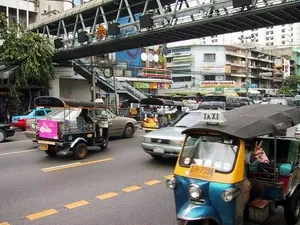
Towering skyscrapers surrounded by palm greenery peacefully coexist here with ancient monasteries and gold-shining temples, where you seem to fall out of time and space. But as soon as you step outside the sanctuary, you are sucked back into the whirlpool of life - smog, eternal traffic jams, motorcyclists racing at breakneck speed.
Our choice of excursions was limited to those places where filming is allowed. Unfortunately, we could not get cameras into the Royal Palace (according to TV people, once a film crew from Ukraine filming the palace without permission even had shots fired at them). They also do not allow filming in the famous temple - Wat Phra Kaeo - the very one where the 60-centimeter statue of the Emerald Buddha is kept, which the king himself dresses in new vestments three times a year.
But we did manage to visit (and even film!) two other, no less famous temples - the Temple of the Golden Buddha (made of pure gold, weight - 5.5 tons) and the Reclining Buddha. At the entrance you must take off your shoes, and if you wish, you can buy a "gentleman's set" - three candles, a lotus flower, and self-adhesive gold paper. The candles are lit and placed in an urn with sand, the lotus is placed in a bowl of water, and the paper is stuck on the bronze statue of Buddha. Only one thing remains - to make a wish. "And it will certainly come true, the main thing is to believe," says Ket.
But even he does not believe in fortune-telling with the help of Buddha. The Buddha-machine looks something like a one-armed bandit, and the fortune-telling goes like this: you throw in a coin (of any denomination) - the dial lights up a number. You take a piece of paper with the number that Buddha indicated, and you read the text (in Thai, English, and Japanese). I got number 10 - "Uncertainty. What is lost cannot be returned. A meeting with a person who will be a wonderful match for you. No luck in sight. Be careful."
Wat Pho monastery, where the statue of the Reclining Buddha is kept, impresses not only with the grandeur and size of the sculpture (46 m long), but also with some special atmosphere. Shrouded in semi-darkness and the smell of oriental incense, it symbolizes Buddha's immersion into nirvana. On the five-meter feet there are 108 mother-of-pearl ornaments. In total, on the monastery grounds there are 400 images of Buddha and 95 pagodas (chedi), where the ashes of emperors and their relatives rest. Tourists are genuinely interested in the stone statues guarding the entrance to the monastery, which somewhat resemble Ukrainian Cossacks, and among them there are also several images of Europeans (as it turned out, they represent Marco Polo). These giants were brought from China long ago, but at that time they had no historical value, and they were taken exclusively as ballast. Now the statues are an integral part of the temple complex.
A visit to Bangkok will not be complete without a visit to the largest jewelry store in the world. Our tourists have also taken a fancy to it. The store has more than two thousand employees, including more than a hundred first-class jewelers. You simply will not be able to leave without buying anything - tested personally. Advice - buy only products with stones (granites, rubies, sapphires, emeralds), because cheap gold can also be found in Turkey. Prices range from $10-15 for a silver and $150-200 for a gold ring (with stones) to $500 thousand for a necklace with emeralds - and that is not the limit. By the way, visit the Jewelbox.ru portal to better navigate jewelry prices. As the sales manager told us, from November to March the store's customers are mainly Russians: "Unlike Western tourists who come to Thailand alone, Russians come with families, which is why they are the most profitable customers." The store's salespeople, by the way, speak 17 languages and even take mandatory three-month Russian courses.
The first day in the land of sun and smiles ended with dinner on a motor ship. The gold of temples illuminated by lanterns and the neon of skyscrapers were reflected in the water, and I wanted to think that the fireworks were arranged in our honor.
Day Two
Our second day in Eastern Venice began with a boat ride along the canals. Skyscrapers floated past us, shacks standing directly on the water with laundry hung out to dry, piers, dazzling temples, pagodas, thatched-roof cafes and snow-white hotels. “Why do these people live on the water?” I ask Ket. “It’s simple: floating houses are much cheaper - about $5 thousand, while the price of an ordinary one-room apartment is from $25 thousand. Houses on the water are bought mainly by newcomers, then they save up money for more decent housing, and other new settlers move into their place.” - “What do they do during the rainy season?” - “During this time (from August to October) the government allocates temporary apartments for them,” the omniscient Ket answers with an unchanging smile. “And what do floating houses look like after a flood? Do you really have to repair them every time?” I don’t let up. “In general, yes, but the money for this is given either by the state or private companies.”
During the walk, feeding the little fish - or rather, the fish - caused a storm of delight and emotion in everyone; it seemed to me that some reached half a meter in length! And how do they manage to live in such dirty water...
Next came a series of official meetings: at the Association of Thai Travel Agents, at the Ukrainian Embassy, and at the Ministry of Tourism of Thailand. The discussion focused mainly on how bird flu affected the tourism business. In a word, after atypical pneumonia and aerophobia during the Iraqi events, they look at it with some skepticism here, although they note a slight decline in tourists (about 10%). This primarily affected Asian markets - Japan, Korea, and China. The CIS market is considered “insensitive.”
Driving through the streets of Bangkok, you are struck by the number of billboards depicting King Bhumibol Adulyadej and his family. Moreover, photographs of varying age appear before the eyes of Thais and guests of the country - wedding photos, for example, are very popular. Thais worship their king in the literal sense of the word. “He is not only the highest person in the state, but also a godlike reincarnation possessing magical omnipotence,” I read in a guidebook. Whether that is so, I won't vouch, but the fact that insulting His Majesty carries up to seven years is a fact. One tourist was locked up behind bars for publicly tearing up a banknote bearing the king's image (and the king appears on all banknotes). Nevertheless, I felt sympathy for the ruler on the basis of jazz: where else would you find a monarch who would set up a jazz studio in his own palace?! Born in Cambridge and educated in Cologne, the king remained faithful to his European habits for a long time.
Another observation: the images of the king are framed in yellow and blue tones, and the colors of the Thai flag completely match the colors of the Russian tricolor - blue, white, and red! The first is probably a simple coincidence, though in fairness I note that the blood of the current emperor of Thailand also contains a bit of Ukrainian blood. Ekaterina Desnitskaya - that was the name of the daughter of a judge from Lutsk - met Prince Chakrabongse, son of Rama V, in Russia in 1905. In 1907 their son was born, but Desnitskaya did not become Queen of Thailand - her husband fell in love with his 15-year-old cousin, and she, of course, could not be just one of many (in those days polygamy in Thailand was quite common) and left the country.
As for the flag, there is no accident here, because diplomatic relations between Russia and Thailand go back to the distant past: in 1883, Tsarevich Nicholas visited Thailand, and three years later the Thai King Rama V arrived in Russia on a return visit. By the way, the Thai anthem was written by a Russian composer, and the royal palace is still guarded by fellows in the uniform of the Russian army of the 19th century.
We spent the evening of the second day in Thailand walking around Bangkok. If you didn't have time to browse souvenir shops during the day, no problem: they are open here at night too (officially they close at two, but it's better to finish your purchases earlier - by twelve or one). Bangkok has two night markets, New and Old, and they are located not far from each other, so it makes sense to visit both. At the New one, a bit more refined, they sell mainly souvenirs - silk goods, leather goods, various aromatic items. The Old market is more spontaneous and “clothes-y,” somewhat reminiscent of Kyiv’s Troieshchyna. Locals are happy to shop there, but there are also plenty of souvenirs for tourists. Prices are quite reasonable, and bargaining is not only accepted - it's simply impossible without it! You don't need a language to communicate with the seller (and in general, if you know English well, forget about it: few people understand it here, and to understand Thai English, you'll have to strain a lot). They bargain silently - using a calculator: the seller shows their number, and you show yours. In my case, the dialogue looked like this: 500 - 50. 200 - 70. 100 - 100.
You still think the market is exclusively for shopping? Anywhere, but not in Thailand! On both sides of the market is a neat line of go-go bars, restaurants and other entertainment venues, as well as hotels. “Sex shows, male and female striptease, lesbian shows,” we heard as we passed. No, thanks, we'll manage somehow...
Satisfied with our purchases, we catch a tuk-tuk (a local motor rickshaw), though it's more accurate to say the “tuk-tuk driver” catches us. “Is it far to Amari Atrium?” - “Oh, very far, about five kilometers. 300 baht.” We traveled those “five” kilometers in about 20 minutes, and the next day we learned that the real price for this route is 30 baht. Offensive...
At midnight the streets of Bangkok were still crowded, and interestingly enough there were children of four or five years old among the passers-by. Of course, there were also individuals whose appearance left no doubt as to their profession. “Beware of dirty cops,” we suddenly hear two guys say as they draw level with us. They spoke English. “Who?” “Cops, policemen,” the guys continue. “Some types in police uniform accosted us, demanded our documents, and wanted to fine us for not having them. What’s more, they themselves had no documents at all.” Having thanked them for the advice, we set off again. On the way we come across a real policeman resting in a hammock. The guardian of the law even allowed us to take a photo with him. But impostors are everywhere!
By two in the morning the noise of the big city gradually subsides, all establishments close by then, and the heart of ten-million-strong Bangkok begins to beat more slowly. Street cooks quietly fold up their mobile kiosks, and the subtle aroma of magnolias, which goes unnoticed during the day, mingles with the smell of food and exhaust fumes. In the morning, an ordinary working day awaits the residents of the big city, and a trip to the resort town of Pattaya awaits us. But that is a separate story...