
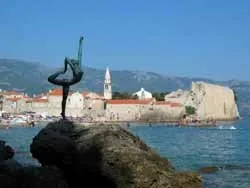
Croatian Coast
Croatia won the hearts of tourists immediately and unconditionally. As soon as the now-distant war events ended, travelers from all over Europe flocked to its shores. The country quickly shook off the ashes, patched up the holes, and renovated hotels, shining even brighter. And the colors here are truly bright: the mad blue of the skies, the transparent emerald of the sea, the greenery of pine groves, and all shades of red, pink, and terracotta given by lush bougainvillea and park roses. And also lilac and blue hydrangea caps - huge, heavy, lush inflorescences on giant bushes.
In Croatia, any type of vacation works perfectly - both passive-relaxing and active-sightseeing. There are ancient resorts and nudist camps, historic monuments and brand-new yachts. It is a hospitable and friendly country, filled with patriarchal charm and the allure of old provincial Europe, sea breeze, and the ringing of bells on Italian campaniles.
The coast of mainland Croatia is divided into Dalmatia, Lika, and the Istria peninsula. In Istria, the best place for a holiday is considered the Kvarner Riviera, which was inhabited and developed back in the days of the Austro-Hungarian Empire. Its oldest resort is Opatija. This city of villas and gardens hides behind mountains from cold winds, pampers its guests with a mild microclimate and almost tropical abundance of nature. Once, European monarchs found their summer refuge here. Isadora Duncan built the villa "Amalia," and Nabokov wrote "Spring in Fialta."
From Rijeka begins the coast of Primorje – also known as Lika, also known as the Velebit mountain range. The centers of the coast are Zadar and Šibenik – known for their architectural monuments. In Zadar, for example, the huge Romanesque Church of St. Donatus from the 9th century is perfectly preserved, in Šibenik – the cathedral built in the 15th century from stone slabs. The coast is adorned with national parks and picturesque islands – Krk, Rab, Pag. For example, the Krka National Park, which is somewhat away from the coast. Among the green mountains, the Krka River either spreads into lakes or rushes down in foamy waterfalls, roars and thunders, spreading the aroma of clean water in the air. On the island of Visovac in the middle of the river stands a Franciscan monastery with a library, and a ship goes there.
The most amazing place in Lika is the ancient town of Primošten. It is located on an island connected to the mainland by a narrow causeway. Primošten swims out to sea like a plump little fish. In the thinnest part of the tail are the city gates, at the top – a church. The continental part is inhabited by tourists: discos, courts, marinas with yachts. Around are low mountains with bald stone tops. Everywhere are stone terraces, lined with even green squares. These are vineyards. Everywhere else in the world, grapes are grown on soil, and only in Primošten – on bare lifeless rocks. Peasants hollow out holes in them and bring soil there, and so that the wind does not blow it away, they surround each cell with a stone wall.
Another interesting city is Trogir. Locals call it "little Venice": the city lies on three islands. Everywhere you see Romanesque towers, gates, chapels, palms, and pointed windows. The city is over two thousand years old; under the Romans it was called Tragurium. The main monument is the cathedral built in 1240. It is guarded by stone lions.
But the main Croatian Riviera is beautiful Dalmatia. Its light mountains are covered with dark spots of greenery, like the coats of Dalmatian dogs, and the coast is indented with fjords. This is called the "Dalmatian type of coast." Here tiny beaches hide between rocks, and lazy cuttlefish swim in the transparent water. Village houses are built of stone, even roofs are laid with slate. On the coastal hills, tall bell towers-campaniles stick up, white villas and hotels descend to the water.
Dalmatia has two cities for excursions – Split and Dubrovnik. Both are beautiful, ancient, listed as UNESCO World Heritage sites. Split is famous for the palace of Emperor Diocletian, built in the 4th century. The palace is a city within a city with its own walls, towers, narrow streets, and sun-drenched squares. You can spend just one night in Split to thoroughly explore it and return to the beach.
But in Dubrovnik you need to spend at least a week to walk along its ancient paved streets, sit in cafes and restaurants, listen to Vivaldi at the Rector's Palace and jazz at a music pub.
* Croatia borders Italy, Hungary, Bosnia and Herzegovina. Its area is 56.5 thousand sq km, the sea adds another 32 thousand.
* The capital is the university city of Zagreb with a million inhabitants.
* The length of the coast in a straight line is only 800 km, but together with islands, peninsulas, bays it reaches 6,000 km. Croatia has 1,185 islands.
* For motorists, there are more than 300 equipped campsites. The country has 9 national parks. The most famous are the Plitvice Lakes, which are on the UNESCO list of world natural monuments: 16 lakes have 92 waterfalls. The two main reserves are entire archipelagos: Brijuni consists of 14 islands, Kornati of 101. The parks Paklenica and Risnjak are mountain ranges, the first with rocks and canyons, the second with forests and animals.
* For yachtsmen, there are more than a thousand marinas on the coast and islands. The country has opportunities for treatment. Mineral springs and clinics are in the resorts of Umag, Opatija, Crikvenica, Vela Lošinj, Hvar, Makarska, Vela Luka.
Land of Green Mountains
Montenegro is famous for the same things as Croatia: untouched nature, beautiful landscapes, clean sea. They say the country got its name because the slopes of its mountains are covered with olive trees with black bark. That may be botanically correct. But the main color that reigns everywhere in Montenegro is green. Green valleys, green hills, green mountain slopes - lush flora of the blessed south grows, blooms and fragrances everywhere. The most famous resorts of Montenegro are Budva, Sveti Stefan, Herceg Novi, Ulcinj, Petrovac, Sutomore, and Ada Island.
One of the most pleasant places in Montenegro is the Budva Riviera with its center in the city of Budva. They say that a stonemason named Marko once lived here, who loved the beautiful Jelena. The girl was not allowed to marry him, and so they took each other's hands and jumped from the city wall into the sea. And when they touched the waves, they turned into fish. And someone's voice said: "Let the two be as one! - Budu dva." This is how the city's name originated. In Marko's house, a stone was found on which two intertwined fish were carved. Now this stone stands in the city museum, and according to local belief, anyone who touches it will find a love as strong and eternal as stone.
The most magical place of the Riviera is the island-hotel Sveti Stefan. This is a fishing village, built in the 15th century on a rocky islet and connected to the shore by a sandbar. Everything here has remained as before: stone fortress walls and low houses almost blend into the rock. In 1970, its residents were relocated to a new village on the mainland, and the island was turned into a hotel. It is a peaceful and secluded place. The medieval cottage-style rooms have separate entrances and their own courtyards. The refinement of antiquity, multiplied by the simplicity of the surroundings, looks seductive to connoisseurs. The island has 80 separate cottages, 16 suites, and villa No. 188, where Sophia Loren, Carlo Ponti, Kirk Douglas, Peter Ustinov, Indira Gandhi, Robert McNamara, Elizabeth Taylor, Richard Burton, Sylvester Stallone, Claudia Schiffer, and Leonid Ilyich Brezhnev once stayed.
The Ulcinj Riviera stretches 30 km in length, of which 24 km are sandy beaches, including black sand. The longest of them is called "Velika Plaža" and stretches for 13 km. The sand here contains remains of coral and has a mild radioactive effect that heals arthritis and muscle diseases. The city of Ulcinj itself is old and beautiful. Tourists' favorite pastime is visiting the colorful Friday market.
Near Ulcinj there is another unique place - Ada Island. It grew from the soil carried into the sea by the Bojana River on the border between Albania and Montenegro. The island has the shape of a regular triangle. Ada is home to many species of animals and unusual plants. Nudists like to relax here. They are attracted by 600 hectares of beach with soft clean sand, many cute bungalows standing right on the sand, where each room faces the sea.
The Herceg Novi Riviera has no sandy beaches; its shore is stones or large pebbles. Picturesque Herceg Novi is a city of sun and gardens. It is adorned with walls and towers built by the Venetians, Turks, and Austrians. Many come here because of the health center "Igalo," which is considered the largest center of wave therapy and preventive medicine in Europe, treating rheumatism, arthritis, osteoporosis, and heart diseases.
Montenegro has no stunning architectural monuments. The palaces of its kings - the Petrović dynasty - look like large country houses, and the rulers' country residences resemble modest dachas. Perhaps only the Roman mosaics from the 3rd century BC in the city of Petrovac are remembered as a monument. But the same Petrovac - former Kastel Lastvi ("Swallow Castle") - with its red tiled roofs among lush greenery on steep slopes can charm anyone. It stands in a beautiful bay, under a high mountain. Wherever you find yourself in Montenegro, you will see turquoise sea and high mountains, bays and fjords, palms and cypresses.
The main Montenegrin attractions are nature and amazing legends. Near the Croatian border, a 32 km long fjord cuts into the land - the Bay of Kotor. From the mountain you can clearly see how the city of Kotor encircles the bay with its little houses. And nearby, a serpentine road is visible on the ground, clearly tracing the letter "M." The road runs along the plain, and there is no reason for it to wind. It's just that Prince Nikola ordered the road to be laid so that those descending from the mountains would see the first letter of his beloved girl Milena's name. Nikola and Milena are long gone, but drivers, each time tracing the letter "M," remember this story.
Excursions to the unusually beautiful canyons of Mrtvica, Morača, Sušica, and Tara are popular. The Tara River Canyon is the deepest in Europe and the second deepest in the world (after the Colorado).
* Montenegro is located on the Balkan Peninsula, in the southernmost part of the Adriatic. The country's area is 13,812 sq km, population is 650,000 people. It consists of Montenegrins and Serbs, Albanians and Croats. The Montenegrin and Serbian population mainly professes Orthodoxy, Albanians - Islam, Croats - Catholicism.
* The capital is Podgorica with a population of 159,000 residents. The historical and cultural center of Montenegro is the city of Cetinje.
* The length of Montenegro's coastline is 290 km. The country has 117 sandy, pebble, and artificial beaches with a total length of 73 km.
* The swimming season lasts 180 days - from mid-May to the end of October. Eight months a year, the average air temperature is +27 degrees Celsius. The average water temperature in summer is about the same.