
A godsend for pickpockets
As Novye Izvestia writes, our compatriots are visible from afar abroad - only we carry thick wallets, while the whole world has long switched to plastic cards. It is for tight wads of dollars that pickpockets love us. They especially often operate near exchange offices: a little attention - and it is immediately clear where you keep your money. In some countries (the former socialist camp is especially guilty of this; but “capitalists” are no exception) they are very fond of stealing ladies' handbags.
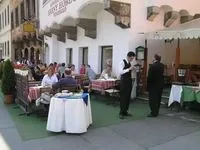
In almost all restaurants in Budapest, for example, there is a sign - a crossed-out chair back with a bag hanging on it. This means that it is better to put the handbag on the table. The author of the article once disobeyed this sign and automatically threw her backpack behind her onto the chair. When it came time to pay, the backpack was nowhere to be found. I was lucky then: seeing that I was clutching my heart, the waiter solemnly brought the bag out before our astonished eyes. It turned out he was joking - and at the same time taught the trusting tourist a lesson.
Summary. Before leaving the exchange office, put the banknotes where they belong - do not show everyone around where you keep them. Another old truth: do not keep money in one place. You can leave most of your savings in the hotel safe, and take small amounts with you. But it is better to get a plastic card. If you are robbed during an excursion or on the road (if we are talking about bus tours), then theoretically you can demand compensation for damages from the travel company that sent you on the trip. However, travel agencies will not recall a case where the victim managed to get his money back.
Keep an eye on the bill
We love to eat well, drink well, and pay without looking at the bill. In some southern countries, they actively take advantage of this. For example, in Spain, if you are out with a company of five or six people, they may simply add an extra €20-30 to your bill. And they will be very offended if you suddenly notice the overcharge and demand a new, correct bill.
In Italy, they may simply forget to bring one of the dishes you ordered, but rest assured they will not forget to include its cost in the bill. In Turkey, on the contrary, cases are not uncommon: a tipsy company is brought a dish that was not ordered. When you ask for the bill at the end of the evening, this one accidentally-included dish will cost as much as all the others combined. Also, the Turks, knowing the limited language abilities of our compatriots, like to give menus that show not the full cost of a dish, but the price per 100 g. And only when you are brought the bill will you realize that the steak weighed no less than half a kilo and cost not €10 (as in the menu), but all €50.
We learned about another way to deceive a tourist while having dinner in a nice Athenian restaurant with two friends. When ordering dishes, we asked for three separate bills in English. The waiter obediently nodded, but at the end of the evening he brought one bill, and in Greek. After carefully studying the paper, we asked him to explain what several figures multiplied by three meant - especially since we had all eaten different dishes. Without batting an eye, the waiter began to explain that this was, supposedly, the charge for bread, that for pepper and butter (you see the little packets by each plate?), and another item costing €3 was interpreted as a charge for... the tablecloth: the waiter washes it with his own hands and does not intend to do it for free.
After we returned the bread and butter, and advised the Greek to forget about the tip, he caught up with us at the exit: “But you’re Russians? Why are you behaving so strangely? Usually your compatriots do not check bills...”
Summary. Do not blush if you catch the waiter with an incorrect bill. He should be ashamed, not you. If you doubt it, then study the paper with a calculator in hand; for some reason our tourists are very embarrassed about this. If you notice a minor overcharge on the bill, smile at the waiter as if nothing had happened, but deliberately do not leave a tip. He will understand everything. In general, communicate more with the service staff. If the price is indicated unclearly in the menu, do not hesitate to ask the cost of the dish before you place your order. And carefully watch what you eat - if a surprise dish appears on the table, you should not by default take it as a compliment.
Wait, train
To tell the truth, we like to criticize everything domestic and are fully confident that many problems do not exist in the West. Not so. Be prepared for the fact that carelessness exists in all countries. In Europe, indifference is especially characteristic of the French, Spaniards, and Italians. For example, once in Nice, through the fault of a careless cashier, my friend and I had to spend the night under the open sky.
This is what happened. My friend and I settled in the small town of Villefranche on the Côte d'Azur. After quickly exploring all the local sights, we decided to go to Nice. We decided to buy the return ticket in advance. The cashier told us that the last train to Villefranche leaves at 22:50. All day we happily ran around Nice, spending almost all our cash. When we arrived at the station at 22:30, the first inspector we met dashed our enthusiasm. “Madame, there is no such train,” he said, having studied our travel documents. “I advise you to throw the tickets in the trash and come back tomorrow morning.”
We were not ready to lose almost €30 and went to argue with the cashier. He kept showing us his computer, complaining about software glitches... They eventually returned the money to us, but, alas, that amount was not enough for a taxi or a hotel. So we spent the whole night in an open-air cafe, warming ourselves with red wine - on the coast it gets quite cold after sunset.
It must be said, the owners of the establishment turned out to be very nice people: upon learning of our problems, they were very concerned and even brought us... black garbage bags with neatly cut holes for the head and arms.
Summary. Commuter trains in southern Europe can have problems. They may be 30-40 minutes late, or might not come at all. Therefore, when heading to another city, try to check the schedule in advance and have other fallback options in reserve - at least, find out how much a taxi or a hotel room costs, and always have the necessary amount stashed away.
What is good for a German is expenses for a Russian
Everyone has heard about the pedantry of Germans, but these stories are often perceived as something abstract. Yet when that scrupulousness concerns you personally and you are not ready for it, trouble arises. My husband and I once suffered because of the German character to the tune of about a hundred euros.
While in Germany, we went on an excursion with a group to a place outside Berlin. When the guide announced that the return departure was scheduled for exactly 19:00, we did not take his words too seriously: what Russian tourist doesn't know that the bus will obediently wait for latecomers for a good twenty minutes after the appointed time?
That is what undid us. By 19:15 the bus was no longer at the designated spot. For a while we ran frantically among the line of excursion buses. Gradually, other stragglers from the group joined us. There were about twenty of us when the crowd finally realized: we would have to get to Berlin by taxi. And then the fellow sufferers instantly forgot the sense of camaraderie and began to shove each other away from the checkered taxis with their elbows. In short, we reached the hotel after midnight, spending almost €100 on a taxi and losing an extra three hours looking for the hotel.
But when we met our guide the next day, he didn't even understand what our complaints were about - like, sorry, good sirs, but I clearly said the bus leaves at 19:00. The guide, to our misfortune, turned out to be a true Aryan.
Summary. When in Germany, Switzerland, Sweden, and Austria, remember that lateness is considered the height of bad manners in these countries. To save your nerves and money, it is better to avoid relying on blind luck and check your watch.