
Rule No. 1. When renting a car, it is best to choose hotels that have their own parking or permission to park nearby.
In Europe, not all hotels have parking lots, but many have agreements with hotels that do. You can always find out about this at the reception, as this is often the most acceptable way to save money without breaking any rules. After all, the lack of parking is a real scourge for motorists in cities of countries like France or Italy, while in Spain it is slightly easier.
Underground parking lots in Europe are good in every way, but you need to learn how to use them. At the entrance to an underground parking lot, there is usually an electronic display that indicates whether there are spaces available or not (for example, in French: libre - free, complet - no spaces). Sometimes the colors of the letters on the sign serve as a hint: green and red, respectively. At the entrance, the driver will see a machine on the left side, where you need to press a button; it will issue a ticket (which you must take) indicating the time of entry into the parking lot and open the barrier. Then follow the arrow signs strictly. After parking, don't forget to take the ticket with you and remember the number and, most importantly, the floor where you left the car. The first entry stage is complete. The next stage, which is no less difficult, is exit.
The machines that accept payment are located at the entrance to the parking lot (usually near the elevators). You need to insert the ticket, and then the display will show the amount due depending on the rate. You must insert cash or pay by credit card, after which it will issue another ticket that you will have to 'feed' to the machine at the exit before the barrier. You will have only 15 minutes to leave the parking lot.
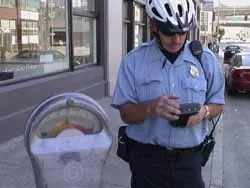
On the streets, paid parking is marked by a blue line, and in France such a parking spot may be indicated by the word Payant (paid). Upon seeing it, look for a payment machine nearby. Its operating principle is somewhat different: you immediately need to select the time for which you are leaving the car and attach the receipt to the windshield. Police periodically check for these receipts.
Parking on the outskirts of large European cities costs about €0.7-2.5 per hour, in the center up to €5 per hour. To leave a car in an underground parking lot, you will have to pay from €20 to €25 per day.
Rule No. 2. All fines must be paid as quickly as possible. Otherwise, the chances of getting on the 'black list' first in the traffic police and then in the consulate increase.
Apparently, the police in Europe have a large and glorious staff of controllers. Therefore, we would not recommend unauthorized parking at all. But... according to our sad experience, the most lenient fine is given in France for parking at a paid parking lot without payment - it is only €11! A more severe punishment awaits a driver for parking in a prohibited place - €35 in France and €60 in Italy, plus the car may be taken to an impound lot, and for its rescue you will have to pay from €80. The other figures for more serious violations are completely off the charts - the most serious parking fine reaches €300.
What should you do with the fine receipt for payment? In France, you need to go with it – you'll never guess – to a tobacco kiosk! (yellow sign Tabac). There you will have to buy a postage stamp for the amount of the fine, stick it on the ticket, and, keeping a copy for yourself, drop the original into a mailbox. Leaving the country without resolving the fine is a bad idea. There is no way to pay it from home. And if non-payment is discovered, it may cause problems with obtaining a visa in the future.
In Europe, there are two systems for paying for highway travel. In Austria, Switzerland, the Czech Republic and Slovakia, you need to pay for roads once by buying a sticker and sticking it on the windshield. Such a sticker, costing from €5 to €50, allows you to drive freely on all toll roads of the country for 15 days to a year, depending on the rules adopted in the country. But in Italy, Spain and France, a per-kilometer payment system is in effect. The toll consists of various fixed amounts depending on the distance. There are several payment systems: you can do it using a machine and a credit card - the slowest method; cash, when the driver literally throws the required number of coins into a basket (!); and the simplest, paying cash to a road employee. For example, from Barcelona to Girona the toll is just over €5. The most expensive roads are in France. All European highways are equipped with video cameras with built-in radars, so police are rarely encountered.
Rule No. 3. It is not worth economizing by avoiding toll highways and trying to take the route on national roads.
Highways in Europe save not only time but also money. On toll roads, you can easily travel at a speed of 130-140 km/h. Drivers are generally very polite and willingly exchange courtesies. A sign of gratitude is the hazard lights turned on for a few seconds.
By the way, all over Europe there are many motorcycles and scooters on the roads, which race along highways at very high speeds. And they are hard to see in the rearview mirror – be prepared for this! Turn indicators also require increased attention, as they usually hang too close to the turns themselves. It is very easy to miss the one you need. Otherwise, as 'Voyage and Leisure' notes, life on wheels in Europe is carefree and pleasant.