
In the capital of England everything is not as it should be. Everyone speaks English everywhere. Of course, according to statistics, there are 300 different languages there, but authentic English speech with singing crazy intonations is terribly widespread. And the Cockney accent is still in fashion: bartenders speak it all their lives, celebrities adopt it and clown around, ordinary people grimace but sometimes start to chew vowels like a docker from the early twentieth century.
Traffic is left-hand. This means that when crossing the road, you have to look right first and then left, not the other way around, as usual. To make life easier for people from the continent and other fools, it is written everywhere: "Look right", "Look left". But it is very hard to overcome instinct, and by the end of the day, tired, you cross the road without looking anywhere on principle, hoping you won't get run over.
The London Underground is a real rip-off. Nobody can give you the exact ticket price: the metro is divided into zones, like our suburban commuter trains. If you simply buy a ticket across several zones for a return journey, it will cost four pounds (at peak times – two pounds more). But you can use the magical "Oyster card" - a plastic magnetic thing - onto which you can put money, and then the fare supposedly costs less. Attention! In London there are turnstiles at entrance and exit, and if you don't pay at the entrance or pay incorrectly, for fewer zones, say, it will cost you a 20-pound fine.
A person living on a remote outskirts, in zone six, and working in the City, spends three hours on the road and more than 150 pounds a month. And he is terribly unhappy with such an underground.
A little spicy detail: the London Underground map is considered a design gem, is protected by copyright, and made it to the finals of the national design competition.
The world's oldest metro has 13 lines, 275 stations and 3 million passengers a day. Trains of different lines run on the same track, lines branch out and join again. Each platform has an electronic board indicating which train to wait for, which station it goes through, and where the terminus will be. Getting to your destination is no trivial task: it often happens that reaching the right place with three transfers is faster than waiting for a direct train.
Some stations have no escalators - only lifts, which at rush hour makes you ponder the meaning of life. On the Circle line, you can wait for trains for about fifteen minutes, but the real scourge is the Northern line with two branches on one side, a bubble in the center, and three spurs on the other. It's no coincidence that Camden is on this line, the birthplace of punk, where every twenty meters you are offered drugs, piercings, tattoos, musical instruments, Indonesian food, clothes for goths and dead schoolgirls. In general, it is hard to imagine anything more chaotic than the London Underground.
Buses are a bit better - there are no traffic jams in central London, buses have their own lanes, onto which cars never drive. In principle, sometimes it is faster, but not every local will take it upon themselves to figure out where ordinary city buses go. By the way, there are no traffic jams for a simple reason: London mayor Ken Livingstone introduced a charge for driving into the city center - five pounds a day. And parking costs another four pounds an hour, but no more than four hours. Only owners of the property on which the parking is located, or holders of special permits, can park without parking meters. Fines for violating parking rules, for driving into a bus lane, for speeding - from a hundred pounds. There are almost no police on the streets: motorists are herded by automatic cameras, which are literally at every step here. Smile, you're being filmed! In a shop, in a hotel, in a restaurant, on the street, in the underground, everywhere there are signs with the magic word CCTV.
But electronics cannot cope: London authorities constantly warn of a terrible danger. No, it's not suicide bombers. Beware of pickpockets: posters hang everywhere urging you to keep all your belongings close to your body.
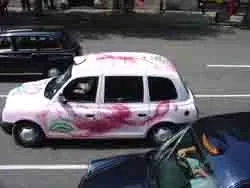
Getting around the city is cheaper and easier on foot (stories about bad London weather are greatly exaggerated – during our week in the British capital, an umbrella was never needed). And if distance and time still require speed, then by taxi. Taxi drivers almost always know where the place you name is, and are very proud of it: they say that to get a license, they pass a special exam on their knowledge of the city. A ten-minute drive will cost six to seven pounds, while on the Underground the same distance may take half an hour. That is, if you are traveling even just the two of you, then the 'tube' will cost more than a cab. A pleasant saving, plus you don't have to squeeze into the crush, which in the London Underground is no different from ours, plus a pleasant chat with the driver. You can hear quite a few interesting stories from taxi drivers. One of them swore that he was a Scottish highlander, had been to Moscow as early as 1878, and once gave a ride to Valentina Tereshkova herself.
Pedestrians make life difficult for motorists. In central London there are many crossings with a push-button traffic light. You press, wait half a minute, and the pedestrian green light comes on. The cameras are apparently not set for pedestrians, since crowds of Londoners and guests of the capital cross on red right under the noses of furious drivers. Even visual propaganda does not help: for example, in the Underground there is a poster for the new album of the star Alicia: a beautiful black woman, stylish design, and across all of it a big white inscription: "The album release is cancelled. Alicia died crossing the road at the age of 11. Please obey the rules of the road." And was there ever an Alicia?
In the metro, of course, there are no homeless people, and where would they come from if it is so expensive. Homeless people live in underpasses. Two hundred thousand Britons are homeless. A significant part of them live in London, at least in every underground passage in the center there is a cardboard box, and in it - a vagrant. They say that before Thatcher there were no homeless people in England, but the Iron Lady came, showed the brutal grin of capitalism, raised housing prices many times over - and now in the passage near the Marble Arch tube station you can find a man lying in a bed and reading a book at zero degrees.
Housing in the British capital costs monstrous money. A young woman working at a large municipal PR agency may consider herself a middle-class girl, but she rents a house with three girlfriends quite far from the center. The house has four bedrooms, one living room, a kitchen and a bath. For this, each of the girlfriends pays 90 pounds a week, that is, the whole pleasure together costs about 1,400 pounds a month. When asked about buying an apartment on credit, the girl answers, almost in tears: what credit can you talk about if a shabby "one-bedroom" (two-room) apartment quite far from the center costs half a million pounds, with a down payment of at least ten percent?
Another acquaintance, a student from Russia, rents a room from an old lady in the Greenwich area for a fairly reasonable price, but with one condition. When the landlady is home, the girl, besides studying and working, has to take care of her. When she goes somewhere, an extremely old cat remains under the care and full responsibility of the guest, a cat that does not recognize its owners and threatens to die from a food bowl placed in the wrong place.
Prices in Oxford, with its university and its rich kids, are about the same as in London. In Sheffield, where aspiring rock stars live, they ask half as much, but wages are different there...
London's high prices hit above all the poor and relatively poor. Fast food, housing, and public transport in London are much more expensive than in our capital, although clothing (both expensive and cheap), restaurants, luxury items may be cheaper. But again, it depends on how you look at it. In London there are no sparkling wines at a reasonable price at all. How do they live without "Salyut", "Kornet" and "Abrau-Dyurso"? Do they give the girls cider?
Tony Blair, upon coming to power, swore never to raise income tax. It was not raised, but various small taxes, fines, excise duties, inheritance tax take away a significant part of a Londoner's budget. One of our compatriots, who has been working in London for a long time and decided to take a mortgage, complained (or boasted?) that his mandatory payments (for the mortgage, insurance, mobile phone, Internet, etc.) amount to more than a thousand pounds a month. A small part of this is insurance against pipe leaks, vitally necessary in England with its bad and expensive utilities.
In non-aristocratic London, everything is broken. Be prepared for washbasins with two taps, and cold water flows from both, for a four-star hotel where the iron, heating, and telephone are out of order. The shower hose leaks. The boiler room serving an entire block a five-minute walk from the British Museum is also broken, and in the famous art college students are kept warm with gas "mushroom" heaters. All vending machines selling water and food at all metro stations are closed for maintenance, half the turnstiles do not work, and the metro in general seems somewhat ruined. This is normal.
But everyone dresses very well. Well-dressed people walk down the street and smile at each other. This makes you feel incredibly comfortable. They always greet you, are always happy to help. In restaurants, shops, hotels, everywhere they take your money, they will say: "Thank you, sir," which makes you feel like a white person.
True, it is unclear why white. Officially, 71% of Londoners are white, and 60% are British. Indians, Pakistanis, Africans, Latin Americans, Chinese – all the rest. However, Lena, our student, said that once, sitting in a café, she decided to count the "white" and "black" people passing by. People even slightly resembling native Londoners turned out to be eight out of 22. And it is more than likely that half of those eight are tourists, and the other half only work in London, but live somewhere in the suburbs.
After Christians, Muslims have become the largest religious group in London and its suburbs. In some areas, the Muslim population exceeds 50%. True, this is not at all like in Paris. Here Arabs do not look so aggressive. According to a representative of the employment exchange for immigrants, despite problems with work and housing, they are still fairly well-off. In addition, employers are obliged to hire approximately equal numbers of representatives of different national and religious groups, so Muslims often have an advantage in this matter.
In general, it is hard to imagine how one can live in this city. But London immigrants are in no hurry to return to their homeland – people living here "get hooked on London". And tourists keep coming back.