
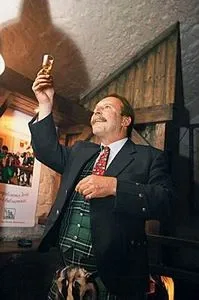
- Mr. MacLean, can you explain why whisky is so popular in the world?
- I can name just one very substantial reason for this phenomenal popularity. Whisky does not dictate any particular way or style of consumption; it can be drunk at any time, in any situation, unlike, say, cognac. Cognac is a very serious digestif. It cannot be drunk before a meal, cannot be drunk in the morning, and there are many other things you cannot do, because drinking cognac is highly ritualized. Whisky, on the other hand, can be drunk at any time: in the morning, in the evening, as an aperitif, a digestif, and during a meal.
- And what should one do after morning whisky?
- What do you mean?! Go back to sleep! Many years ago in Scotland there was a tradition called skalc, which in Celtic means "a strong blow to the head." In the highland regions, a guest was treated as follows: the first glass was offered when the guest had just woken up, the second when he sat up in bed, the third while getting dressed, and the fourth while the oatmeal was cooking. That is, before a meal, a person received four good glasses of 60-degree alcohol. What could he do after that? Only sleep on. This concerned only guests. After the intoxicated guest fell asleep, the hosts went off to work. Even today, when you are a guest in a Scottish home, two glasses are placed in front of you: one for water and one for whisky. If you don't want to, you don't have to drink. But it must be there.
- The foggiest question in whisky-making: who actually invented this elite alcohol - the Scots or the Irish?
- When the Romans came to England, they encountered the expression "water of life," which in Celtic sounded like "whisky." Most likely, it is a collective Celtic invention. After the Christianization of Scotland, the distillation process was practically monopolized by monasteries, although peasants in mountain villages continued to produce "water of life." But documentary evidence speaks in favor of the Scots: in 1494, the monk John Cor from Lindores Abbey turned eight bolls of barley into "living water" for King James IV.
- Was whisky a medicine at that time?
- Yes, whisky was used exclusively as a medicine for internal consumption, and for a wide variety of purposes. It was consumed both simply to improve well-being and to treat serious illnesses. One of the Scottish medical treatises of that time gives the following recommendation: "Consumed moderately, it slows aging, strengthens youth, aids digestion, interrupts catarrh, drives away melancholy, cheers the heart, eases the mind, restores vigor. It serves as a cure for dropsy, heals suffocation. It prevents the head from spinning, the eyes from going blind, the tongue from slurring, the teeth from chattering, the throat from soreness, the gullet from choking, the stomach from churning, the heart from trembling, the belly from cramping, the bowels from rumbling, the hands from shaking, the sinews from shrinking, the veins from drying out, the bones from softening. In truth, it is the highest drink if taken regularly." In general, following this recommendation, the population soon switched to constant consumption of "water of life."
- The production of wine is influenced by a huge number of factors, and any trifle can lead to a deplorable result. Is whisky just as capricious in its production?
- Whisky production is a fast and vibrant process. It does not depend on things like soil quality, weather, or a great harvest. The taste of whisky is primarily influenced, of course, by the raw material. Either it is barley, as in Scotland, or corn and other grains, as in America. Although regardless of the territory of production, there are two main influencing factors. The first is the cask. The taste and color of whisky come from the cask, and therefore its role is hard to overestimate. For aging whisky, casks that previously held sherry or cognac are used. And therefore, when talking about the taste of whisky, experts often mention the phrase "cask activity." With each new aging period, the influence of the cask on the drink will be completely different. The second factor affecting whisky is the method of distillation. A producer can use different condensers: in the form of a tall column or a worm. The taste of whisky obtained from distillation in a worm is stronger and richer.
- How then should we understand the expression "whisky of such-and-such a year's harvest" if the harvest has no influence on the product?
- Yes, experts sometimes use this expression by analogy with wine and thereby confuse people. In fact, the difference in taste arises because each year the influence of the cask becomes less. The longer a cask is used, the softer the taste of the drink.
- There is such a comparison of whiskies by Scottish regions: "Whisky from Islay sounds like a cello, from the Highlands a violin, and Lowland whiskies approach the sound of a piano." Is that true?
- That is a very poetic comparison. In reality, it is all a bit simpler. Of course, whiskies from different parts of Scotland have different flavor characteristics. Island malt whiskies are very specific and differ greatly from one another. On the Isle of Islay, seven distilleries produce single malt whisky for sale, using pure peat for kiln firing and natural, untreated water. Perhaps this is the reason for the pronounced character of Islay malt whiskies. You either love them or hate them at once. The island has a stormy climate that cannot blow away the smell of peat. Speyside, part of the Highlands, is Scotland's most distillery-dense region. It has 35 distilleries bottling single malt Scotch. They are concentrated in an area of 15 square miles around the town of Dufftown. Speyside malt whisky is the sweetest and the best of all Scotches. Most of the famous single malt whiskies come from Speyside: Glenfiddich, Glenlivet, The Macallan, and Glen Grant. Lowland whiskies are good for blending and are rarely used as a standalone alcoholic product. Malt Scotch can be compared to French grand cru: less than 5% of all Scotch production is sold as malt whisky.
- How many different brands of single malt whisky are produced in Scotland?
- There are about 90 distilleries that produce single malt whiskies, but each of them releases drinks of different years, different aging, different flavors, so overall, I think the number of brands is approaching three hundred.
- Is it true that over many years of tasting you have never tried two identical whiskies?
- Yes, that is absolutely true. Identical single malt whiskies do not exist. You can take two bottles from the same producer, same year and same aging – and even they can be different.
- How many whiskies do you taste a year?
- A lot. And very different ones – both from casks and already bottled. I think around a thousand different whiskies a year. Of course, I don't get drunk every time during tasting.
- Are there any special intricacies to whisky tasting?
- Whisky tasting is very similar to wine tasting. First you look at the color – from it you can determine age and origin. Then you smell – the aroma will give you the most information about the drink, so you need to approach this very carefully. Then you add water to the whisky – it helps the drink reveal its flavor. You roll the liquid in your mouth and try to understand which sensation was dominant. And there are only four sensations: sweet, bitter, sour, salty.
- Where did the expression 'angel's share' come from?
- During aging in the cask, part of the whisky evaporates, and then they say that 'the angels have taken their share'. I have no idea who coined this expression. In my opinion, it has been used since ancient times. It is unlikely that the authorship belongs to the Celts, more likely to monks. But no documentary evidence of when and who first used this expression has survived. I only know that it is very traditional.
- Does it take time to acquire a taste for whisky, or is it usually love at first sight?
- Love for whisky comes with age. It is not a drink for young people. Of course, young people drink it in cocktails, but that is not at all an understanding of whisky. To feel the fullness of its flavor, time is needed. It is a drink for mature people. Although, on the other hand, in Spain – the largest whisky consumption market in the world – it is also drunk by young people. And even girls under 25, which is quite strange.
- I was sure that the main consumer of whisky in the world is the USA.
- In fact, the main consumers are arranged like this: Spain, France, Great Britain, and only then the USA.
- Quite a large number of wine collectors are known, much less is heard about whisky collectors...
- The largest whisky collection, of 15,000 bottles, belongs to the Italian Giuseppe Begnani from Piedmont. The interest in this drink is evidenced by a case I encountered just two weeks ago: at one of the auctions, a bottle of forty-year-old whisky was sold, and it turned out to be fake. More precisely, the bottle and box were genuine, but the whisky in the bottle was much younger than the stated forty years. A fake is the most striking indicator of interest.
- Does whisky require any special storage conditions?
- Of course, whiskies are not as finicky as wines. They cannot be stored lying down, only standing, and should be protected from direct sunlight. That, perhaps, is all.