
On the equator, night falls quickly. The sun passes its circle exactly overhead. Even sundials here are vertical. There are many such clocks along the equator. Every hotel that claims a high "star rating" considers it a duty to keep a primitive solar timer in the inner courtyard, along with a mini-fountain, pool, and lounge chairs.
The most famous clocks are in a place called Mitad Del Mundo (Middle of the World), near Quito, the capital of the Republic of Ecuador. Twenty years ago, at a point determined by French geographers of the 18th century as the "middle of the world," a pompous monument was erected. A square, alleys, a museum, monuments, exhibition pavilions, souvenirs, cafes, ice cream - any lures for foreign tourists wishing to cross the equator line. Only the true equator turned out to be 230 meters south. This became clear when GPS navigators appeared. And the enterprising Ecuadorians opened a second, smaller museum.
Watch your ears - you are in the Andes!
My journey through Ecuador began in the company of Russian mountaineers. On the day of arrival, we contacted a nearby travel agency. The next morning a guide who spoke a little English came for us. With him we completed standard acclimatization routes - ascents of the volcanoes Pasachoa, Ilinizas, and Cotopaxi.
In Ecuador, there are no rescue services in principle. But every guide must have a license, and it's not easy to earn one. Travel agencies provide any equipment for rent, so there's no point in lugging heavy things on the plane. By the way, stores in Quito sell clothes, shoes, and other tourist-mountaineering supplies of the same brands as ours. And prices are the same.
Local guides do not usually take a first aid kit. So it's better to have headache and stomach colic medicines - common companions of mountain acclimatization. Another remedy is held in high esteem here: coca, which grows abundantly in the Sierra.
Most of Ecuador's natural attractions are enclosed in the barbed fences of national parks. Entry for foreigners is $10-12. Local travel agencies usually do not include this money in the tour price. The reason: it is often possible to sneak into the reserve without paying, due to the absence of a ranger. If the ranger (guardaparque) notices you already on the protected territory, from a distance he might accept an old ticket bought in another national park - the state-issued design is the same everywhere.
The higher you go into the mountains, the fiercer the sun. If you don't put sunscreen on your ears, they will burn inside. The climate changes with altitude. Groves of bamboo and eucalyptus give way to the "magic forest" - something between tundra and prairie. Here you can meet hares, wolves, lizards and hummingbirds, see a huge condor soaring above a "lunar" landscape. In world mountaineering rankings (in the Andes they are called andinistas), Cotopaxi (5,897 m) is a multiple winner of the beauty contest "Miss Mountain". The only competitor is Japan's Fuji.
At the refugio (mountaineers' shelter) before the ascent, there is lively bustle and an international atmosphere. English, German, French speech is heard. But the language of international communication is Spanish. Two-tier bunks, rainwater, dim electricity from wind turbines. However, an international payphone works. And this at an altitude of 4,800 m!
The ascent begins at midnight. You need to reach the summit at dawn, see the volcanic crater, and be back before the snowy trail becomes wet from the sun. About 800 m of descent can be glided down the glacier on your own "trasero" (i.e., on your bottom).
After the ascents, our paths with the mountaineers diverged. They went to burn money and the remaining vacation days on a posh yacht cruising along the Galapagos. My path lay into the jungle, or as it is called in South America - the selva.
Baños
Perhaps this city is the most popular resort town in Ecuador. According to statistics, 9 out of 10 tourists arriving in Ecuador visit it. And there are reasons for this.
A basin between mountains. Jungle. Giant waterfalls and fairy-tale gorges in the surroundings. You can go horseback riding and cycling, try rafting on a turbulent river, walk across a hanging bridge over a gorge, or fly on a cable car over an abyss. You can even jump into that abyss, secured with a special harness. There is a funny zoo and a serpentarium.
But the main attraction is the Tungurahua volcano. Periodically it showers the city with ash and covers the highway with lava. It also supplies the pools of Baños with healing thermal water, which are open from 4 a.m. to 10 p.m. The best way to cool off after a hot bath is directly under the cold stream of the Virgen waterfall (which means "virgin"). You can hang out in the "thermal baths" all day for just $1-2. It's no wonder that SPA hotels have sprung up everywhere. Every Friday they are filled by Ecuadorians themselves - big lovers of travel and entertainment.
In Baños I met a cheerful company of Chilean students. The next morning, a colorful bus with Indians and the inscription "Amazonia" took us to Puyo - the last bastion of civilization on the way into the deep selva.
Visiting Don Juan
Cabañas are Indian huts made of reeds and bamboo. They resemble a hut on chicken legs. Inside are woven beds covered with mosquito nets.
We made our way to the dwelling of the big Indian family of Juan along a turbulent river by canoe. After a quick snack of salty banana chips, we moved into the forest, towards the waterfall. Juan occasionally cleared the trail with a machete, simultaneously demonstrating the wonders of the selva: herbs, roots, trees, fruits. You can eat them, drink them, treat wounds with them, or make poison. 'The selva has everything a person needs!' the leader assured us. He sat down on the ground, stuck his hand into a rotten trunk and pulled out a handful of black beetles. 'A favorite delicacy of Indian women,' he said and crunched one. The bitten beetle continued to convulsively twitch its legs on Juan's lips until it was finally chewed and swallowed. The Indian broke into a smile and offered us to join the meal. We stared silently for a few minutes. The shock wore off by the fourth or fifth beetle. I decided to try. The delicacy tasted like bland cookies.
The next day I ate nothing. I was preparing to take ayahuasca - the hallucinogenic drink of the Amazon Indians. In the evening the shaman came. He plucked a hairy fruit from a tree, dug his fingernail into it and began to paint intricate patterns on his face with red paint. We sat around the fire, beat small tambourines, calling on the spirits of the river and forest. Thus began the mystical ritual. We each drank a sip of the murky herbal liquid and froze in anticipation. The shaman continued to invoke the spirits. His wrinkled face came closer, then retreated, disappearing into a white veil of tobacco smoke. And again I was surrounded by insects! Myriads of voices filled the entire sound spectrum and turned into a continuous ringing. In my ears... In my head... I dissolved into that ringing. Became part of it. And now my own voice was finding its place in the harmony of the selva. 'Wow, I'm an insect?' the vision delighted. Instead of hands, in the flickering light of the fire, mobile green claws gleamed, a carapace skin on my chest rose and fell evenly. It was the source of the piercing singing emanating from me. The shaman exhaled heavy smoke into a glass with the remains of rum, muttered an indistinct incantation and poured this hellish mixture into my gills. The vision disappeared. I emerged from the darkness of the forest to the light of the fire, looking at the other participants of the feast. They were painfully vomiting the remnants of water and food from their bodies. The shaman hissed: 'Thus evil spirits are cast out!' I smiled: 'Probably the guys have learned the recipe for ayahuasca!'
I returned from don Juan a different person. A fresh tan, a bright top, Indian beads, numerous friendship bracelets on my wrists, and comfortable sneakers. In the city, no one doubted that I was a Chilean student. This image is much more advantageous than a 'girl from Europe' and even more so a 'gringo' (that's what they call tourists from the US here). Prices in markets became significantly lower, and hotels gave good discounts to a 'Latina'!
City - Market
You must bargain in Ecuador! The most famous market is 'Otavalo'. Textiles, leather, ceramics, souvenirs and many other goods are brought here from all over the country and sold wholesale right on the streets. Upon hearing the initial price, boldly reduce it by half, or even three times. You'll eventually meet in the middle.
In the evening, in numerous restaurants serving national cuisine, live Andean music plays. It is performed by the same long-haired Indian guys who traded at the market during the day. At this late hour, their girlfriends, dressed in colorful Indian outfits, diligently sit at computers in nearby internet cafes.
Europeans are respected here, gringos are not liked. A gringo tourist is seen as a moneybag on legs. Watch your bags! Robbery of tourists is common. Theft thrives on buses. It's better not to sleep there - they'll clean you out. And in general, Ecuador is a restless place. On city streets after midnight there are no pedestrians. Fences are decorated with barbed wire and broken glass. And in the center of Quito, even at lunchtime, a policeman unlocks the door of an expensive restaurant with a key.
During my three weeks in the country, there were two strikes, one political assassination, and the inauguration of the president. Thank God, the events bypassed me. But mishaps on the road did occur.
Bus Tales
An Ecuadorian bus can easily be half an hour late or leave early, turn off the road to a gas station or to a 'mechanic' (that's what they call auto repair shops here). Or even halfway decide not to go to the destination. True, in that case they will still transfer you to another. But the undeniable advantage of traveling around the country by regular buses is cheapness. And, perhaps, the local color! For starters, they drive with the door open. A tout sticks out of it and loudly shouts the destination. If it suits you, you jump in on the go. The bus only slows down slightly. It will come to a complete stop only for an elderly passenger. A 10-15 minute stop is provided in transit cities on intercity routes. At that moment, the cabin fills with vendors of cola and food, musicians and salesmen come in.
At the entrance to the bus station, you only need to say where you're going, and some guys pick up your things and carry them onto the bus. Everything happens very quickly. You barely have time to get your bearings, and you're already speeding along another highway. Fellow Ecuadorian travelers are happy to tell you about the country, advise where to go and how to get there.
The quality of roads here is as varied as back home. There are toll roads - on them, large trucks race by, bright and colorful, like in American movies of the 70s. Lots of small pickup trucks. This is very efficient transport – it has been tested in practice that the bed can accommodate 12 people and one donkey at the same time.
A good alternative to the bus is the plane. For example, the trip from Quito to Manta costs $8-10, the flight costs $40-50. Duration 9 hours and half an hour. Is there a difference?
The most crime-ridden areas of Ecuador are on the coast. The places here are wild. And the land-dwelling descendants of sea buccaneers still thirst for easy money. Therefore, all traffic along the Costa stops completely at night. But during the day, colorful moto-taxis run in abundance - a funny mix of carriage and motorcycle.
Sandy campus
In the morning, from modern Manta I headed to a beach town of freedom-loving surfers and hippies. About Montañita, it can be said that it is Goa in Ecuador. Discos and bars operate all night. Accommodation at five to six dollars per bed reminds of a student campus. Here you can braid braids and dreads, get original piercings, dress up at a beach designer. Clothes, souvenirs and faces are noticeably different from everything I had seen before in cities and villages. Images of Krishna and Bob Marley crowd out the all-Ecuadorian cult of Che Guevara - the main superhero of Latin America.
Gringolandia - that's what locals call Montañita. But there are few real gringos here. In January-February, there are more tourists from South America in Ecuador. After all, it's summer there, vacation. And the time of Europe and gringos will come in July.
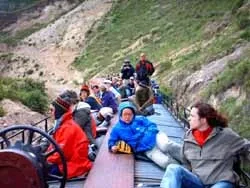
After breakfasting on traditional colonial scrambled eggs with freshly squeezed juice, I joined a group of students from Argentina, whom I had met earlier, at another hippie haven - on the 'Nose of the Devil' (Nariz del Diablo) - an ancient railway winding like a serpentine in the Andean canyons. For seven hours, three rusty carriages dragged frozen tourists along wild Indian settlements of the highlands. Archaic, but in terms of impressions - stronger than the famous Siberian Circum-Baikal Railway. Here there are bridges over abysses, and narrow chutes where you had to dodge attacking bushes and trees. And the main thing - the inhabitants of dugouts and shacks, watching the show three times a week - the solemn passage of motley tourists on the roof of the train. Indian grandmothers in national costumes waved cheerfully, and children caught candies on the fly. Sometimes the diesel locomotive would stop in some village to take on a sack of potatoes, a donkey or a mare in the cargo hold.
After the 'walk to the Devil', my Argentinians left for Cuenca - the archaeological Mecca of Ecuador, preserving the ruins of the Incan Empire, to compare it with Machu Picchu (Peru). I, on the other hand, found information at an internet office, got on a bus, and after 10 hours reached the Costa. And again on the way appeared 'chicken-foot roads', only instead of Amazon rivers there was the Pacific Ocean, and instead of jungle – sand and dried cacti.