
Photo epa
The Netherlands national team has always been considered one of the most international teams. In the 70s, the orange jersey was donned by the Andamanese Simon Tahamata; in the 80s, the sons of Surinamese fathers shone - Ruud Gullit, Frank Rijkaard, Gerald Vanenburg. In the mid-90s, a racial conflict split Guus Hiddink's team. Perhaps this is why the current Netherlands national team stands out for its whiteness. Only the swarthy Moluccan (from the island of Kalimantan) Giovanni van Bronckhorst and the mulatto Danny Landzaat, coming on as a substitute, somewhat dilute the picture. Could it be that Marco van Basten, who had eaten more than one pood of salt with the very same Gullit and Rijkaard, has begun to pay attention to skin color?
No, of course not. First of all, there are still Kew Jaliens, Hedwiges Maduro, and Ryan Babel on the roster, who will surely appear on the fields of Germany. Others - Patrick Kluivert, Jimmy Floyd Hasselbaink, Clarence Seedorf - have ended their international careers. Goalkeeper Boy Waterman is injured, and even if he were healthy, Edwin van der Sar would hardly have yielded the number one spot to him. Salomon Kalou did not have time to obtain Dutch citizenship, which offended the Ivorian and he decided that he would no longer be Dutch. Romeo Castelen and Spartak player Quincy Owusu-Abeyie could not withstand the competition. Who really can feel offended by van Basten are Pitbull - Edgar Davids - and George Boateng. But it is unlikely that, when dropping these midfielders from the squad, van Basten was guided by their origins. After all, another dropped player, Klaas-Jan Huntelaar, would not think of looking for some secret reasons for his absence from the list.
The young Spartak player Quincy Owusu-Abeyie was wanted by the Ghana national team - the footballer's historical homeland. But Quincy preferred to wait for his chance in the Netherlands national team. And Ghana upheld its reputation as an exporter of footballers. Remember the captain of the France national team, Marcel Desailly - he too was born on the Gold Coast. But the Netherlands refused the services of the already mentioned Quincy and Boateng, while the Americans did without the prodigy Freddy Adu. Meanwhile, the German national team has two Ghanaians at once - Gerald Asamoah and David Odonkor. The Germans reciprocated by sending Hans Sarpei and Otto Addo to the African team.
In general, the Germany national team is a very international team. In addition to two natives of Ghana, two Poles play for the Bundesteam - Lukas Podolski and Miroslav Klose. How did they feel playing against their compatriots? The decisive goal in that match was also scored not by the ethnic German Oliver Neuville, but by a Franco-Swiss who from childhood answered to the name Olivier Noville. The German lineup could have been even more colorful if Klinsmann had included in the squad Patrick Owomoyela, a descendant of immigrants from Nigeria, a couple more Poles - Lukas Sinkiewicz and Eugen Polanski, as well as Kevin Kuranyi - a little Hungarian, a little Gypsy, a little Brazilian, a little Panamanian. But Klinsmann considered such an international mix to be too much.
However, in Switzerland they accept everyone. Both the Spaniards Cabanas and Senderos, and the Albanians Behrami and Dzemaili, and the Turk Yakin, and the Ivorian Djourou. There is room for everyone.
Brazil remains the main exporter of footballers. In addition to the Brazilian national team, the wizards of the ball play for several other teams. Deco scores for Portugal, Zinha for Mexico, Marcos Senna wears the Spanish jersey, Alex fights for Japan, and injured Francileudo Santos cheers for the Tunisia national team. The Brazilian legionaries are not alone. Argentine Mariano Pernia even postponed his wedding in order to help the Spain national team. Another Argentine, Mauro Camoranesi, serves in the Italian team.
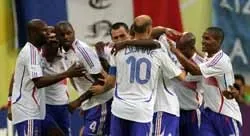
Traditionally, there are many people from Africa and the West Indies in the France national team. If a person far from football looks at the French team, he could mistake it for some kind of African national team, in which Barthez, Sagnol, and the only slightly dark-skinned Algerian Zidane accidentally found themselves.
In Europe they have learned tolerance. The times when English fans booed and threw bananas at Viv Anderson and Luther Blissett have sunk into oblivion. Now the English love and respect their dark-skinned stars - Ashley Cole, Sol Campbell, Rio Ferdinand, Aaron Lennon, and young Theo Walcott. However, goalkeeper David James is quite deservedly called a Natural Disaster. But there is a curious detail: all the dark-skinned Englishmen come from the West Indies. But Afro-Englishmen are chronically unlucky: Ugo Ehiogu, a native of Nigeria, was dropped from major tournaments three times.
The first black goalkeeper in the history of the England national team could have been not James, but Shaka Hislop. But it did not work out. Hislop, a certified space engineer, offered his services to his historical homeland - Trinidad and Tobago. As we see, not in vain. The 37-year-old Englishman became one of the heroes of the current championship. But if Hislop outwardly does not differ from his teammates, then Chris Birchall is hard to confuse with anyone. He is the first white player in the history of the "Warriors of Football". The mother of the Port Vale midfielder was born in a distant West Indian country, and this circumstance allowed Chris to play in the World Cup. When else will a footballer from the second English division get there!
No one is bothered by people from Africa in the Portugal national team either. The westernmost country in Europe was the first to resort to the services of talents from its colonies - Mozambique, Angola, and the Cape Verde Islands. Angola, which reached the World Cup for the first time, also called on its white sons for help - goalkeeper João Ricardo and midfielder Figueiredo, who had long ago left for the metropolis but still remembered their distant African homeland.
Well, and at the end another intrigue of the third round match in Group F between the national teams of Australia and Croatia. In the Australian team there are seven ethnic Croats, including captain Mark Viduka. Could have been ten, but Joseph Simunic, Tony Seric and Joe Didulica decided to help their historical homeland. That's the collision that awaited the players: Croatian Australians fought against Australian Croats. But that's not all. Brothers Niko and Robert Kovac lived their whole lives in Germany, which does not prevent them from being in leading roles in the "checkered" team, and Niko also wears the captain's armband.