
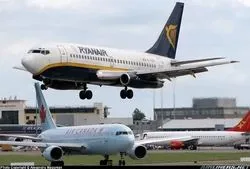
British Airways' advertising slogan still claims that this airline is the most popular in the world (World's favourite airline). It seems things are not quite so. According to data for July 2005, the passenger traffic of Ryanair, the Irish low-cost airline, for the first time equaled that of British Airways, totaling 3.1 million people. The main competitor of the Irish, the British low-cost airline EasyJet, is not far behind - in July 2005 it carried 2.85 million people. At the same time, the traffic volumes of low-cost airlines continue to grow rapidly: Ryanair's passenger traffic in July of this year increased by 29.4% compared with last July, and EasyJet's by 21.9%. Traditional airlines, even the largest - British Airways, Lufthansa, Air France-KLM, SAS, Iberia, Alitalia - see their passenger traffic increase by at most a few percent per year.
This means that low-cost airlines, of which there are already more than a hundred within the European Union, are gradually taking business away from traditional, more expensive carriers. And events such as the three-day strike by British Airways employees at Heathrow Airport, which occurred in mid-August at the height of the holiday season, only play into the hands of the low-cost carriers, whose employees are not members of trade unions. As a result of the strike, British Airways lost about $70 million and tens of thousands of passengers: many used the services of low-cost airlines, which offered them the lowest fares.
Not all that bad
The 'old' airlines so far do not seem particularly concerned about the successes of their low-cost competitors and are not inclined to exaggerate these successes. Traditional carriers point out that low-cost airlines include in their passenger traffic even those who bought a ticket but did not show up for the flight: if you fail to take a low-cost flight, the ticket price is never refunded. "The true indicator of success is profitability and revenue, and by this indicator low-cost airlines are ten times smaller than us," said Jane O'Brien, the head of British Airways' marketing department for Great Britain and Ireland.
Indeed, in the last financial year (April 2004 - March 2005) British Airways received a record profit of $750 million. The company's turnover was $14.1 billion. Last year, British Airways received $321 from each passenger, while EasyJet received $79, and Ryanair only $58. But at the same time, the costs of the companies are incomparable: British Airways spent $308 per passenger versus $46 for Ryanair. The result: British Airways' profitability is only 4.1% versus 20% for Ryanair.
Therefore, although in official statements traditional carriers refer to their low-cost competitors somewhat disdainfully, in fact they are forced to adapt. Ryanair, EasyJet and others compete with traditional carriers in the European Union market - beyond the EU, with rare exceptions (a few flights by German carriers to Russia, Turkey, Bulgaria), they do not fly. When low-cost carriers first entered the market, all traditional airlines in the segment of short (less than four hours) flights saw a collapse in financial indicators. For example, if in 1997 flights around Europe brought British Airways neither profit nor loss, then already in 2000 the losses amounted to $540 million.
Then British Airways president Rod Eddington turned intra-European transportation into effectively low-cost: prices were sharply reduced by reducing the range of services, and although BA still offers drinks and food (the cheapest wines and sandwiches) on short intra-European flights, the company now spends no more than two dollars on meals per passenger.
It is clear that it is impossible to adapt to the new conditions without competent marketing. In recent years, British Airways' marketing budget has grown by 5% per year and reached $108 million. The main funds go to promote specifically European destinations, where competition is the most acute. For example, advertising of the company's website alone, where you can buy relatively inexpensive tickets by booking in advance, consumes 14% of the marketing budget. Another 6% is spent on promoting the company's cheap services: posters constantly appear in the London Underground advertising flights to Paris or Milan "from more convenient airports" at prices no higher than Ryanair's.
Competitors stand their ground
All these measures - lower prices, cost reduction and an active advertising campaign - allowed British Airways to bring its European direction to break-even level. But that and no more: all the company's profit is provided by transcontinental flights - to Asia, North and South America. In Europe, British Airways, despite everything, cannot make money. But low-cost carriers, flying from inconvenient airports at inconvenient times, manage to earn quite well. In the last financial year, Ryanair reported a profit of $354.6 million, and EasyJet - of $111.6 million.
However, despite the higher profitability of its competitors, British Airways does not intend to change its style. Thus, on all flights, even the shortest, the airline offers free meals and business class seats. And although this is reflected in costs, British Airways believes that service will help attract business passengers, especially those who transfer to short European flights from transcontinental ones. To attract this category of passengers, BA has hired advertising agencies M&C Saatchi and Zenith Optimedia, which should convincingly demonstrate all the advantages of flying on the company's European flights.
Forced to economize, low-cost carriers prefer to do marketing and advertising themselves. "Our marketing strategy is quite simple - maintain low prices, communicate information about them to customers, and ensure an adequate level of service. In the long term, the lowest price wins, so there is nothing more to worry about," Sinead Finn, the head of Ryanair's marketing department, told Expert. Modest budgets, as is known, stimulate imagination. For example, EasyJet painted the fuselages of its planes bright orange. "In good weather, our planes are visible from the ground at an altitude of ten kilometers. So we even use fuselages as our advertising," said EasyJet marketing manager David Miliveo. Incidentally, according to a survey by British magazine Marketing Week, it is this airline that has the most recognizable brand in Europe.
Low-cost airlines are also very proud of their punctuality and careful handling of baggage. Over the past 12 months, 90% of Ryanair's planes departed and landed on schedule. The corresponding figure for British Airways (one of the best among traditional airlines in Europe) was noticeably worse - only 74%. While Ryanair loses only 0.5% of baggage, traditional carriers lose from 10.2% at Iberia to 15.6% at British Airways.
Growth points
In May 2005, Ryanair placed an order for 140 new aircraft. And the company's president, Michael O'Leary, announced plans to double passenger traffic to 70 million passengers by 2012. One of the main growth directions for low-cost airlines today is opening new routes. Thus, Ryanair and EasyJet were among the first to enter the markets of Poland, Hungary, and Estonia as soon as these countries joined the European Union. Within the "old" EU, many low-cost airlines continue to discover new niches for themselves. Since summer 2005, Ryanair has entered the domestic Italian market, operating flights within the country and directly competing with Alitalia, which is going through hard times.
However, traditional airlines are not going to give up easily. "The way British Airways was forced to swallow its pride and change its European strategy to compete more successfully with low-cost carriers has already entered business textbooks," Chris Avery, an analyst at investment bank J. P. Morgan, told Expert. In particular, the decision to sell its own low-cost airline Go in 2002, which many criticized, turned out to be correct - it forced British Airways itself to change. Otherwise, the company simply would not have had the resources to wage a price war with rapidly growing competitors, and the intra-European market would have been lost for BA.
Be that as it may, the battle for Europe's skies is far from over. The trend of competition between traditional and low-cost carriers from the UK, where the first low-cost companies appeared, is gradually spreading to neighboring markets. But the growth potential is far from exhausted. For comparison: while in the US low-cost airlines have a fleet of 850 aircraft, in the European Union, where the population is almost twice as large as the American one, such a fleet is noticeably smaller - only 380 aircraft. If Ryanair, EasyJet, and other European low-cost carriers can take advantage of this potential, then in five to ten years they will easily catch up with traditional leaders in terms of profit.