
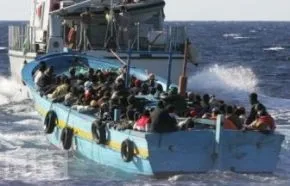
Refugees of the 'date' revolutions disembark in Italy by the thousands, heading for Germany and Great Britain
It is believed that the massive influx of illegal immigrants is a consequence of the fall of the regime of Tunisian President Zine El Abidine Ben Ali, who ruled the country with an 'iron fist'. Over the past month, the level of security in this North African country has sharply declined, and Tunisia's ports are virtually uncontrolled. Meanwhile, the distance to the first Italian island, and therefore to the territory of the European Union, is only 130 kilometers by sea. It is clear that the lawlessness in Tunisia has been exploited by thousands, mostly young citizens of this country, who want to try their luck in the EU.
Meanwhile, Italian authorities are completely at a loss, as they were clearly not prepared for such a turn of events. The refugee camp on Lampedusa, which had been closed a couple of months ago, had to be urgently reopened. But there is still a catastrophic shortage of space for all illegal immigrants, and a lack of not only food and medicine but also drinking water is already being felt. The refugees themselves claim that Italy is only a transit point on their way to Germany and Great Britain.
The decision of the Italian Council of Ministers to declare a humanitarian catastrophe regime is intended to allow civil defense units to 'take immediate measures to control the situation and provide assistance to people arriving from North Africa'. There is an agreement between Italy and Tunisia on preventing illegal migration. However, Rome realizes that it is unable to cope on its own with such a massive influx of unexpected guests.
The Italian authorities called on Brussels to convene an emergency meeting of the EU Council at the level of justice and interior ministers, as well as to deploy a mission of the European Agency for the Management of Operational Cooperation at the External Borders of the EU, Frontex, to Lampedusa and Sicily. It was even proposed to demand permission from official Tunisia to send Italian police to the territory of the country gripped by post-revolutionary fever. However, Tunisian politicians have already spoken out categorically against it, stating that they can handle the situation themselves.
According to 'Russkaya Germaniya', last Sunday special security forces units were indeed deployed to the coastal areas of Tunisia, trying to stop the flow of refugees. But according to eyewitnesses, over 20,000 people are currently waiting in Tunisian ports for places on boats heading to the European coast.