
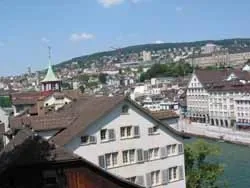
from the archives of «Zagranitsa»
For 500 years it has lived without wars and does not get drawn into conflicts of other states. Social peace here is guaranteed by a unique system of 'direct democracy,' where important political decisions are made by national referendum. Immigrating to Switzerland is extremely difficult, so the 1 million foreigners living in the country form a fairly reliable social group. Many of them are qualified specialists and scientists working under contract. Geneva and Zurich are recognized every year as the best cities in the world in terms of quality of life.
However, striving to live in Switzerland is not at all necessary. For a long time, the country has specialized in providing wealthy people not so much with luxurious living but with a financial safe haven. It is chosen as a place for capital investment to have a constant in a rapidly changing world. Switzerland is unfamiliar with laws like the American Enemy Act, where the government reserves the right to block a foreigner's property if the US is in conflict with his country. Even during political crises and world wars, they maintained neutrality towards foreign depositors and owners, and such a policy has always been supported by the state: legal reliability is absolute.
Purchasing real estate in Switzerland is usually a long-term decision. Short-term speculation in securities, currency, and real estate in some fast-growing markets can be significantly more profitable. However, such speculative income is typically associated with high risk. In Switzerland, foreigners are interested not so much in profit as in reliable placement of funds and their reasonable growth. The stability of the Swiss economy, which has a solid foundation: 85% of GDP is produced by numerous small and medium-sized enterprises, serves as a guarantor of this. One of the main drivers of the economy is the service sector, primarily the financial sector. Switzerland's banking secrecy is also world-famous, sacredly guarded by the state's financial policy: one of the reasons why Switzerland is in no hurry to join the European Union. The Swiss currency is considered one of the most stable and currently exceeds its nominal value in gold equivalent several times. This is still the only case in the world.
Administratively, Switzerland is a confederation of 26 sovereign territories called cantons. Each canton has its own tax system. Nevertheless, overall the tax burden here is considered moderate by European standards. This applies to taxation of both individuals and legal entities. Capital and investment income can be freely withdrawn from the country.
Often, many of those who have made a fundamental decision to invest in the Swiss market, by inertia, consider only housing as an investment object. Meanwhile, most cantons have been closed to foreign buyers for many decades. In cantons where villas and apartments are theoretically allowed to be purchased, the number of offerings is usually limited, and permission from authorities is required, which is very difficult to obtain in practice. Year by year, the situation in this regard only becomes more complicated.
However, the Swiss commercial real estate market, on the contrary, has become more open. In 1997, legislation changed significantly, and all existing restrictions on the acquisition of commercial properties for foreigners were lifted. In addition to greater freedom of choice, commercial real estate provides the owner with much higher and more predictable income than seasonal rental of housing. According to Swiss law, residential real estate cannot be sold until 10 years have passed since the purchase (except for force majeure economic circumstances necessitating the sale of property). But in the commercial real estate sector, there are no restrictions on resale periods.
Of greatest interest are warehouse and office spaces. For investments in the latter, Switzerland is today much more attractive than many developed countries. In addition to purely economic indicators, such a forecast also relies on demographic statistics. The maximum number of working-age population in countries such as Germany and Italy was recorded ten years ago, and by 2040 the mass of workers will decrease there by a third compared to the beginning of the century. France, the Netherlands, and Spain are passing their peak this year, and the number of working-age citizens will shrink by 20% by that date. In Switzerland, the situation is much more encouraging. The number of adults of non-retirement age will grow here for another 11 years (accordingly, -3%). And according to statistics, almost half of Swiss workers are 'white-collar' office workers.
The total area of office space in Switzerland currently exceeds 56 million square meters. Most of it is concentrated in Zurich, less in Geneva and Bern. The number of office premises in the city of Fribourg is growing every year. This region attracts world-renowned companies such as Cartier, Wella, and Michelin, offering enterprises more favorable tax conditions than Zurich or Geneva. The occupancy rate of office space in major Swiss cities significantly exceeds that of the largest European metropolises. According to statistics, only 2-5% of the total stock is vacant here, while, for example, for the Frankfurt and London markets, 12-13% is considered normal.
Purchasing commercial real estate in Switzerland is allowed for both foreign legal entities and individuals. Both must obtain an official permit from the Swiss authorities and provide confirmation that they will report on the purchased property to the relevant financial authorities. The buyer also undertakes to pay notary fees for obtaining a Swiss tax number for the property, commissions, and expenses for entering into the register of ownership rights. Those who do not want their name to appear in the register can arrange the transaction through an offshore company - this is widely practiced here. In addition to anonymity, sometimes this option helps save on taxes - for example, if the property is purchased from an offshore company by transferring its shares. Given that the cost of commercial properties ranges from $600,000 to $15 million, the savings are substantial. The tax on purchasing real estate in Switzerland ranges from 2 to 5%.
Commercial real estate is also attractive because the investor can forecast their income for the near future. The premises are offered already operational, and tenants usually simply transfer to the new owner from the previous owner 'by inheritance.' Lease agreements are concluded here for 5-10 years, and compared to purchasing housing, this provides a guarantee of income. By entrusting the management of the property to a company with experience in this field (in fact, the property can be purchased directly from such an entity), you relieve yourself of all legal, financial, and managerial worries and can only be concerned with the state of your savings account.
Having a bank account in Switzerland is attractive in itself for any businessman, however, for a foreigner 'off the street,' opening an account in Switzerland is a difficult procedure. Access to Swiss financial services can be obtained by purchasing and entrusting the management of real estate to a company well-known to the bank. Some such structures have been operating in this market for 30-40 years, have a reputation, trust relationships with bank directors, and can vouch for you as a client. For those interested, mortgages are available in Switzerland: financing of 50-60% of the property value is possible at a maximum of 3.5% per annum. By the way, this year mortgage interest rates in Switzerland reached their lowest level in the last 30 years.
By choosing Switzerland as a place to invest your funds, you become the owner of real estate in a neutral country, gain real financial independence and confidence that nothing will happen to your property. And that is precisely why money invested in Switzerland truly makes people happy.
Ольга ВИНОГРАДОВА.
«Дайджест Недвижимости»