
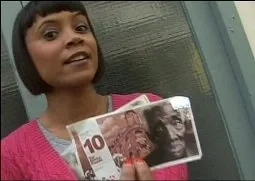
The municipality of a London suburb decided to fight the crisis on its own and introduced "district" money
The new banknotes are exchanged at a one-to-one rate with the traditional pound, but Brixton pounds cannot be spent outside Brixton or placed in a bank. At present, 10,000 such banknotes have already been printed. For the economy of Brixton itself, the benefit is undeniable – the money does not leave the district and continues to circulate within it, stimulating the local economy. Despite accusations of protectionism, this municipal initiative was supported by more than 60 local business owners.
Interestingly, the self-proclaimed pounds are not accepted in large chain stores and hypermarkets, but they are a hit in small shops, cafes, and consumer service enterprises. Naturally, no one is going to abolish the local island currency (pound sterling) yet; both types of money have parallel circulation, as has happened more than once in world history.
The Brixton currency experiment is already the fourth in the island kingdom, with three more administrative entities following the same path. English long-living pensioners still remember the Great Depression of the 1930s, when British companies paid wages with wooden discs, metal tokens, and other makeshift objects instead of the missing currency. After all, any object can be declared money if people agree to use it as a universal means of payment and exchange.
Such an idea is by no means new and goes back centuries. For example, in ancient times, every Greek city-state minted its own coins, and among them there were practically no gold or silver coins with real, not nominal value. And on the islands of Polynesia, until recently, sea shells were used as money.
In the Middle Ages, coins (there was no other currency) were minted by anyone who wanted; all principalities and independent cities quite legally made their own money, and this coexisted peacefully with imperial thalers, marks, and other central money. In cases where a merchant was going shopping very far away, he would easily exchange local currency for a more universal one. Or he would do something simpler: deposit money with pawnbrokers or, for example, with the Templars, receiving in return a parchment personal check, with which the bearer could withdraw almost the same amount in any country that had branches of these improvised Lombard (Templar) banks.
And if we recall domestic history, then on the territory of the USSR, along with the ruble, checks from Vneshposyltorg were quoted and used quite legally, with which one could buy all the blessings of civilization without queue at the Berezka stores, which were inaccessible to holders of simple 'wooden' rubles, as the few lucky ones who worked abroad and received instead of local American, French, and other currencies the stripe-less checks (first-category currency), checks with a blue stripe (second category), checks with a green stripe (instead of tugriks and other currencies of third-world countries) contemptuously called the national currency. With checks, one could buy cars without a 25-year waiting list, apartments without a 50-year waiting list, as well as foreign TV and radio equipment, incredible clothes, imported drinks, in short, everything that was inaccessible to exactly 98% of the residents of a country that had long ago conquered its own citizens of socialism. Also in the USSR, bottles of vodka (for paying plumbers and builders) and American cigarettes (in the 70s, sold for ten rubles per pack and used to pay traffic police officers) were used as currency.
In the era of total globalization and prosperity, the world gradually began to abandon national currencies, but in the hard times that have come, it is easier to solve pressing economic problems on a regional or even district scale, sometimes even switching to simple barter and growing vegetables in flower beds. And sitting and waiting for everything to 'settle' at the planetary level most often turns out to be more expensive.
Of course, Russians would find it not at all funny and even terrible to think about switching to Moscow currency, and even more so, to the rubles of some Eastern Administrative District. Apparently, the British do not find such an approach to supporting the local economy at all fantastic, and the central island authority is not at all opposed to such experiments. After all, ultimately, the drowning are primarily interested in their own rescue, and very often the problems of the Indians are of no interest to the local sheriffs.