
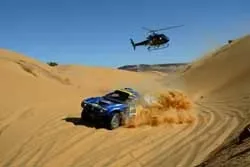
«Barrier» for the caravan
The race was canceled just hours before the start. Rumors of a possible route change had been circulating a couple of days before "H-hour" and were linked to the murder of four French tourists in Mauritania. In this regard, the French government recommended excluding the land of the Moors from the rally route. Still, the organizers were determined to hold the race in full. The disappearance of a "scout car" in southern Morocco the day before the start, vague data about threats from a local terrorist group, and, according to some reports, the refusal of major insurance companies to sign an agreement with the organizers became the straws that broke the camel's back. Purely political reasons were also cited — allegedly, the French government thus decided to put pressure on recalcitrant Mauritania.
Cancellations of individual stages due to military actions in African republics, emergency airlifts of the entire convoy over troubled areas, and corrections in road books had long become the norm for the Dakar. This is not surprising: it is virtually impossible for such a giant project to go off without a hitch, especially in such an unstable region. However, the rally had never been canceled entirely. And so the decision of the company A.S.O. — organizer of the Dakar — had no shortage of critics.
"It's strange that we didn't see a 'Plan B' in action, where participants would have to complete the Dakar on a modified route," says former Dakar director Hubert Auriol. However, the organizers became hostages of last year's events: after excluding two stages in even more unstable and dangerous Mali, they had to "cut" more than two-thirds of the special stage mileage specifically through Mauritania. According to Alexey Kuzmich, these special stages were supposed to be the highlight of the race.
Representatives of the Mauritanian authorities also criticized the organizers, having personally guaranteed the race director Etienne Lavigne the safety of the route — after all, the country was left without the only world-class event capable of attracting tourists and their money! At the same time, most major factory teams, including the main contenders for victory in the "car" category — Volkswagen and Mitsubishi — understood A.S.O.'s decision, despite their own huge financial losses. After all, their ranks include many experienced marathoners who know firsthand what safety in the desert means.
"Usually, the military is ordered to guard the convoy," shares a Russian navigator with Dakar experience. "At every bivouac (as the park for rest and service is called at the Dakar — editor's note) in Mali and Mauritania, there was a double cordon with machine guns and AKs. In some places, tanks were visible in the distance. Soldiers with assault rifles patrolled even the camp itself, and when crossing Western Sahara, the 'channel' was guarded by jeeps with heavy machine guns. But someone who has never been in the desert cannot even imagine that in these sands you can easily hide an entire tank division just meters from the track, and no one will notice! Once we got stuck in a small sand trap in the dunes, and it became obvious — it would be difficult to get out on our own. It was about a hundred meters from the main track. None of the passing crews even saw us! We spent four hours getting out of the sandy trap!
Another time in a similar situation, as soon as we got stuck, locals appeared out of nowhere and offered to help us for €10. When the car was pushed out and I put away the shovels, none of the natives were around anymore — they disappeared as suddenly as they appeared. I still don't understand how that's possible, because the nearest village was several dozen kilometers away. So, when the 'channel' of participants scatters across the desert in search of the optimal route through the dunes, ensuring everyone's safety is an impossible task."
The "marathoners" had very interesting relations with local residents without military uniforms. "The natives perceive the caravan primarily as an endless source of freebies and try to snatch something by any means available — beg or steal... If you open the door at the time control point, a whole crowd of children and adults immediately swoops in with the sole purpose of stealing everything within reach. This happens not because they have a personal grudge against you, it's just the lifestyle there," notes Alexey.
How the desert comes alive
This year's rally-marathon distance was supposed to be over 9,000 kilometers — the distance the cars cover under their own power, excluding the ferry crossing. More than half of the route consists of special stages — sections where cars drive in 'combat mode' — at full strength, at the maximum possible speed for the crew and vehicle. To cover such a distance, huge investments are needed — both in preparing the car for the race and on the route to maintain the vehicle (motorcycle, truck) in combat-ready condition.
The car, 'jeep' part of the Dakar is divided into two large preparation groups — 'production' cars (also T2, or Production class) and 'prototypes' (T1, or Super Production). This also includes buggies of original design — for example, the legendary Desert Fox Jean-Louis Schlesser or Russian driver Sergey Shmakov compete in these. The technical requirements of the T1 group are so liberal that the race in this class has long turned into a war of investments and technologies — this is where most of the 'car' factory teams and the most famous 'privateers' compete, including multiple participants, prize-winners, and winners of the desert marathon. The budgets of such teams and their financial losses from the cancellation of the race are hard even to imagine — each of them can spend several million dollars on one Dakar!
Budgets in the T2 class are more modest. From a technical point of view, these are really almost standard cars. If we forget for a moment about the mandatory safety requirements - roll cage, seats, four- or six-point seat belts and specific navigational equipment, as well as the vitally necessary 400-liter fuel tanks in the desert, then only the suspension and engine management program can be slightly modified. The gearbox, axles, cylinder blocks - all of this is exactly the same as on an ordinary Pajero, Pathfinder or L200 from any dealership. Such a car, fully prepared for the race, costs about €150-180 thousand.
There is an option not to buy a car but to rent it along with service during the race - that would cost about the same €180 thousand. This amount includes mechanics' salaries, support vehicles, hotel accommodation, necessary equipment, tires, fuel, a certain set of spare parts, and the entry fee. For each SUV it is €24 thousand, for a motorcyclist - €13 thousand. For trucks, the fee is naturally higher. The organizers promised to refund this amount and some other 'direct' payments to participants, but that's a drop in the ocean.
The rental option is acceptable for those who do not set themselves super-tasks. If the crew's ambitions extend to podium places, then they will have to bring both their own car and their own team to Africa - the mechanics must know the car like the back of their hand and work smoothly and efficiently. In addition to technical personnel, each crew needs at least two support vehicles. One of them - the 'camel' - runs in the truck category and carries everything needed for emergency repairs, and if that is not possible, it takes the 'combat' car in tow and drags it to the bivouac. From a sporting point of view, it is the same participant in the marathon, only loaded with spare parts. The second support vehicle is a huge truck - the 'elephant', which moves from bivouac to bivouac along the shortest route and is allowed to assist its charges only during specially designated service time.
• By the way, regardless of which car is used to participate in the race, both Mitsubishi and Toyota spare parts are pre-stocked. After all, not only a professional racer but also an ordinary driver would not want to be left on the track without necessary components. That is why car teams pay special attention to technical support.
It is clear that only a very limited number of people can pay for the race out of their own pocket without straining. Most crews who have caught the idea of going to the legendary rally marathon either look for sponsors for this purpose or take multi-thousand loans... And not everyone is able to understand the state of those who, instead of a unique test of endurance, got only an unfulfilled dream and debts to sponsors or banks. After all, for many, participation in the most famous automotive adventure has long become the meaning of life... This year, 245 motorcyclists, 205 SUV crews (410 people) and 100 truck crews (300 people) were left 'out in the cold'.
Global-scale crisis
Naturally, not only the crews suffered from the cancellation of the rally. In total, about five thousand people, an incredible number of SUVs and trucks, as well as helicopters and airplanes, take part in supporting the race. 'Imagine a city almost the size of a capital district, which folds up in a day, moves to a new location, and by the time the racers arrive, it is already functioning normally. And all this - in the middle of the desert!' - Alexey Kuzmich tries to somehow explain to me the grandeur of the Dakar bivouac. It is clear that all this infrastructure requires careful and expensive preparation. And if you add to this hotel and airfare bookings, television contracts and sponsorship of the race itself, the need to refund entry fees, then, according to Western media estimates, the company A.S.O. lost about $52 million due to the cancellation of the rally! And this may not be the worst thing yet. In addition to money, the company also lost its image. After all, for the first time in history, a race that had become a symbol of world motorsport over 30 years, a kind of crowning achievement that some racers pursue all their lives, was cancelled! And now few believe in the return of the old 'Dakar' a year later. Among the pessimists are even such regulars of the race as Jean-Louis Schlesser, Semyon Yakubov, Stéphane Peterhansel, Luc Alphand, Kenjiro Shinozuka, and other superstars. Many of them are now planning to go to other competitions instead of the 'Dakar' that deceived them.
The blow to the image has been dealt probably not only to the organizers of the legendary marathon, but to the entire motorsport as a whole. It has long been no secret that there is an increasingly acute shortage of sponsorship money - technology is constantly improving and becoming more expensive, and the return on advertising does not always justify the huge investments. After such events, sponsors will certainly not become more accommodating. Russian racers may feel this especially acutely - after all, 'Dakar' was the only international race of such a level where our compatriots from the KAMAZ-Master team have long become the main favorites.
However, it would be naive to assume that today's events will only affect motorsport. The cancellation of the famous race may mean, sad as it is to admit, the beginning of an era of victory for international terrorism. Victory even over such strong-willed, seasoned and risk-taking people as the organizers and participants of 'Dakar'. What next global event will be cancelled at the whim of African or Asian ragamuffins with bombs and machine guns? The World Cup or the Olympic Games? In their sincere concern for the safety of the race participants, A.S.O. and the French government created a most dangerous precedent, for it has long been known: any fulfillment of terrorists' demands will only lead to a further increase in the terrorist threat.