
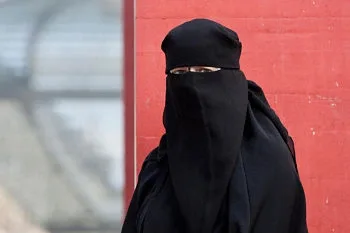
Starting July 1, 2016, the Swiss canton of Ticino introduced a ban on covering the face in public places
The diplomatic mission posted a reminder on Twitter: “The embassy would like to emphasize that the cantonal authorities of the canton of Ticino, located in southeastern Switzerland, have announced that as of July 1, 2016, a ban on wearing the burqa and niqab in public places comes into force, including in the cities of Lugano, Locarno, Magadino, Bellinzona, Ascona, and Mendrisio. The cantonal authorities indicate that the fine for violating the ban will be 1,000 Swiss francs, and those who violate it repeatedly will have to pay even more.”
Since school holidays are about to begin, the embassy reminds its respected citizens that in order to avoid problems, it is necessary to comply with Swiss laws and also to conform to Swiss norms and rules.”
As Swissinfo.ch notes, back in 2013, almost 65% of voters in Ticino approved an initiative to ban the wearing of face-covering clothing in public places. The legislation does not mention the words “burqa” or “Muslims,” but states that “in public spaces, on streets or squares, no one may be with their face hidden.”
The authorities also indicated that this ban also takes into account sports fans and political activists, who tend, as a rule, to hide their faces during illegal demonstrations.
This initiative attracted a lot of attention in Switzerland and abroad, and, of course, the sports-political aspect of this ban was immediately forgotten and not mentioned by anyone. Therefore, most often criticism was leveled at this decision of the people in the sense that, perhaps, this law does not make much sense, because there are not that many women living in Ticino who wear the burqa and niqab. The new law also applies to tourists.
Similar bans – though directly concerning exclusively Islamic clothing – exist in France and Belgium. Some right-wing groups in Switzerland are calling for a nationwide ban on wearing face-covering clothing in public places.
In a number of Muslim countries, there are extremely strict laws regarding extramarital affairs, which also apply to foreigners. The other day, a court in Qatar issued a scandalous decision regarding a Dutch national, who was sentenced to one year of suspended imprisonment and a fine of $800. The girl had been in custody since March. The reason was a rape report she filed with the local police. According to her, something was slipped into her drink when she went dancing at a hotel where tourists are allowed to consume alcohol.
However, after filing the report, not only the alleged rapist was arrested but also she herself. The reason for the woman's detention was local legislation prohibiting intimate relations outside of marriage. The man suspected of rape was also convicted and sentenced to 100 lashes for extramarital sex and 40 lashes for alcohol consumption.
BURQA, NIQAB, HIJAB
Burqa – women’s outer garment in Muslim countries, particularly Central Asia, Afghanistan, and the Middle East, consisting of a robe with long false sleeves and a hair net covering the face. It is the strictest interpretation of the religious requirement for women to wear modest clothing.
Niqab – a Muslim headdress that covers the face, hair, neck, and face, with a slit for the eyes. The niqab is usually black, worn mainly by women from the Persian Gulf countries, although also in other countries.
Hijab – a Muslim scarf that covers the hair and neck, but not the face. In some regions, it is worn in combination with the niqab.