
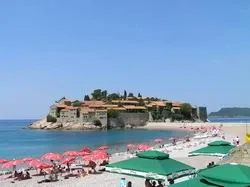
In combination with the lush southern greenery and the emerald sea, the rooftops create a special flavor for the entire coastal zone of Montenegro. The generous Mediterranean sun makes these roofs so bright that it seems as if the locals deliberately paint their houses with bright paint in order to attract tourists.
And tourists, as statistics show, have significantly decreased in Montenegro over the last decade. If rich Germans and Scandinavians used to like to vacation on the coast of the former Yugoslavia, then after the turbulent events the tourist flow to Montenegro has decreased almost tenfold, and now it mainly consists of not-so-rich neighbors, former compatriots, deprived of a sea coast. And although there were no active military operations on the territory of Montenegro, the already not very developed tourist infrastructure, due to the lack of proper investment, fell into a state of stupor. But Montenegrins are a smart and wise people - as befits mountaineers, they decided to invite their long-time friends - Russians - to more active business cooperation.
Russia helps to build and live
Montenegro and Russia are connected by centuries-old historical friendship both as brothers in Slavic blood and as co-religionists in Orthodoxy. Due to their geographical position, Montenegrins have long been experienced seafarers, both law-abiding captains and pirates. Therefore, their history is largely connected with the sea, and not only the Adriatic. Russian Tsar Peter I sent boyar children here to learn the skipper's craft, and many Montenegrin captains served for the glory of the Russian fleet, for which they received high Russian ranks and awards.
The current leadership is also trying to maintain this friendship, so to speak, at a new qualitative level. Russians buy plots on the coast and build high-class hotels, which is exactly what Montenegro lacks; they build bridges, of which, given the mountainous terrain, there cannot be many. Aluminum magnate Deripasko bought the only metallurgical plant here. Moscow Mayor Luzhkov gave the capital of Montenegro, Podgorica (formerly Titograd), monuments to Pushkin and Vysotsky, whom Montenegrins love and honor for speaking well in their works about a distant but proud country.
Russians are welcome guests here. They willingly spend money on local souvenirs, happily order large portions of national cuisine dishes, drink a lot of rakia, slivovitz, local wine and beer, take excursions to mountain Orthodox monasteries and worship the same shrines as local residents. Montenegrins classify Ukrainians and Belarusians as Russians, and only recently have they begun to reluctantly differentiate their Slavic brothers. The pinnacle of local love for Russians can be considered a joke in which a Montenegrin answers a question about the population of his country: “Together with Russians, we are 200 million!”
In fact, about 700 thousand people live on a territory the size of the Kiev region, 200 thousand of them in the capital, and the rest are concentrated on the coast. During the hostilities in the former Yugoslavia and unrest in neighboring Albania, the population of Montenegro increased by 20 thousand people. But most of them decided to seek a better life in more prosperous Italy, Germany and Sweden. The population problem is solved mainly due to immigrants from Muslim Albania, where five to seven children per family is considered the norm. It should be noted that despite ethnic and religious diversity, different peoples have traditionally lived peacefully under one roof in Montenegro. The ancient coat of arms of the country depicts a cross supported by two hands: one symbolizes Orthodoxy, the other Catholicism. There are several churches that have both an Orthodox iconostasis and a Catholic altar.
A small people with a great history
Montenegrins consider themselves an ancient people. Of course, this area was not always called Montenegro. The first mention of the current name is found in the Vatican archives in the 14th century. The entire ancient history of this freedom-loving mountain people is connected with the struggle for their independence. The current Montenegrin coast was too tempting a morsel. The closest neighbors across the sea from Genoa and Venice, where the fleet, crafts and trade were more developed at that time, were able to offer a variant of the so-called “friendly occupation.” This gave a positive impetus to the corresponding development of local skills.
Gloomy pages of Montenegrin history were written during the Turkish occupation. Fortresses and temples were destroyed, cities were plundered, ships were sunk, and the able-bodied population was sold into slavery.
Montenegrins honor their history, especially everything connected with the reign of Petar II Petrovich Njegos (1811-1851). It was thanks to his wise rule that Montenegro was able to form as an integral state with all the proper attributes. At the very top of Mount Lovcen (1,750 m above sea level), grateful descendants erected a majestic mausoleum for him, which is approached by 800 steps.
A remarkable example of how Montenegrins love and cherish their antiquity is the old town area of Ulcinj, located almost at the very south of the Montenegrin coast, 15 km from the Albanian border. This town is famous for the fact that Cervantes lived there. Here he fell hopelessly in love with a local girl who became the prototype of Dulcinea of Toboso; here the future famous writer was sold into slavery for accumulated utility debts. The 1979 earthquake severely destroyed the old city, but the local government under the chairmanship of Mr. Ismet Karamanaga, selflessly in love with this area, made titanic efforts to restore the destroyed streets and buildings and return the city to its former glory.
Real Independence Day came for Montenegro only on July 13, 1878, after the Berlin Congress approved its independence. On July 13, 1942, an uprising of Montenegrin partisans against the fascist invaders took place. Therefore, July 13 is celebrated here as a major national holiday. To mark the date this year, the longest mountain tunnel was opened, and the largest cable-stayed bridge in the capital was commissioned.
Pearls of the sea coast
Montenegro has beaches for every taste. Most of them are rocky and pebble, but there are also sandy ones. The beaches are usually located in cozy bays, so winds and strong waves do not disturb vacationers. If the coastal zone of Montenegro can be compared to a necklace framing the mountainous part of the country, then the beautiful pearls in it will be the islands generously scattered along the entire coast. People long ago noticed the charms of island life: on the one hand, spiritual seclusion, on the other, natural protection from uninvited guests. The Montenegrins began to develop the islands more or less suitable in size back in ancient times. There were fishing settlements, fortresses, and monasteries on the islands. In our time, many of them have been rebuilt into elite hotels. The most famous island-hotel bears the name of St. Stephen. World-famous personalities like to relax there: Sofia Loren, Claudia Schiffer, Sylvester Stallone. A holiday on the island turns out so wonderful that many villas and apartments are bought into private ownership, although they are actually used only a couple of weeks a year. But apparently, the awareness that no one but your beloved self will lie on this bed outweighs any considerations regarding the material inexpediency of such a purchase.
Currently, the new Russians are actively showing interest in the islands. Someone even managed to build a luxurious villa on a tiny islet, making it completely invisible. The local authorities had to make maximum efforts to restore the island's pristine beauty. Despite the great respect for private property shown by Montenegrin rulers, there is a clear understanding that not everything can be given over to development, otherwise the attractive element that makes tourists return to these places again and again will disappear.
Mountains not black at all
Every tourist arriving in Montenegro shakes his head in bewilderment, searching for black mountains, the color of which, logically, should have been the reason for the country's name. The mountains are there, quite similar to the Crimean ones, only about ten times higher, but not black at all, rather gray, limestone, with a layered structure. The reason lies in the vegetation that covers these mountains, more precisely in a special type of pine found only here. The distinctive features of these trees are dark gray bark and dark green needles. When the sun is hidden by clouds, the pine forests take on a gloomy, almost black color, which, accordingly, affects the overall color scheme of the mountain range. As is known, clouds in coastal areas do not stay in one place for long, so to see the black mountains one needs a certain degree of luck and observation. Apparently, the ancients were not lacking in these, since they gave the area such a name.
The true pride of Montenegro is the largest canyon in Europe (the second in the world after the Colorado Canyon, which is in America), carved through the mountains by the Tara River. The best way to admire this natural wonder is from the bridge that was built in 1940. Of course, it is impossible to view the entire canyon this way because of the winding nature of the river, but it is quite possible to feel its scale.
For mountain recreation lovers, Montenegro has all the conditions: beautiful lakes full of fish, clear rushing rivers for rafting, protected forests with many birds and animals, and perhaps most importantly, amazingly clean air, which, unfortunately, city dwellers do not often enjoy.
Into the future with optimism
The Montenegrin government has a plan to turn the country into a zone of elite tourism. And not by raising service prices to such heights that vacations here would be available only to the elite of business and politics, but by improving the quality of the entire tourism infrastructure. And this plan is already beginning to be implemented: new tunnels are being bored, bridges are being built, roads are being improved, five- and four-star hotels are being erected, historical monuments are being restored, and a solid international information campaign is being conducted to popularize Montenegro as a country with excellent tourism opportunities.
Local residents like to tell jokes about their hard work, like the following. A radio announcer declares: 'The exact time is 12 o'clock. Good morning, hard-working Montenegrin people!' But seeing with what zeal the Montenegrins build their houses with orange roofs, one believes that a wonderful future awaits Montenegro.