
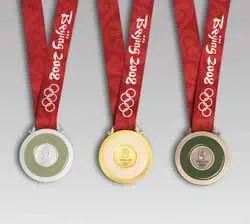
In the official press release of the organizers of the 2008 Games, the inclusion of local motifs in the design of the medals is linked to traditional values of honor and morality. In addition, the Olympic awards are intended to symbolize “dignity and nobility.” As a result of this symbiosis of styles, the medals look very unusual: if the “European” side is almost completely covered with a design depicting the goddess and the arena, and is filled with small details, then the “Chinese” reverse is deliberately strict. In the center is the emblem of the Games, but it is small. The rest of the surface of the reverse side contains no design at all: neither on the metal nor on the jade ring are there any images, everything is provocatively laconic. Intentionally or accidentally, the West turned out to be the opposite of the East even in the symbolism of these Olympic Games.
The most unusual and at the same time the most Chinese detail of the medals was the jade inserts. In the culture of the Celestial Empire, this rather cheap and not very bright semi-precious stone occupies a special place; there, oddly enough, it is valued very highly. Jade has become a symbol of this Eastern culture along with tea, porcelain, wushu, and flying dragons. So its choice as a finishing material for the medals of the first Chinese Games was simply begging to be made. Especially since, by decorating the Olympic awards with jade inserts, the Chinese are strictly following the global fashion trend of recent decades.
Currently, the host countries of the Games are trying to award Olympians not with banal round metal plaques, but with small works of numismatic art. The organizers of the Winter Games are especially diligent: the last time ordinary round medals decorated only with ordinary relief designs were awarded was in 1988 in Canadian Calgary. Four years later, the Games were held in French Albertville, and here the hosts amazed the world with a non-standard design. For a place on the podium in 1992, glass awards set in gold, silver, or bronze were presented.
As it turned out, Albertville set the trend for many years to come. In 1994 in Norwegian Lillehammer, the base of the medals was made from a local variety of granite: stone “pucks” were inserted into a metal frame. At the Games in Nagano (1998), silver, bronze, and gilded discs were decorated with traditional Japanese enamel. In 2002 in Salt Lake City, there were no foreign materials in the medals, but the designers, in search of an original style, made awards of irregular shape, only partially resembling the traditional even circle. Finally, in 2006 in Turin, winners and prize-winners were awarded not so much medals as “donuts” - in the center of the disc there was a gaping hole through which the award ribbon was tied.
The Summer Games in this regard were much more conservative. The vast majority of summer medals are the usual roundels of colored and precious metals; the imagination of designers here, as a rule, was manifested only in the designs, but not in the shape or material. However, the very first experiment was conducted at the Summer Games - in distant 1900 in Paris (in fairness, winter Olympics did not yet exist then). The Paris medals were not round, but rectangular.
But that attempt to introduce an avant-garde stream into the Olympic award standard remained without consequences: for many years, winners and prize-winners received fairly similar-looking metal discs. Only occasionally did the organizers show weakness and allow designers some liberties in the form of uneven or figured edges of the medals. The most non-traditional awards of the “pre-Albertville era” were presented in 1984 in Sarajevo: then a round medal was stamped on a piece of metal of irregular shape. But in our time, such design refinements would probably be considered a return to conservative classics.