
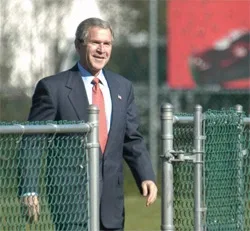
With this statement, George Bush made it clear that he is fundamentally changing the country's migration policy. Until now, it had been very tough. Just a week ago, for instance, the authorities were ready to deport all illegal immigrants from the country. A law was repealed that allowed an illegal alien to move freely within the United States while a court decided on his deportation. Because of the huge number of such cases, courts typically dragged on for a long time. During that time, illegal immigrants managed to move deeper into the country and settle there firmly. This practice, known here as 'catch and release,' as stated a week ago by U.S. Homeland Security Secretary Michael Chertoff, is no longer in effect.
Against this backdrop, Bush's proposal at first glance seems absurd. After all, the number of immigrants will not decrease; it's just that illegal ones will become legal. Analysts believe that Bush made this initiative to win the sympathy of business representatives who are interested in cheap labor from abroad. However, George Bush's plan involves not only granting visas to guest workers but also simultaneously strengthening security on U.S. borders. The president proposes increasing the number of border guards by one thousand people and equipping the border with electronic surveillance systems. For this purpose, $32 billion is provided in the U.S. budget for 2006.
As for illegal guest workers, Bush proposes to legalize them retroactively by granting them work visas. The visas will be valid for three years, after which they can be extended, provided that between these three-year periods the migrant spends at least a year at home.
However, legalization will not solve all the problems of immigrants. They will find it difficult to get a job. The president insists that employers should have the right to fill vacancies with foreigners only if American citizens do not apply for them. However, as Tom Donahue, president of the U.S. Chamber of Commerce, said while commenting on Bush's initiative, the labor market in the United States cannot currently be called oversaturated. On the contrary, there is a shortage of labor. Especially in the service sector and other low-paid areas. And foreigners do not disdain such work.